TD ABUJA, FCT — The Nigeria Democratic Congress (NDC) Polling Units Support Group and Strategists/Lobbyists has raised fresh concerns over Nigeria’s rising public debt.
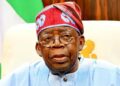
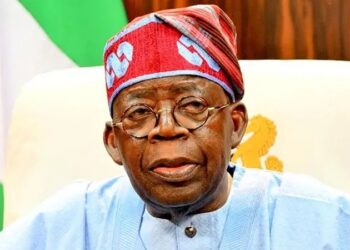
The group argued that the country’s borrowing trajectory under President Bola Ahmed Tinubu requires greater public scrutiny.
The group made the position known in a World Press Briefing signed by its National Convener, Prince Crispus Amarabhi Ovoh Jnr.
The statement questioned the continued reliance on borrowing following the Federal Government’s removal of petrol subsidy in May 2023.
Subsidy Removal And The and the Promise of Fiscal Relief
President Bola Ahmed Tinubu announced the removal of petrol subsidy during his inauguration on May 29, 2023.
The administration subsequently argued that eliminating the subsidy would free resources for development and reduce the financial burden on government.

The NDC support group said Nigerians were therefore entitled to ask why borrowing continued to rise after the subsidy was removed.
The group described the situation as a contradiction requiring closer examination.
Nigeria’s Debt Stock Before and After Tinubu
Data published by the Debt Management Office (DMO) provide a basis for examining the country’s debt trajectory.
Nigeria’s total public debt stood at ₦46.25 trillion at the end of December 2022, according to the DMO.
By June 30, 2023, the figure had risen to ₦87.38 trillion.
The DMO explained that a major component of the increase was the inclusion of ₦22.712 trillion in securitised Ways and Means advances, alongside new borrowings by the Federal Government and sub-national governments.

By September 30, 2023, total public debt had reached ₦87.91 trillion.
The DMO attributed the increase mainly to new domestic borrowing for the 2023 Appropriation Acts, among other factors.
By December 31, 2023, Nigeria’s total public debt had climbed to ₦97.341 trillion.
The DMO reported that the ₦9.43 trillion increase between September and December 2023 was largely caused by new domestic borrowing by the Federal Government to partly finance the 2024 Appropriation Act, together with disbursements from multilateral and bilateral lenders.
The Group’s Case: Tinubu and the Largest Debt Accumulation
The NDC support group argues that these figures demonstrate that the Tinubu administration presided over the largest increase in Nigeria’s public debt stock among the administrations compared in its briefing.
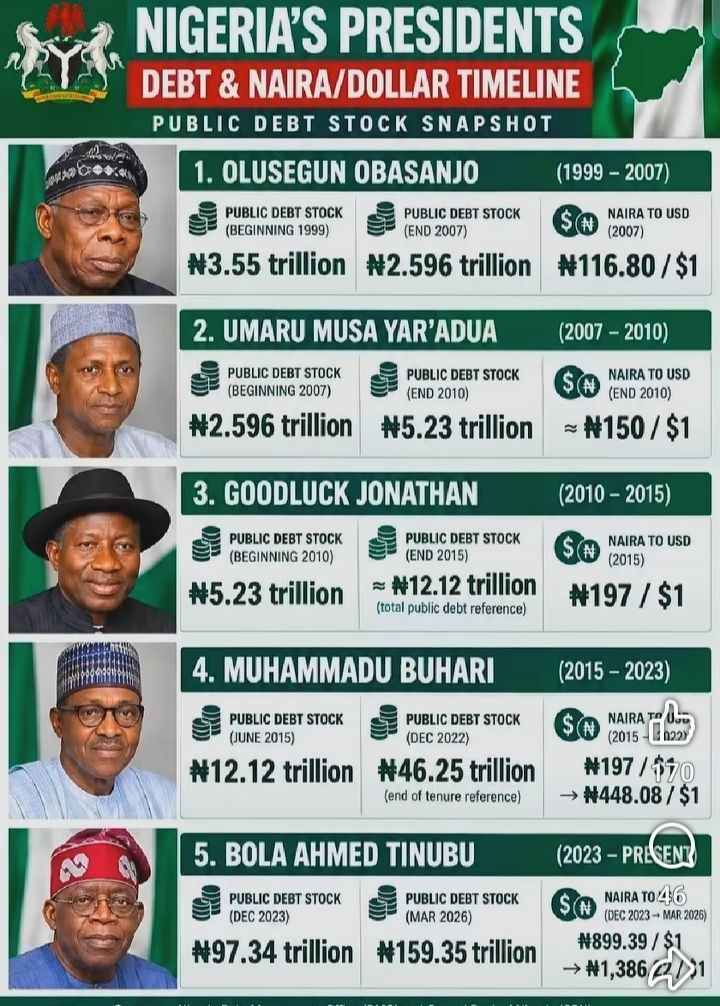
Its comparison places Nigeria’s public debt at approximately:

- Olusegun Obasanjo: ₦3.55 trillion to ₦2.596 trillion
- Umaru Musa Yar’Adua: ₦2.596 trillion to ₦5.23 trillion
- Goodluck Jonathan: ₦5.23 trillion to approximately ₦12.12 trillion
- Muhammadu Buhari: ₦12.12 trillion to ₦46.25 trillion
- Bola Ahmed Tinubu: ₦97.34 trillion at December 2023 to ₦159.35 trillion by March 2026.
The comparison also highlights substantial movements in the naira-dollar exchange rate across the administrations.
For Tinubu’s period, the figures supplied by the group show the exchange rate moving from ₦899.39 per US dollar at the end of December 2023 to about ₦1,386 per dollar by March 2026.
The DMO confirms that its December 2023 debt calculation used an official exchange rate of ₦899.393 to the US dollar.
Why the 2023 Figure Requires Context
The debt increase recorded in 2023 deserves careful interpretation.
President Tinubu assumed office on May 29, 2023, meaning the December 2023 debt figure covers only about seven months of his administration.
The DMO’s first debt publication after his assumption of office put total public debt at ₦87.38 trillion as of June 30, 2023. The agency has specifically warned against attributing the entire increase from the previous figure to the Tinubu administration because the June figure incorporated the ₦22.712 trillion securitisation of Ways and Means advances.
Nevertheless, the DMO subsequently recorded additional increases during the second half of 2023.
The September figure was ₦87.91 trillion, while the December figure reached ₦97.341 trillion. The DMO said the fourth-quarter increase was largely linked to new domestic borrowing and multilateral and bilateral disbursements.
Debt Rose Further Under Tinubu
The debt trajectory did not stop in 2023.
The DMO reported total public debt of ₦159.28 trillion at December 31, 2025, while its debt-profile database subsequently published a report for June 30, 2026, showing that the debt position continued to be monitored beyond the March 2026 figure cited in the group’s briefing.
The latest DMO publication is titled Nigeria’s Total Public Debt as at June 30, 2026, and was published on September 25, 2026.
This means the ₦159.35 trillion figure cited in the original briefing should not be described as Nigeria’s latest debt position in October 2026.
Borrowing After Subsidy Removal
The NDC support group argues that the continued accumulation of debt raises questions about the fiscal rationale presented for subsidy removal.
Its central question is straightforward: if subsidy removal was intended to release government resources and reduce fiscal pressure, why has the country continued to rely heavily on borrowing?
The group contends that Nigerians should demand clear explanations about how borrowed funds are being deployed and what measurable economic benefits they are producing.
The Borrowing Chronology
The briefing listed numerous financing transactions since 2023, including World Bank and African Development Bank financing, domestic borrowing, Eurobond issuances and other forms of government financing.
Among the documented transactions were:
June 2023: The World Bank approved $750 million in additional financing for Nigeria’s power-sector recovery programme.
June 2023: The World Bank also approved another $500 million for the Nigeria for Women Programme Scale Up.
June 2024: The World Bank approved $2.25 billion in financing for Nigeria.
September 2024: The World Bank approved another $1.57 billion for Nigeria.
December 2024: Nigeria raised $2.2 billion through Eurobond issuance.
These transactions form part of the broader financing picture surrounding Nigeria’s fiscal position.
Debt Is Not The Same As Borrowing
Economists and public-finance analysts distinguish between debt stock and new borrowing.
Debt stock represents the amount of outstanding public debt at a particular point in time.
It can change because of new borrowing, repayments, debt restructuring, exchange-rate movements and accounting changes.
The 2023 experience illustrates the distinction clearly.
The DMO said the June 2023 debt stock was substantially affected by the securitisation of Ways and Means advances.
Therefore, the increase in the debt stock cannot automatically be described as ₦22.712 trillion of new borrowing undertaken after Tinubu assumed office.
At the same time, the DMO explicitly identified new domestic borrowing as one of the factors behind subsequent increases in the debt stock.
WHAT THE NUMBERS SHOW
Regardless of the debate over how individual components should be attributed, the official figures show a substantial expansion in Nigeria’s public debt stock during the period covered by the Tinubu administration.
The DMO’s December 2023 figure was ₦97.341 trillion, compared with ₦46.25 trillion at the end of 2022.
The March 2026 DMO publication and the subsequent June 2026 publication demonstrate that Nigeria’s debt stock remained significantly higher than the levels recorded before Tinubu assumed office.
The political question raised by the NDC group is therefore whether the economic benefits of the government’s borrowing and reforms justify the resulting debt obligations.
Future Generations And Debt Servicing
The group warned that today’s borrowing creates obligations for future administrations and generations.
Public debt must ultimately be serviced through government revenue.
That makes debt servicing capacity an important component of fiscal sustainability.
The NDC group therefore called for greater transparency concerning the purposes of government borrowing, the projects financed with borrowed funds and the economic returns generated from those investments.
The Group’s Political Message
Prince Crispus Amarabhi Ovoh Jnr. said the issue should not be treated merely as a political argument.
According to the statement, Nigerians should examine the country’s debt trajectory, government revenue, debt-service obligations and the performance of the economy before making future electoral decisions.
The group urged citizens to make accountability, transparency and fiscal responsibility central issues in the national political conversation.
Conclusion
Nigeria’s public debt has risen substantially since 2023, according to official DMO records.
The NDC support group’s argument is that the scale of borrowing deserves particular scrutiny because the petrol subsidy was removed partly on the basis that government resources would be freed for other priorities.
The DMO data, however, also show that changes in debt stock cannot automatically be equated with new borrowing.
This is because factors such as the securitisation of Ways and Means advances, exchange-rate movements and debt-management operations affect the figures.
What remains clear from the official records is that Nigeria entered the Tinubu administration with a significantly lower public-debt stock than the levels subsequently recorded.
The debate now centres on whether the additional borrowing and associated fiscal measures are producing sufficient economic returns to justify the obligations being created.