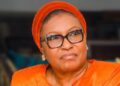

TD Senator Ireti Kingibe of the FCT put a number on the table this week, and the number is 25. She warned that a tax law already passed by the Senate will force Nigerians to pay up to 25 per cent of their earnings in taxes if President Tinubu secures a second term in 2027, and said its full implementation has been timed to take effect after the general elections.
Her charge, in plain language, is that the bill has been passed, the fear of the ballot box is holding it back, and the day after the votes are counted the collector will knock.
Let me do what I always do and separate the claim from the record, because I will not hand anyone the excuse of a wrong figure.

The Record
The Nigeria Tax Act 2025 was signed in June 2025 and took effect on 1 January 2026, raising the top marginal rate of personal income tax to 25 per cent and replacing the old Consolidated Relief Allowance with a capped rent relief. The first ₦800,000 of taxable income is taxed at zero, the 25 per cent rate applies to taxable income above ₦50 million, and the bands in between are taxed at 15, 18, 21 and 23 per cent. So the fact-checkers are right on the arithmetic: the 25 per cent does not fall uniformly on every Nigerian. A market woman in Mile 12 is not about to lose a quarter of her stall.
But I would ask Nigerians not to stop reading there, because the arithmetic is the least important part of this story. Three other things are in that law. Tax residents are now liable on their worldwide income, regardless of where the income is earned or received, and authors, sportsmen, musicians and other creatives resident in Nigeria lose an exemption they used to have. The opposition movement that objected to the law last December went further, saying that it requires all adults of taxable age, employed or not, to file returns by 31 March 2026 or face sanctions, and that business owners must file for every employee regardless of income. That is their reading, not mine, and I report it as theirs. And underneath all of it sits the stated purpose: to lift Nigeria’s tax-to-GDP ratio from around 10 per cent, one of the lowest in Africa.

Translate that out of the language of accountants. The state intends to see everyone, register everyone, and reach further into every pocket it can find. Whether the rate you personally face is 15 or 25 per cent, the direction is the same, and Senator Kingibe is right about the politics even where the pamphleteers are right about the maths: nobody passes a wider net in an election year and then shouts about it.
The Question Nobody in Abuja Wants Asked
Now to the real question, which is not “how much?” but “for what?”
Tax is not theft. In Sweden, where I have lived for thirty years, I pay rates that would make a Nigerian senator faint, and I do not complain, because I can see where it goes: the hospital, the school, the road, the police officer who arrives when called, the court that does not sell its judgments. Taxation is one half of a contract. The other half is governance. A government that collects the first and fails to deliver the second is not running a tax system. It is collecting tribute.
So let us audit the other half of the contract after three and a half years of Renewed Hope.
On the economy. The President told the nation on 1 October that the economy had grown by more than four per cent this year and that inflation had fallen substantially from its peak. The headline number is true: the statistics bureau put inflation at 14.63 per cent in September, down from 15.39 per cent in August. But food inflation was still running at 19.59 per cent year on year, and the fall is measured from a peak the same government created: the reforms triggered a cost-of-living crisis that collapsed the naira and pushed inflation to 34 per cent. Celebrating the fever coming down after you set the house on fire is not a scorecard. Meanwhile, at a forum this very week, a Moniepoint executive pointed to income surveys suggesting that about 40 per cent of Nigerians still earn below ₦100,000. The World Bank has said Nigeria has the highest number of extremely poor people in the world and warned that more may fall into poverty by 2027. Those are the people being told they live in an “age of prosperity”.
On debt. The country that could not fund itself at ₦87 trillion of debt when this administration took office now carries, by the Debt Management Office’s own figures, something north of ₦150 trillion. Every naira of new tax is being raised into a hole the same men dug.

On security. In July, bandits killed 26 soldiers and 48 citizens in Niger and Zamfara in a single day, and within twenty-four hours the President was telling an audience that he was “doing well”. On Independence Day, he acknowledged the efforts of the security forces but did not speak specifically about the rising wave of killings, kidnappings and attacks on communities across the country, communities in Sokoto, Zamfara, Katsina, Benue, Borno and Plateau that have been burying their dead all year. A government that cannot keep its own soldiers alive in Niger State is asking the survivors to file a return by 31 March.
On corruption. I have itemised the ledger before and I will not repeat every line here: the Humanitarian Ministry figures, the refinery billions, the Chagoury contract pile now knocking on twenty billion dollars, the budget padding, the emergency rule in Rivers, the State House spending, the hundreds of days the President has spent abroad. Every one of those items remains an allegation until a court says otherwise, and I note the denials. But a citizen does not need a conviction to ask the obvious question: if the money already collected cannot be accounted for, on what basis should he hand over more?
Should Nigerians Agree?
My answer is no, not as the deal currently stands, and I say that as a man who believes in taxation.
A tax is legitimate when it is consented to, when it is spent transparently, and when the people who impose it carry the same burden as the people who pay it. Not one of those conditions holds in Nigeria today. The National Assembly that passed this Act is a rubber stamp. The asset declarations of the President and his ministers have never been published. The audited accounts of the ministries that will spend this money are years late or non-existent. And the same ruling class that wants 25 per cent of a Lagos banker’s income flies to Paris and London on the public purse and comes home to tell the banker to tighten his belt.
The English fought a civil war over this principle. The Americans founded a country on it. No taxation without representation was never a slogan about rates; it was a statement that the collector must answer to the payer. Nigeria has it backwards. The payer answers to the collector, and the collector answers to no one.
The Kio Solution
This is what I would put to any party asking for Nigerians’ votes in January, including the one in power:

One. Suspend the new personal income tax bands until the Auditor-General’s reports for 2023, 2024 and 2025 are published and debated in open session. No audit, no increase.
Two. Publish the Code of Conduct asset declarations of the President, Vice-President, every minister, every senator and every governor before a single new return is filed. The men who demand transparency from citizens must show their own.
Three. Place every naira of new tax revenue in a ring-fenced account with monthly, line-by-line publication online, administered by an independent fiscal commission, not the Ministry of Finance. If AI can run a bank’s ledger it can run Nigeria’s.
Four. Tie the tax to the contract. Set published targets for the security of life, the cost of a bag of rice, power supply and road deaths, and write into the law that the bands revert automatically if the targets are missed.
Five. Recover before you collect. Enforce the Isabel Precedent: go after the stolen money sitting in London, Dubai, Paris and Chicago before asking the honest taxpayer in Surulere to cover the shortfall.
Senator Kingibe has asked the opposition to take this to the grassroots. I would go further. Every Nigerian who can read should explain it to ten who cannot, because the people who will be hurt most by a widened net are the ones who will never see this post.
Pay your taxes to a government that keeps you alive, keeps your money honest and keeps its own accounts open. Until then, 25 per cent of nothing is still nothing, and 25 per cent of a broken promise is a crime with a receipt.
Nigeria belongs to Nigerians.
Disclaimer: The corruption matters referred to in this piece are allegations and reported figures, not findings of guilt. Denials, where issued, are noted. This piece is published under Swedish press freedom protections.