
TD ENUGU, Nigeria — The International Society for Civil Liberties and Rule of Law (Intersociety), in collaboration with the United States-based Ekwenche Research Institute and Organization, has alleged that thousands of families in Nigeria’s South-East remain unable to account for relatives who allegedly disappeared following military and security operations in the region.
In a joint report issued on Sunday, the organisations claimed that more than 6,000 families were still searching for sons and daughters who allegedly went missing under Nigerian military custody between January 2021 and July 2026.
The report also alleged that thousands of other people remained untraced or unaccounted for following security operations conducted between August 2015 and December 2019.
According to the organisations, at least 400 people were allegedly abducted, controversially labelled or remained unaccounted for between January and July 2026 alone.
The report attributed the alleged disappearances to what it described as a combination of unlawful arrests, secret detention, discriminatory law enforcement, mass criminalisation, ethnic and religious profiling, flawed trials and extrajudicial killings.
It further alleged that some detainees were held at military facilities, including what the organisations referred to as the “WAWA” military cantonment, as well as other undisclosed detention locations in northern Nigeria.

The organisations said the situation had contributed to growing reluctance among parents in the South-East to encourage their children to enlist in the Nigerian military.
Alleged Fulani Herdsmen Attacks in South-East
The report also accused armed non-state actors, particularly groups it described as jihadist Fulani herdsmen and bandits, of carrying out attacks against predominantly Christian communities in the South-East.
Intersociety and Ekwenche claimed that approximately 7,000 Judeo-Christian lives had been lost in attacks across the region since April 2016.
They further estimated that about 200 people were allegedly ambushed, abducted or killed on roads and in forests between January and July 2026.
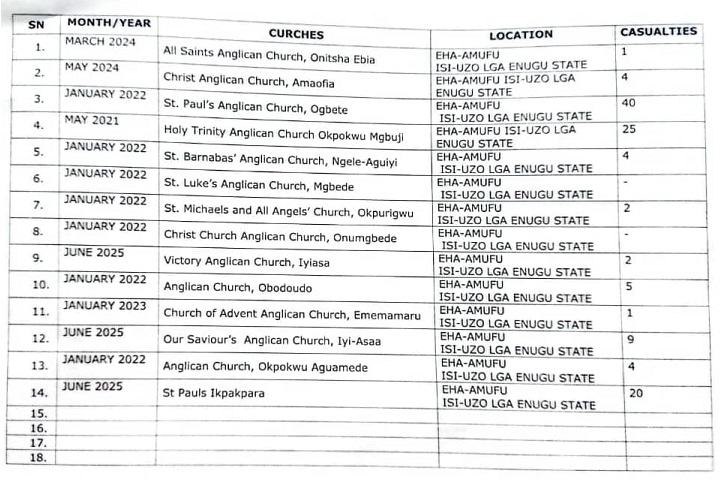
Ezeagu and Eha-Amufu communities in Enugu State were highlighted as case studies of what the organisations described as recurring attacks involving suspected armed herders.
The report alleged that failures by state institutions had compounded the insecurity.

It specifically raised questions about the responses of the Enugu State Government, the Enugu State Police Command and personnel of the Nigerian Army’s 82 Division.
The organisations, however, did not provide independent evidence establishing that government officials or security agencies deliberately collaborated with attackers.
Their report instead described the alleged institutional failures and responses as evidence of what they called “circumstantial complicity.”
299 Christians Reportedly Killed in July
The report’s nationwide assessment alleged that at least 299 Christians were killed and 213 abducted by jihadist groups in Nigeria during July 2026.
It identified Benue, Kaduna, Plateau, Adamawa, Niger, Taraba and other states as among the areas affected.
Benue was reported as having recorded the highest number of Christian deaths, with 65 deaths and 30 abductions, according to the organisations’ compilation.

Southern Kaduna allegedly recorded 58 Christian deaths and 70 abductions, making it the area with the highest reported number of Christian abductions in the organisations’ July compilation.
Plateau State was listed with 55 Christian deaths and at least 10 abductions, while Adamawa was reported to have recorded 35 Christian deaths and Niger 30.
The report also listed six Christian deaths and 18 abductions in southern Kebbi, while Southern Borno, Kogi and Edo were each associated with 20 reported Christian abductions.
The organisations further claimed that at least 40 additional Christian deaths occurred elsewhere in the country, including parts of the South-East.
They described the figures as including “dark figures of crime” — incidents they said were not captured in official statistics or were otherwise difficult to verify.
According to the report, jihadist Fulani herders and bandits accounted for approximately 70 percent of the alleged attacks documented by their researchers.
The organisations calculated that the July figures amounted to an average of about 10 Christian deaths and seven abductions every day.
Religious and Community Institutions Targeted
The report also alleged attacks on Christian religious institutions and clergy during the period under review.
It claimed that several churches were attacked, two Catholic seminarians were abducted in Enugu and Kogi states, one Catholic priest was killed, and four Pentecostal pastors were either killed or abducted.
The organisations described the alleged attacks as part of what they characterised as an ongoing pattern of religious persecution and violence against Christian communities.
However, the report’s casualty figures and attribution of responsibility are claims made by Intersociety and Ekwenche Research Institute and were not independently verified in the statement.
Official security agencies and state governments would need to respond to the specific allegations for the claims to be fully assessed.
Call for Accountability
Intersociety and Ekwenche Research Institute called for greater accountability over alleged disappearances, unlawful detention and attacks on civilian communities.
They argued that families whose relatives disappeared during military or security operations deserved information about their whereabouts and, where applicable, access to justice.
The organisations also urged greater scrutiny of security operations in the South-East and called attention to what they described as failures to adequately protect civilian populations from armed attacks.
The report was signed on behalf of Intersociety by Emeka Umeagbalasi, criminologist and Lead Researcher/Head of Intersociety Nigeria; Chidinma Evangeline Udegbunam, Head of its Department of Campaign and Publicity; and Obianuju Joy Igboeli, Head of its Department of Civil Liberties and Rule of Law.
On behalf of Ekwenche Research Institute, it was endorsed by Prof. Justin Akujieze, President and Chairman of the Board; Mazi Luke Nwannunu, Secretary and Chair of the Finance Committee; and Rev. Father Emeka Nwachukwu, Chair of the Education and Spirituality Committee.
The report represents a serious set of allegations concerning civilian protection, military detention, disappearances and religiously motivated violence.
Verification through official records, court documents, independent investigations, community-level documentation and responses from the Nigerian military, police and affected state governments would be necessary to establish the full scale and circumstances of the claims.