
The African Democratic Congress (ADC) is engulfed in its most severe crisis since inception.
Allegations have emerged that the David Mark-led National Working Committee (NWC) forged signatures of party executives to secure a controversial court judgment.
Watch the video clip below:
What was intended to consolidate control has instead backfired spectacularly, plunging the party into disarray and exposing deep fractures within its leadership.
For years, political analysts have described the ADC as “still born”—a party with lofty ambitions but little traction in Nigeria’s crowded political space.
Despite branding itself as a credible alternative, it has struggled to build grassroots support or establish a coherent national presence.
The latest revelations reinforce this perception, casting doubt on whether the ADC can survive long enough to play any meaningful role in the 2027 elections.
Implications for 2027 Presidential Aspirants
The crisis has immediate and far-reaching consequences for high-profile politicians who had considered the ADC as a platform for their presidential ambitions.
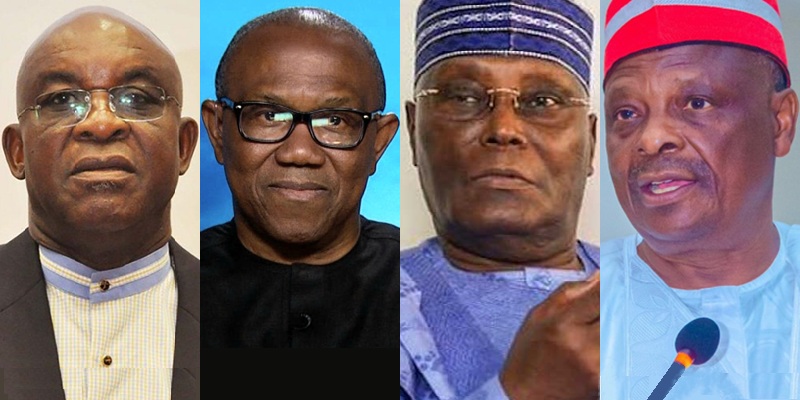
Figures such as Peter Obi, Rotimi Amaechi, and Atiku Abubakar now face a stark dilemma:
- Option 1: Register with another party within the next two weeks, a move that could disrupt their campaign strategies and alliances.
- Option 2: Attempt reconciliation with key ADC stakeholders like Nafi’u Bala, Ralph Nwosu, and Dumebi Kachikwu, though such negotiations may prove costly and uncertain.
Political observers stress that neither INEC nor the ruling APC can be blamed for the ADC’s implosion.
The crisis is largely self-inflicted, born of internal power struggles, questionable leadership tactics, and a failure to build consensus among party elites.
Kachikwu’s Fiery Press Conference
At a heated press briefing, ADC stalwart Kachikwu launched a scathing attack on the David Mark-led leadership, accusing them of hypocrisy and manipulation.
He questioned why they appealed the Court of Appeal’s ruling if they claimed not to be affected by the “Status Quo Ante Bellum.”
“What are they doing at the Supreme Court if they’re not affected? They’re now blaming INEC and APC—such hypocrites,” Kachikwu declared.
His remarks underscore the growing frustration among party members who feel betrayed by the leadership’s maneuvers.
The press conference also revealed the widening gulf between factions within the ADC, with accusations flying and trust eroding rapidly.
Judicial Setbacks
The ADC’s legal woes have compounded its political crisis.
According to Vanguard, the court refused Kachikwu’s motion against INEC and the David Mark-led leadership, further weakening the party’s position.
With the matter now escalated to the Supreme Court, the stakes are high—but insiders argue that the ADC’s credibility has already been fatally undermined.
The drawn-out litigation risks alienating potential aspirants and donors, leaving the party financially drained and politically isolated.
Even if the Supreme Court delivers a favorable ruling, the damage to the ADC’s reputation may be irreversible.
The Bigger Picture
The ADC’s crisis is more than an internal squabble.
It threatens to derail the ambitions of major presidential hopefuls and reshape Nigeria’s political landscape ahead of 2027.
Forged signatures, failed motions, and accusations of hypocrisy have left the party teetering on the brink of irrelevance.
Unless reconciliation or restructuring occurs swiftly, the ADC risks collapsing entirely, forcing aspirants to scramble for alternative platforms to pursue their ambitions.
For Nigeria’s opposition politics, this implosion could prove pivotal.
It narrows the field of credible challengers to the ruling party and altering the balance of power in the run-up to 2027.