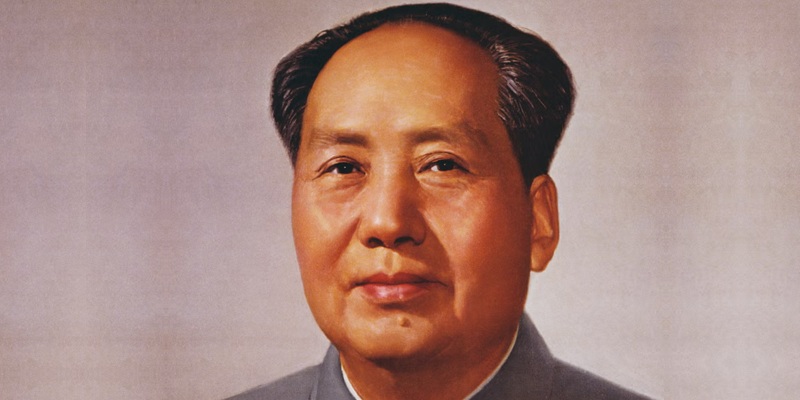
TD Mao Tse-tung, the founding father of modern China, died on September 9, 1976, exactly 50 years ago. His death marked a decisive turning point in the making of new China.

The leaders who succeeded him adopted pragmatism as a disposition and as an instrument of social and economic transformation. Though many of them had endured humiliation and purges during the decade of the Cultural Revolution, they had little time for anger or bitterness.
From 1978, under the leadership of Deng Xiaoping, the Chinese set about rebuilding their country with extraordinary discipline and urgency.
In less than half a century, China moved from a poor, largely rural and agrarian society, scarred by hunger and technological backwardness, to one of the world’s most consequential industrial and economic powers.
What can African nations learn from the Chinese experience, beyond seeing China as a source of cheaper goods or an alternative to the West?
Many succumb to the lure of holding China up as the ultimate development model for Africa. The familiar trope is that Africa and China (or the Asian Tigers) were in roughly similar positions 50 years ago; that China has surged ahead while Africa has fallen behind.
Such comparisons are unnecessary as the two are not comparable in any simple or mechanical sense. They were and still are different societies, shaped by different histories, traditions, cultures, political structures and external circumstances.
China in 1976 was indeed poorer, more rural and technologically weaker than several African countries are today. But China entered its reform era with advantages that many African states still lack. Fifty years ago, China was already a cohesive state with shared history and language, nationwide administrative reach, broad basic education, and a leadership that made economic transformation (not ideological purity) the central test of political legitimacy.
On the surface, Mao’s China may have appeared to share some of the poverty and development challenges familiar across Africa. Beneath the surface, however, the differences were profound. Many of the conditions that aided and propelled China’s economic rise were already present in 1976, even if they were not immediately visible.
There is no value in unproductive national self-criticism or endless leadership blame games. Countries do not develop through slogans or occasional bursts of patriotic emotion. They develop when political incentives and national purpose begin to work in the same direction.
It is, therefore, grossly misleading to see China’s experience as a finished package that African countries can import wholesale. So, are there lessons Africa can learn from China? Certainly. Does China possess all the answers to Africa’s economic future? By no means.
China treated development as a sustained national project. It is a lesson that African nations must imbibe: learn globally, experiment locally and build enduring, capable institutions. They must direct both public and private power towards production, employment, exports and technological capability. For policymakers, the challenge is to turn engagement with China into a relationship of learning, bargaining, production and capability-building; not one of dependency or imitation.
The decisive variable remains African agency. Do governments approach China and, indeed, every external partner, with coherent national and regional strategies? Do they approach negotiations with competent teams, enforceable conditions and institutions capable of monitoring outcomes? Every nation must, in the end, intentionally make its own success.
If only two lessons are to be drawn from China’s post-Mao transformation, they are these: build a development-oriented elite consensus and build a learning state in search of a workable, rather than perfect, model. China’s post-Mao leaders gradually forged a durable consensus around national renewal. Agriculture, industry, infrastructure, education, exports and administrative competence became parts of one connected national project.
African countries need durable elite bargains that rest on the simple understanding that public power must build productive capacity among all. Leaders in politics, business and universities must agree that private enterprise should be rewarded for investment and innovation rather than rent-seeking. And citizens must demand performance and accountability.
Such a consensus need not mean uniformity of opinion or the suppression of democratic competition. It means accepting that certain national priorities must outlast election cycles, changes of government, personal ambition and ethnic contestation.
The second lesson is the importance of a learning state. China’s rise was a story of learning first, before it became a story of capital, factories and infrastructure. As a central policy, they sent students abroad, absorbed technology through trade and investment, expanded technical skills to foster local experimentation before scaling what worked.
They tested major reforms in selected localities before national adoption. For Nigeria, this approach could redirect energy wasted on toxic inter-ethnic rivalry. States and regions can become laboratories of development, testing policies in agriculture, technical education, industrial clusters, transport, digital services, renewable energy and local manufacturing.
Too often, new administrations begin from zero: plans are renamed, data vanish, programmes are abandoned, and implementation capacity is lost. China’s advantage lay in continuity of purpose across decades, and in the pace of reform. Governments changed, policies evolved, yet the commitment to transformation endured.
Africa should see China neither as a source of cheap imports nor simply as a geopolitical alternative to the West, but as the demanding example of national learning, institutional persistence, policy experimentation and productive ambition. Africa cannot, and should not, reproduce China. Our histories, diversity and democratic aspirations require locally legitimate paths.
The challenge is clear: can African leaders embrace long-term planning, productive investment, competence and accountability? The future of the continent and its peoples depends on the seriousness to learn, negotiate, produce and build for generations unborn, drawing on relevant lessons from Mao’s China.
Dr Richard Ikiebe is a Media and Management Consultant, Teacher and Chairman, Board of Businessday Newspaper.