THIS DAWN — Residents of several rural communities in Osun State have raised alarm over what they describe as decades of infrastructural abandonment, citing the absence of basic amenities such as functional schools, motorable roads, healthcare facilities, and banking services.

The situation, they say, reflects a broader failure of governance that has persisted across successive administrations, with particular reference to the period when Rauf Aregbesola governed the state under the All Progressives Congress (APC).
One of the affected towns, Okerimi Oro, is located in the interior axis of Osun State.
It falls under Ife North Local Government Area, not far from other Ife-area communities.
Okerimi Oro presents a stark picture of neglect.
School
Community leaders and residents report that there is no government-owned secondary school within the town, forcing children to trek long distances to neighboring communities.
The only primary school in the area—identified by residents as St. Peter’s Primary School.
It is said to be operating with dilapidated classrooms, leaking roofs, broken furniture, and an acute shortage of teachers.
“There is no public secondary school here.
“Our children either drop out or walk several kilometers every day to attend school elsewhere.
“Many parents cannot afford transportation, and this has contributed to rising illiteracy,” a resident said.

Road infrastructure
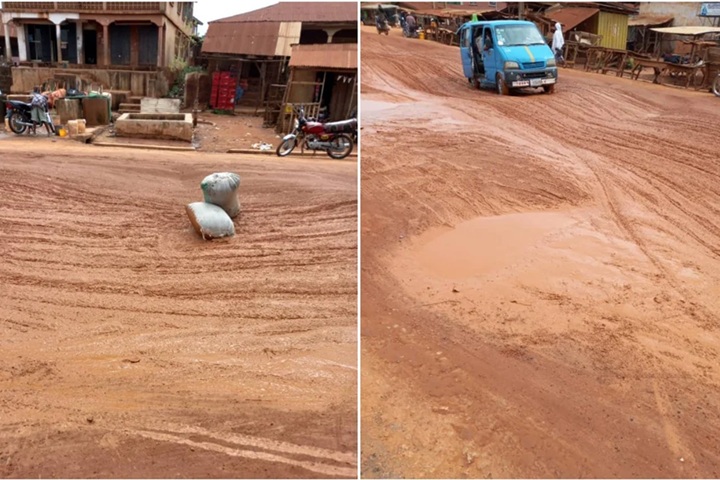
Road infrastructure is another critical concern.
The main access route linking the town to nearby local government headquarters—commonly referred to by residents as the Ilobu–Erin rural link road—is described as nearly impassable, especially during the rainy season.
Deep potholes, erosion gullies, and collapsed drainage systems have reportedly cut the community off from economic activities, healthcare access, and emergency services.
Traders say the poor state of roads has crippled local commerce.
Farmers are unable to transport produce to markets, leading to post-harvest losses and declining incomes.
Commercial drivers reportedly avoid the area altogether, further isolating the town.
Banks
Equally troubling is the total absence of financial institutions.
Residents confirm that there is no commercial bank, microfinance bank, or even a functional ATM point within the community.
This forces locals—particularly traders, pensioners, and civil servants—to travel to towns such as Osogbo or Iwo to conduct basic banking transactions.
Healthcare
Healthcare infrastructure is also limited.
The town’s lone primary healthcare center is described as poorly equipped, understaffed, and frequently without essential drugs.
Pregnant women and emergency patients are often referred to distant hospitals; a journey residents say can be life-threatening due to the poor road network.
Aregbesola absent under APC, reappears under ADC
Many residents trace the roots of the infrastructural decay to the period between 2010 and 2018, when Rauf Aregbesola served as governor of Osun State.
While acknowledging that subsequent administrations have not fully reversed the decline, critics argue that the neglect became more pronounced during that era.

“Aregbesola governed for eight years, and this was the condition of our town throughout that period.
“Today, he is promising Eldorado under a new political platform, but people here remember how things deteriorated during his tenure under the APC,” a community elder said.
Aregbesola, now associated with the African Democratic Congress (ADC), has recently made public statements promising a renewed vision for development and good governance.
However, residents of neglected rural communities say such promises ring hollow unless there is acknowledgment of past failures and concrete plans for restitution.
CSOs to the rescue
Civil society groups and community advocates are calling on the Osun State Government to prioritize rural development through targeted interventions.
They are demanding the following:
- construction and rehabilitation of schools,
- immediate reconstruction of critical rural roads,
- establishment of at least one functional healthcare center, and,
- incentives to attract banking services to underserved communities.
“This is not about politics; it is about survival.
“A town without schools, roads, banks, or healthcare is a town abandoned by government,” a youth leader said.
As calls for accountability grow, residents insist that meaningful development—not political rhetoric—will determine whether trust in governance can be restored in Osun’s forgotten towns.
Watch a video clip showing the state of affairs in an Osun community: