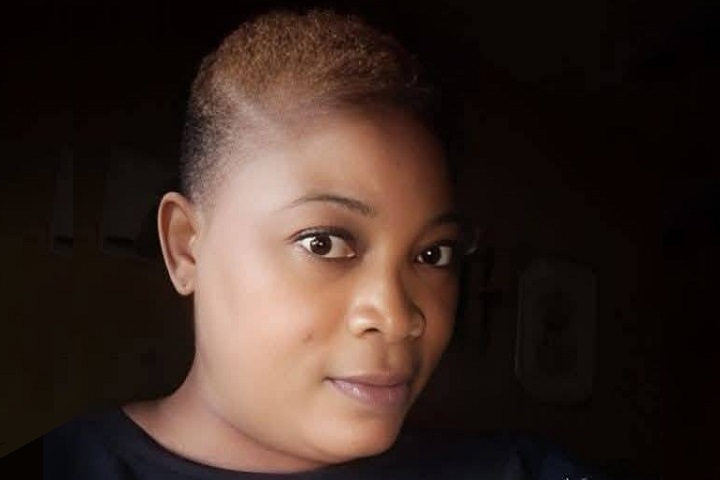
THIS DAWN — Dayo Abiola Wuraola, a known supporter of President Bola Ahmed Tinubu, who openly denied Christian genocide on social media, has suddenly died amid controversy over the cause of her death.

A heated debate had erupted across Nigerian social media following the circulation of false claims alleging that the late Wuraola was killed in a terrorist attack at the Christ Apostolic Church in the Eruku area of Ekiti Local Government, Kwara State.
Contrary to these viral reports, however, close associates have confirmed the cause of death.
They clarified that Wuraola died in Lagos after a prolonged battle with an unnamed terminal illness — not from bandit or terrorist violence.
The controversy first intensified after resurfaced posts from November 2, 2025, in which Wuraola declared on her social media handle:
“I am a Nigerian and I am a Christian. I am not facing any genocide or existential threats. God bless Nigeria. May PBAT succeed.”
See a screenshot of the post below:
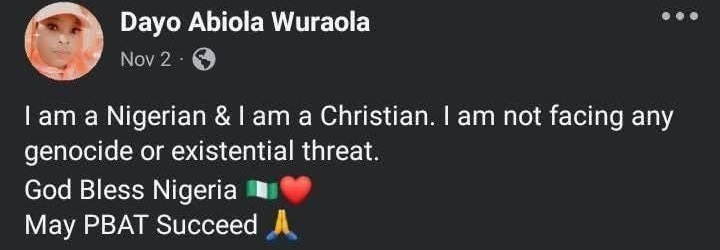
Her comments, rejecting claims of Christian genocide in Nigeria, drew strong reactions, particularly from political and religious commentators.
They accused her of politicising insecurity to defend the ruling All Progressives Congress (APC).
Following her death, detractors weaponised her earlier remarks.
They falsely linked her passing to a church attack, prompting strong rebuttals from friends and associates.
More clarifications from friends, acquaintances and associate
Prominent commentator Sunday Wale Adeniran described Wuraola as “a good friend and an outstanding patriot”.
Adeniran condemned what he termed a “barbaric attempt to lie against a dead person.”
He stressed that Wuraola passed away in Lagos, where no bandit attack occurred.
He wrote: “The said lady who was our good friend and an outstanding and courageous patriot lived and died in Lagos.
“It is barbaric to lie against a dead person and insist on spreading the falsehood after seeing proofs that she was not killed by bandits just because their Trump said that he would invade Nigeria to come and save Christians…
“Wuraola died in Lagos where there was no bandit attack of any kind.”
Adeniran criticised those spreading the false narrative, especially individuals leveraging global political rhetoric — including references to foreign intervention — to push claims of Christian genocide in Nigeria.
He acknowledged that Nigerians have suffered from Boko Haram, bandits and IPOB-related violence.
However, he reiterated that “there is no Christian genocide in this country,” insisting that more Muslims have been victims of terrorism and communal attacks.
Further clarifications
Further clarity came from mutual acquaintances.
Kenny Oduwale noted that Wuraola was active online shortly before her death, even celebrating her daughter’s birthday.
Akin Iyanda, another associate, urged Nigerians to reflect on the moral decay exposed by the misinformation surrounding her death.
He highlighted that Wuraola’s political stance made her a target of online hostility.
He posited: “She died from a terminal illness that, if she was in a first-world country, could only have been prevented, not cured.
“Her quality of life would have been better and probably extended by some more years.
“Some folks claimed that she was killed by Fulani terrorists just to fit into their narratives.
“Her death is being celebrated by some people, many of whom had never met her nor interacted with her on social media…
“Tinubu is failing in many aspects of good governance, but… his policies will affect you, your family, and your friends, directly or indirectly.”
Nonetheless, he argued that celebrating her death or twisting the circumstances to fuel political agendas reflected a troubling trend.
Ìyàndá added that although many Nigerians disagree with President Tinubu, hoping for the country’s failure is self-destructive.
“Mid-air is not the place to attack a pilot flying the plane,” he cautioned, urging citizens to support stability while demanding accountability.
The controversy underscores deeper political polarisation, misinformation, and the dangerous weaponisation of personal tragedy for ideological battles in Nigeria’s digital space.