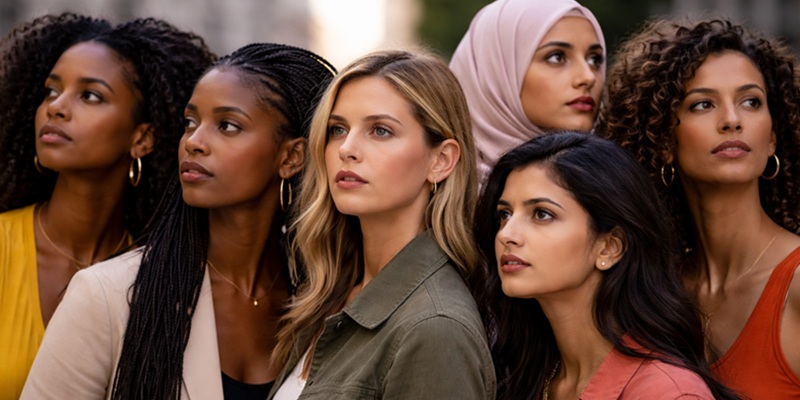

“The hand that rocks the cradle rules the world.” Yet in every age, those who rocked the cradle were also made to carry the weight of the world, silently, faithfully, and without ceremony.
Women have long worn accountability not as a badge of honour but as a cloak placed upon their shoulders before they could speak.
From the earliest civilisations to the corridors of modern governance, the expectation of responsibility has shadowed women, stretching across their roles as mothers, daughters, wives, workers, and leaders.
Yet here lies the contradiction that the world rarely acknowledges; that the same women burdened with disproportionate responsibility have repeatedly demonstrated that they are uniquely equipped to wield accountability not as a burden but as a blazing torch.
Across history and across nations, they have carried it into boardrooms and battlefields, into laboratories and legislatures, into kitchens at midnight and courtrooms at dawn. What was meant to confine them has often become an instrument of liberation not only for themselves, but for the societies they help sustain.
This reflection is both a celebration and a challenge. It explores what happens when the accountability long placed upon women is reclaimed, refined, and redirected toward confronting corruption, injustice, and silencing the forces that weaken institutions and stall national development.
It is also a tribute to women everywhere, such as the homemakers and heads of state, technocrats and teachers, activists and civil servants, all those who have looked wrongdoing in the face and refused to blink.
Before a nation is built, a home is built. And it is often the woman who lays that foundation brick by invisible brick.
She becomes the emotional architect of the family, managing conflict with the skill of a diplomat, healing wounds with the patience of a physician, and instilling values with the precision of a philosopher.
She is the first teacher of every scientist, every judge, every president. She shapes character before character has a name. This labour is too often mistaken for passivity.
Yet the woman who keeps a home is practising governance at its most granular level, allocating scarce resources, managing expectations, resolving disputes, and ensuring that every member of the household is prepared to face the world.
In many ways, she is the first economist, the first psychologist, and the first peacemaker. Nations forget, at their peril, that the home is the seedbed of civilisation.
History also shows that women have often led long before they were formally invited to lead. Ellen Johnson Sirleaf guided Liberia out of the shadows of civil war and into a new chapter of democratic recovery.
Jacinda Ardern governed New Zealand with empathy and decisiveness, redefining what leadership could look like in a modern democracy. In Nigeria, figures such as Ngozi Okonjo-Iweala have stood at the crossroads of global economics, wielding intellect and integrity with remarkable influence.
These leaders did not emerge by accident. Their leadership was shaped by struggle, by persistence, and by a lifelong training in accountability, an ability to hold the big picture in view while attending carefully to the smallest detail.
For many women, courage is not an optional virtue; it is a necessity learned through navigating systems that often demand more from them than from others.
Beyond politics and public office, women have also been architects of progress in science, technology, civil society, and environmental stewardship. Ada Lovelace laid the foundation for modern computing with the first published algorithm.
Wangari Maathai mobilised communities to plant millions of trees, transforming environmental protection into a movement for accountability and human dignity. Malala Yousafzai faced violence for defending girls’ education and emerged as a global advocate for the right to learn.
These stories are not isolated exceptions; they reveal a pattern. When given even the smallest opportunity, women frequently become catalysts for transformation.
They do not merely occupy spaces; they reshape them. Much of the world’s progress rests quietly on their persistence, often unseen, often uncredited, yet profoundly consequential.
Within this landscape of courage and responsibility lies one of the most powerful acts of accountability, i.e., whistleblowing.
At its core, whistleblowing is the decision to place truth above comfort, principle above self-preservation, and the public good above personal safety. It demands moral clarity and extraordinary bravery.
History offers striking examples. Sherron Watkins warned Enron’s leadership of financial irregularities before the company’s collapse, exposing one of the largest corporate scandals in American history.
Erin Brockovich pursued evidence that a corporation had contaminated water supplies in California, ultimately bringing national attention to environmental injustice.
Frances Haugen revealed internal knowledge about the harmful impacts of social media algorithms, sparking global conversations about digital accountability.
These women did not stumble into courage; they chose it deliberately, often at high personal cost. Their decisions demonstrate how accountability, when combined with conviction, can challenge even the most powerful institutions.
Across Africa and particularly in Nigeria, women in civil society, journalism, and public service continue to stand at the forefront of anti-corruption advocacy.
They have exposed procurement fraud, reported the diversion of health resources, and documented abuses of power in environments where silence is often expected. Many do so while balancing family responsibilities, professional pressures, and the persistent risk of retaliation.
The burden of whistleblowing is rarely light. It can bring social ostracism, professional consequences, personal danger, and psychological strain.
Yet women who have already carried immense responsibilities within families and communities often demonstrate remarkable resilience in confronting these risks.
Like the tree that bends in a storm and yet continues to stand, they endure adversity while continuing to provide strength and shelter to others.
The intersection of gender, whistleblowing, and accountability is therefore not simply a social curiosity; it is central to modern governance.
Studies consistently show that societies with higher levels of female participation in leadership and civic institutions tend to experience lower levels of corruption, stronger public service delivery, and more resilient democratic systems.
This pattern is not a coincidence; it reflects the practical insights women bring from lives shaped by accountability.
In Rwanda, women played a central role in rebuilding parliament after the genocide, helping pass laws on land rights, gender-based violence, and financial transparency that reshaped national governance.
In Iceland, women were appointed to key leadership roles in the aftermath of a financial collapse, helping restore credibility and trust in institutions. Across India, female leaders in local councils have frequently delivered stronger outcomes in areas such as health, infrastructure, and transparency.
Yet despite this evidence, the systems designed to encourage whistleblowing often remain hostile to women. Legal protections are frequently weak. Cultural expectations discourage women from challenging authority.
Retaliation, whether social, professional, or legal, remains common. The very institutions that most need women’s voices are often the ones that suppress them most aggressively.
This reality is not accidental. Systems that benefit from silence rarely welcome those who expose wrongdoing. When women speak out, they challenge not only corruption but also the deeper structures that sustain it.
For this reason, the accountability women already practise in private spaces must be recognised as a national resource.
The discipline required to manage a household on limited resources, the patience needed to raise responsible citizens, and the courage to maintain integrity under pressure are not merely personal virtues. They are skills essential to building transparent and resilient institutions.
Imagine the possibilities if these capacities were fully supported. Imagine the woman who has stretched a household budget applying the same vigilance to public procurement.
Imagine a nurse who has witnessed the disappearance of medical supplies having a secure and protected channel to report it.
Imagine journalists, accountants, teachers, bankers, and civil servants across every sector knowing that their integrity will be protected rather than punished.
Realising this vision requires deliberate action. Governments must strengthen whistleblower protection laws and ensure that they account for the specific risks women face.
Civil society organisations must expand safe, anonymous reporting channels that are accessible and trusted. Private institutions must create cultures where integrity is rewarded rather than penalised.
When women are equipped with the tools, protections, and platforms necessary to expose wrongdoing, they do more than reveal corruption.
They reshape institutional culture, restore public trust, and demonstrate that accountability is not merely an ideal but a practical foundation for development.
Finally, the cloak of accountability that women have carried for generations, often quietly and often at great personal cost, can no longer remain hidden. It must be recognised as a mandate.
A call to every woman who has witnessed wrongdoing and felt compelled to remain silent; your hesitation is understandable, but your voice is necessary. A call to every institution that has relied on women’s labour while ignoring their testimony; the cost of silence is national stagnation.
Women have built homes, nurtured communities, and strengthened nations with resilience that is rarely acknowledged.
On account of this, the next step is simple but profound; give them the microphone and protect them when they speak, because when women’s voices are empowered rather than suppressed, systems do not merely tremble; they transform.
And from that transformation, stronger and more accountable nations can rise.
Nkechi Ugwu is Snr Programme Officer, Monitoring and Evaluation at the African Centre for Media & Information Literacy (AFRICMIL).