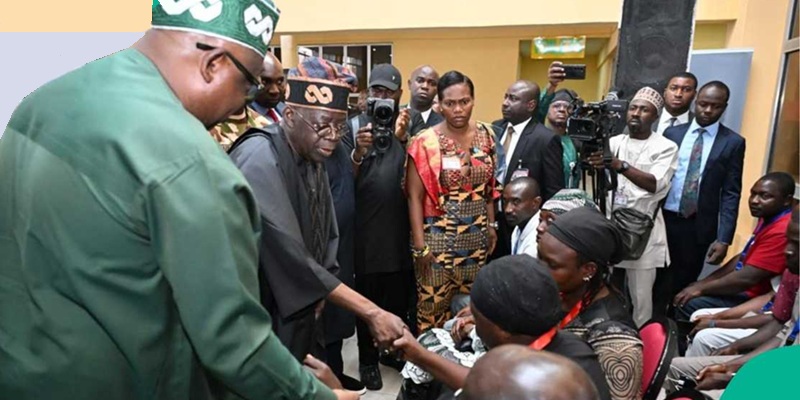
TDThe Presidency has provided detailed clarification on why President Bola Ahmed Tinubu met victims of the recent Plateau attacks at the Jos airport rather than within the township.

The move cited a combination of diplomatic obligations, logistical constraints, and security considerations.
A Day of Tight Scheduling
According to a statement issued by Bayo Onanuga, Special Adviser to the President (Information and Strategy), Tinubu’s itinerary for Thursday was already packed with two major engagements.
These include receiving Chadian President Mahamat Idriss Déby Itno in Abuja and proceeding to Iperu, Ogun State.
After Plateau State Governor Caleb Mutfwang briefed him on the severity of the attacks, Tinubu suspended his Ogun trip and ordered an urgent visit to Jos.
The bilateral meeting with Chad’s president, however, could not be postponed.
The talks, which focused on strengthening regional security collaboration against terrorism and cross-border insurgency, ran longer than expected.
This delayed Tinubu’s departure for Jos and compressed the available time for his visit.
Logistical Challenges in Jos
Upon arrival in Jos, the President encountered logistical hurdles.
The road distance from the airport to Jos township is approximately 40 minutes, but the airport runway lacks navigational aids for night flights.
Driving into town, meeting victims, and returning before dusk was deemed unfeasible.
To ensure Tinubu could still engage directly with affected communities, state and federal officials arranged for representatives of the victims to gather at a hall adjoining the airport.
This allowed the President to meet them promptly while adhering to aviation safety restrictions.
High-Level Security Presence
The meeting was attended by senior federal officials, including the Minister of Defence, the Chief of Army Staff, and the Inspector General of Police.
These officials had earlier visited Rukuba, the epicentre of the violence, to assess the situation on the ground.
Tinubu also deployed a high-level team led by his Senior Special Assistant on Community Engagement to undertake groundwork in Rukuba, focusing on stabilising the area before his arrival.
During the solemn gathering, Tinubu expressed his condolences to the victims and assured them of justice.
He pledged the deployment of 5,000 AI-enabled surveillance cameras across Jos to monitor the city, identify perpetrators, and strengthen law enforcement.
He also invited community leaders to Abuja for further consultations aimed at finding a lasting solution to the decades-old cycle of violence in Plateau State.
Tinubu emphasized that peace must be built with the people, not imposed upon them, and promised federal support to end the recurring bloodshed.
Strategic Engagement, Not Symbolism
The Presidency stressed that Tinubu’s visit was not merely symbolic, but a strategic intervention designed to bring stakeholders together and address the root causes of conflict.
The meeting, broadcast live, was described as solemn and reassuring, boosting residents’ confidence in the government’s commitment to peace.
“President Tinubu achieved the purpose of his visit, despite attempts by naysayers to ridicule it.
He dropped an unmistakable message: sustainable peace must be built with the people, not imposed on them,” Onanuga stated.
He explained that Tinubu’s decision to balance international diplomacy with urgent domestic security concerns highlights the delicate task of governing in a period of heightened insecurity.
According to him, Tinubu’s engagement in Jos underscores the administration’s recognition of Plateau’s violence.
He noted that it is not just a local crisis but a national challenge, requiring both immediate relief and long-term solutions.