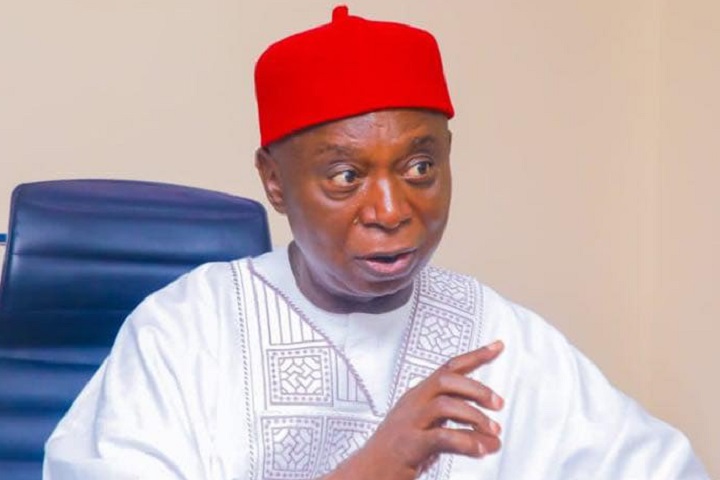
THIS DAWN — A viral online video has sparked controversy after an unidentified man, describing himself as a “church servant,” alleged that Senator Ned Nwoko offered him money to kill Nollywood actress Regina Daniels.

The man claimed that the senator provided him with details of Daniels’ alleged locations in Asanta, Akurota, and Apaka to enable the supposed attack.
The dramatic allegation—made without evidence—comes amid renewed public attention on the couple, whose marriage in 2019 had previously generated widespread debate.
In recent months, social media users have circulated reports alleging friction between the couple, including claims attributed to Regina Daniels accusing Nwoko of abuse and confinement, while the senator was said to have blamed her alleged drug and alcohol use.
None of these claims has been independently verified, and neither party has issued any public statement confirming or debunking the allegations.
The video’s content has prompted skepticism across social media, with many Nigerians cautioning that the man’s statements could attract serious legal consequences if proven false.
Legal analysts note that the video, as presented, fit the pattern of potentially defamatory content.
This is especially given the absence of corroboration, police confirmation, or comments from any official source.

Fresh Video Deepens Controversy
A new twist has, meanwhile, emerged in the unfolding social-media controversy involving Senator Nwoko and Actress Regina Daniels.
A second video surfaced showing the same unidentified young man making further unsubstantiated claims about the couple.
The individual, who previously alleged that Senator Nwoko offered him money to kill Daniels, now claims he once “worked with both of them,” although he provides no verifiable details to support this assertion.
In the new video, the man repeats earlier accusations and expands on them, alleging behind-the-scenes conflicts and personal misconduct involving the couple.
As with the first video, none of the statements are backed by evidence, documents, witnesses, or any form of verification.
The man does not provide dates, locations, or any corroboration that could substantiate his claims of proximity to either Nwoko or Daniels.
The allegations continue to trend online, but public reaction remains overwhelmingly cautious.
Many Nigerians describe the videos as “suspicious,” “inconsistent,” or “attention-seeking”.
They note that the young man frequently contradicts himself and offers no proof for any of the claims made.
Legal commentators have warned that if the videos are proven false, they could constitute serious defamation, especially given the prominence of both individuals involved.
Despite the growing chatter, no official response has been issued by Senator Nwoko, Regina Daniels, their representatives, or the Nigeria Police Force.
Authorities have not announced any investigation, and there is no independent confirmation that any complaint has been filed by either party.
Silence fuels conspiracy theories
Media analysts are urging the public and content creators to act with caution.
Some emphasise that repeated circulation of unverified allegations can cause reputational harm and escalate tensions without contributing to factual understanding.
They note that sensational online claims often spread rapidly before being debunked, creating confusion and misinformation.
For now, the allegations in both videos remain unverified, unsupported, and unacknowledged by any credible authority.
That leaves the true motives behind the recordings unclear as the controversy continues to unfold.
As of the time of reporting, there has been no response from Senator Ned Nwoko, Regina Daniels, their representatives, or law enforcement agencies regarding the circulating claims.
The Nigeria Police Force has also not acknowledged any report, investigation, or complaint related to the alleged plot.
Public reaction sharply divided
While some individuals have called for a formal investigation to clarify the situation, a larger portion of online commentators have dismissed the video as fabricated, attention-seeking, or politically motivated.
Media experts have urged caution in amplifying unverified allegations that could endanger reputations and potentially trigger legal action.
With no substantiating evidence currently available, the claims remain unconfirmed.
Observers, meanwhile, expect that formal legal or public statements may follow if the matter continues to trend.
The situation underscores the growing problem of unverified viral content and its capacity to influence public perception before facts are established.