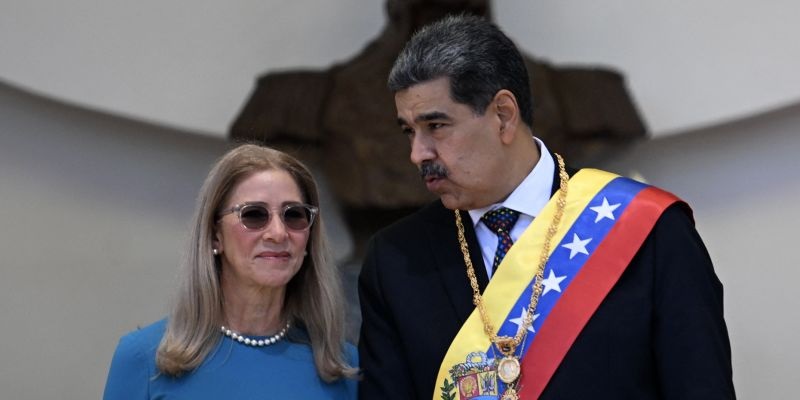
THIS DAWN — The dramatic announcement of U.S. military action in Venezuela, culminating in the capture of President Nicolás Maduro and his wife, has triggered sharp condemnation from major global powers.

Russia, China, and Iran have each issued strong statements denouncing the operation as a violation of international law and a dangerous escalation in Latin America.
Their responses signify the geopolitical fault lines deepening around Washington’s intervention and highlight the broader debate over sovereignty, legality, and global order.
Russia’s Response
The Russian Foreign Ministry described the U.S. operation as an “act of armed aggression” that has caused “deep concern and condemnation.”
Moscow rejected Washington’s justification for the strikes, calling them “unfounded” and driven by “ideologized hostility” rather than pragmatic diplomacy.
Russia emphasized the need to prevent further escalation and urged dialogue as the only viable path forward.
“We believe that all partners who may have grievances against one another should seek ways to resolve their problems through dialogue-based solutions.
“We are ready to support them in this,” the statement read.
Moscow also invoked the 2014 regional declaration that Latin America must remain a “zone of peace,” insisting that Venezuela has the right to determine its own fate free from external interference.
The Foreign Ministry reaffirmed solidarity with the Venezuelan people and their Bolivarian leadership, pledging continued support for sovereignty and national interests.
Additionally, Russia backed calls for an immediate meeting of the United Nations Security Council to address the crisis.
The Russian Embassy in Caracas confirmed it was operating normally and reported no injuries among Russian citizens.
China’s Position
China’s Ministry of Foreign Affairs, through spokesperson Lin Jian, condemned the U.S. strikes as a serious infringement on sovereignty and a violation of the United Nations Charter.
“The United States’ actions seriously infringe on other countries’ sovereignty, security, and legitimate rights and interests, seriously violate the United Nations Charter and international law, and threaten peace and security in Latin America and the Caribbean,” Lin said.
China stressed that Venezuela, as an independent sovereign state, has the right to pursue mutually beneficial cooperation and defend its legitimate interests.
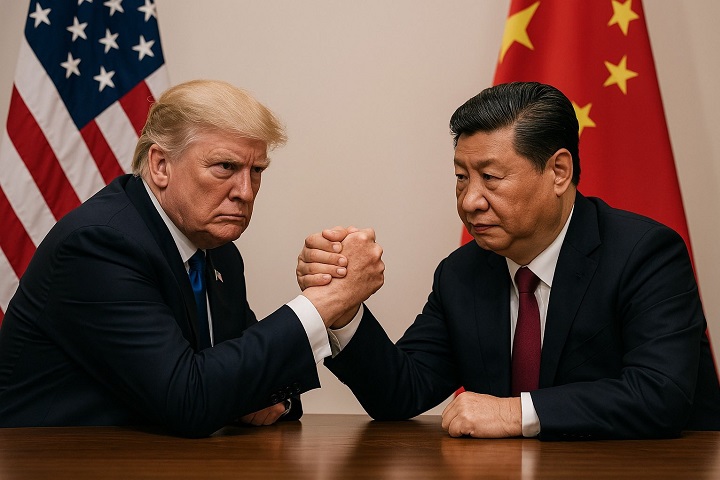
Beijing reiterated its opposition to unilateralism and bullying, rejecting the use or threat of force, external interference in Venezuela’s internal affairs, and unlawful sanctions.
The statement urged Washington to heed the international community’s call, cease its actions, and contribute to peace and stability in Latin America.
China framed the U.S. intervention as part of a broader pattern of unilateralism that undermines global order, calling for respect of sovereignty and dignity across nations.
Iran’s Condemnation
Iran’s Foreign Ministry issued one of the strongest denunciations, labeling the U.S. military action a “blatant violation” of Venezuela’s sovereignty and territorial integrity.
The statement asserted that the attack constitutes a clear breach of Article 2(4) of the UN Charter, which prohibits the threat or use of force, and fully qualifies as an “act of aggression.”
Tehran warned that the invasion represents a grave breach of regional and international peace, with consequences that threaten the entire international system.
“Its consequences affect the entire international system and will further expose the UN Charter-based order to erosion and destruction,” the ministry declared.
Iran emphasized Venezuela’s inherent right to defend its sovereignty and self-determination, while calling on the UN and its Security Council to immediately halt the U.S. aggression.
The statement also stressed the need to hold accountable the planners and perpetrators of crimes committed during the operation.
Broader Implications
The coordinated condemnations from Russia, China, and Iran highlight the geopolitical stakes of the U.S. intervention.
Each country framed the operation as a violation of international law and a threat to global stability, while reaffirming support for Venezuela’s sovereignty.
Their responses also reflect broader strategic alignments. Russia and China, both permanent members of the UN Security Council, are likely to challenge Washington’s narrative in international forums.
Iran’s denunciation underscores its longstanding opposition to U.S. military interventions and its solidarity with anti-Western governments.
For Venezuela, the backing of these powers provides diplomatic cover amid uncertainty over Maduro’s fate and the future of governance in Caracas.
For the United States, the condemnations signal mounting resistance to its extraterritorial actions and raise questions about the legitimacy of prosecuting a sitting head of state.
The U.S. invasion of Venezuela has opened a new chapter in global geopolitics, drawing sharp rebukes from Russia, China, and Iran.
Their statements converge on a common theme: the defense of sovereignty, rejection of unilateral force, and insistence on dialogue.
As the crisis unfolds, the clash between Washington’s framing of Maduro as a “narco-terrorist” and the counter-narratives of major powers will shape not only Venezuela’s future but also the broader contest over international law and global order.