
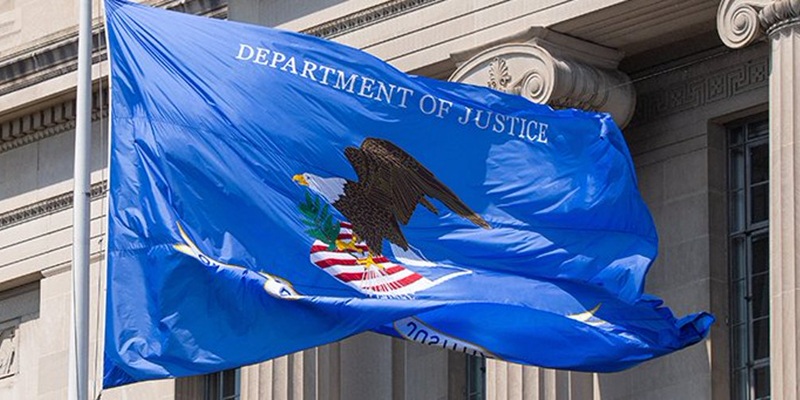
TDThe U.S. Department of Justice announced the seizure of four domains linked to Iran’s Ministry of Intelligence and Security (MOIS).

The domains — Justicehomeland[.]org, Handala-Hack[.]to, Karmabelow80[.]org, and Handala-Redwanted[.]to — were allegedly used to facilitate hacking campaigns, psychological operations, and transnational repression.
According to investigators, these sites were employed to:
- Claim credit for destructive cyberattacks.
- Leak sensitive stolen data.
- Incite violence against journalists, dissidents, and Israeli individuals.
- Spread anti-American propaganda.
Examples of Malicious Cyber Activity
- March 11, 2026: Handala-Hack[.]to claimed responsibility for a destructive malware attack against a U.S.-based medical technologies firm.
- March 9, 2026: Handala-Redwanted[.]to posted sensitive personal data of 190 individuals linked to the Israeli Defense Force and government, accompanied by threats.
- March 6, 2026: The same domain leaked confidential data from members of the Sanzer Hasidic Jewish community, warning of further exposure and threats.
- Emails from Handala_Team@outlook[.]com were used to send death threats to dissidents and journalists, even offering bounties and soliciting cartel violence.
Official Statements
-
Attorney General Pamela Bondi:
“Terrorist propaganda online can incite real-world violence.
“Thanks to our National Security Division and the U.S. Attorney’s Office for the District of Maryland, this network of Iranian-backed sites will no longer broadcast anti-American hate.”
-
FBI Director Kash Patel:
“Iran thought they could hide behind fake websites and keyboard threats to terrorize Americans and silence dissidents.
“We took down four of their operation’s pillars and we’re not done.”
-
Assistant Attorney General John A. Eisenberg:
“Iran, the leading state sponsor of terrorism worldwide, used the seized domains to dox and harass dissidents and journalists, incite violence against Jewish communities, and spread Tehran’s anti-American propaganda.”
-
U.S. Attorney Kelly O. Hayes (District of Maryland):
“Unleashing terroristic ideology into the cybersphere is a direct threat to our national security.
“We will not hesitate to use all our resources to ensure the safety and security of our nation.”
Broader Context on Cyber Warfare
The FBI’s investigation revealed that the seized domains were interconnected through shared leak sites, Iranian IP ranges, and a common operational playbook.
This included destructive cyberattacks and “faketivist” psychological operations designed to intimidate and destabilize.
The Department of State’s Rewards for Justice program is offering up to $10 million for information on individuals engaged in malicious cyber activities against U.S. critical infrastructure at the direction of foreign governments.
The Justice Department’s disruption of these Iranian-controlled domains underscores America’s commitment to dismantling cyberwarfare infrastructure.
They also protect dissidents and safeguard national security against state-sponsored psychological operations.
3 Arrested for Diverting Cutting-Edge AI Chips to China
In another development, three men—Yih-Shyan “Wally” Liaw, Ruei-Tsang “Steven” Chang, and Ting-Wei “Willy” Sun—have been charged with conspiring to illegally divert advanced U.S. artificial intelligence technology to China.
The three allegedly used false documents, dummy servers, and covert shipping schemes.
Liaw and Sun were arrested in California, while Chang remains a fugitive in Taiwan.

Key Details of the Case
-
Defendants:
- Yih-Shyan “Wally” Liaw – U.S. citizen, co-founder and senior executive of a California-based server manufacturer.
- Ruei-Tsang “Steven” Chang – Taiwanese citizen, general manager of the company’s Taiwan office, now a fugitive.
- Ting-Wei “Willy” Sun – Taiwanese broker accused of orchestrating the logistics of the illegal exports.
-
Charges:
- Conspiracy to violate the Export Controls Reform Act (maximum 20 years).
- Conspiracy to smuggle goods from the U.S. (maximum 5 years).
- Conspiracy to defraud the United States (maximum 5 years).
Alleged Scheme
The defendants allegedly acquired servers equipped with cutting-edge AI GPUs under false pretenses.
These servers were shipped to intermediary countries in Southeast Asia, repackaged, and covertly redirected to China.
To deceive compliance inspectors, the conspirators staged dummy servers—machines that appeared compliant but concealed the true destination of restricted technology.
Between 2024 and 2025, investigators estimate that $2.5 billion worth of servers were diverted, including $510 million in just six weeks in early 2025.
Official Statements
-
John A. Eisenberg, Assistant Attorney General for National Security:
“The indictment unsealed today details alleged efforts to evade U.S. export laws through false documents, staged dummy servers to mislead inspectors, and convoluted transshipment schemes, in order to obfuscate the true destination of restricted AI technology—China.
“These chips are the product of American ingenuity, and NSD will continue to enforce our export-control laws to protect that advantage.”
-
Roman Rozhavsky, FBI Counterintelligence Division:
Rozhavsky stressed that AI hardware is now a frontline issue in national security, and that the FBI is intensifying efforts to prevent adversaries from acquiring U.S. technology illicitly.
-
Jay Clayton, U.S. Attorney for the Southern District of New York:
Clayton characterized the operation as “a tangled web of lies, obfuscation, and concealment” that not only generated billions in unlawful profits but also posed a direct threat to U.S. strategic interests.
National Security Context
-
Export Restrictions:
The U.S. Department of Commerce requires special licenses for the export of advanced AI accelerator chips and servers to China and Hong Kong.
These restrictions are designed to prevent adversaries from using American technology to enhance military capabilities, cyber operations, and nuclear proliferation.
-
Strategic Significance:
AI hardware—particularly GPUs and servers optimized for machine learning—is considered a cornerstone of modern defense systems, intelligence analysis, and autonomous weapons development.
Unauthorized transfers risk eroding America’s technological edge.
-
Broader Geopolitical Stakes:
The case reflects the intensifying competition between Washington and Beijing over artificial intelligence supremacy.
As AI becomes a critical enabler of both economic growth and military power, safeguarding supply chains and export pathways has become a top priority for U.S. policymakers.
What Happens Next
- Liaw and Sun are scheduled to appear in federal court in California.
- Chang remains at large in Taiwan, and U.S. authorities are coordinating with international partners to pursue his extradition.
- If convicted, the defendants face up to 20 years in prison for the most serious charge, alongside financial penalties and forfeiture of illicit gains.
This indictment highlights Washington’s determination to protect U.S. innovation in artificial intelligence from unlawful transfers abroad.
It underscores the growing importance of export controls in the global race for AI dominance, where cutting-edge chips are not just commercial products but strategic assets with profound national security implications.