TDThe latest escalation between the United States, Israel, and Iran has once again exposed a familiar truth about the international system: when great powers clash, the United Nations Security Council struggles to act.

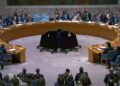
In late February, coordinated strikes by the United States and Israel against Iranian targets triggered an emergency meeting of the United Nations Security Council. The moment called for clarity. Instead, it produced division.
The Council did not condemn the strikes. Nor did it adopt a resolution addressing their legality. Instead, the debate inside the chamber mirrored the geopolitical fault lines that increasingly define global politics.
The United States and its allies framed the strikes as a defensive measure against security threats. Iran and several other states described them as an unlawful act of aggression against a sovereign state.
Meanwhile, Russia and China criticised the attack as a violation of the prohibition on the use of force under the Charter of the United Nations.
The result was predictable: paralysis.
This paralysis is not simply the product of diplomatic disagreement. It is built into the structure of the Security Council itself.
The Council’s five permanent members — the United States, the United Kingdom, France, Russia and China — possess veto power. Any one of them can block a resolution, even if the rest of the world supports it.
In practice, this means the Council rarely condemns actions taken by a permanent member or its close allies.
In the present crisis, any attempt to censure the United States or Israel would almost certainly face a veto from Washington.
Conversely, efforts to adopt a resolution strongly aligned with Western narratives risk opposition from Moscow or Beijing.
Caught between these competing vetoes, the Council often defaults to the lowest common denominator: calls for restraint, appeals for de-escalation, and carefully worded resolutions that avoid assigning responsibility.
That dynamic was visible again in the Council’s later resolution addressing Iran’s retaliatory missile and drone attacks on Gulf states.
The resolution passed, but it conspicuously avoided mention of the original strikes that triggered the escalation. Critics argue that such selective framing risks creating the impression that international law applies unevenly.
For supporters of the current system, this may simply reflect geopolitical reality.
The United Nations was never designed to override the interests of major powers. Instead, it was built to ensure that those powers remained inside the diplomatic system rather than outside it.
But the cost of that compromise becomes evident during crises like this one.
When the Security Council cannot clearly address the legality of military action, the authority of the international legal order begins to erode. Norms against the use of force depend not only on treaties and principles but also on consistent enforcement.
The confrontation between the United States, Israel and Iran therefore raises a broader question: what role can the Security Council realistically play in a world where strategic rivalry is intensifying?
For now, the answer appears limited. The Council remains an essential forum for diplomacy and crisis management. Yet when conflicts involve powerful states and their allies, it is less an arbiter of international law than a mirror of global politics.
The chamber in New York still hosts the world’s most important diplomatic debates. But as the latest crisis shows, debate alone is not the same as resolution.