THIS DAWN — United States President Donald Trump has declared himself the “Acting President of Venezuela” in a controversial social media post, following the U.S. military’s capture of Venezuelan President Nicolás Maduro earlier this month.

The post has sparked global debate over sovereignty, legality, and Washington’s role in Venezuela’s future.
Trump’s Declaration
On January 11, 2026, U.S. President Donald Trump posted a digitally altered image on his Truth Social account, styled like a Wikipedia infobox, labeling himself as the “Acting President of Venezuela”.
The image featured his official presidential portrait and listed the designation as “Incumbent January 2026”.
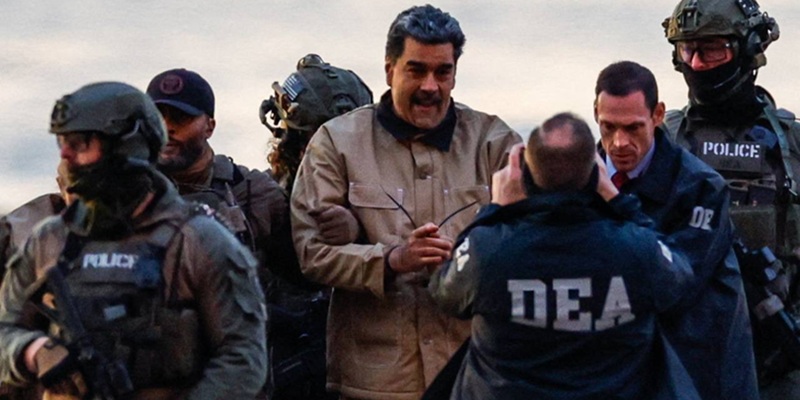
The post came days after U.S. forces captured Nicolás Maduro in a nighttime operation on January 3, 2026.
Maduro was flown to New York and arraigned on federal charges, including narco-terrorism conspiracy.
He continues to challenge his detention, citing violations of international law and sovereign immunity.
U.S. Justification and Reaction
According to reports, Trump’s administration claims the U.S. will temporarily oversee Venezuela’s administration and oil resources “until a safe, proper and judicious transition” can be arranged.
The post did not clarify the legal basis for Trump’s self-appointment, nor did it reference any formal recognition by international bodies.
Meanwhile, Venezuela’s Supreme Tribunal of Justice has ordered Vice President Delcy Rodríguez to assume the role of acting president.
It rejected U.S. authority and calling Trump’s declaration “a violation of national sovereignty”.
International Response
The global reaction has been swift and polarized:
- Latin American governments including Brazil, Colombia, and Mexico have condemned the U.S. intervention and Trump’s declaration, calling for respect for Venezuela’s sovereignty.
- Russia and China have denounced the move as “imperialist overreach,” while European Union officials have urged restraint and called for a multilateral diplomatic solution.
- Human rights groups have raised concerns about the legality of Maduro’s capture and the implications for international norms.
In the U.S., Trump’s post has stirred controversy:
- Critics argue that the declaration undermines diplomatic norms and risks escalating tensions in Latin America.
- Supporters claim it reflects a bold stance against authoritarianism and drug-linked regimes.
The White House has not issued an official statement clarifying whether Trump’s post reflects formal policy or symbolic rhetoric.
Legal and Constitutional Questions
Trump’s declaration raises complex legal questions:
- Can a sitting U.S. president assume leadership of a foreign nation without international recognition?
- What are the implications for Venezuela’s constitutional order and succession?
- Does Maduro’s capture constitute lawful extradition or illegal rendition?
Experts say the situation could trigger a wave of legal challenges in both U.S. and international courts.
Donald Trump’s self-declaration as “Acting President of Venezuela” marks an unprecedented moment in U.S.–Latin American relations.
With Maduro detained, Venezuela’s leadership in flux, and global reactions intensifying, the coming weeks will test the boundaries of international law, diplomacy, and executive power.