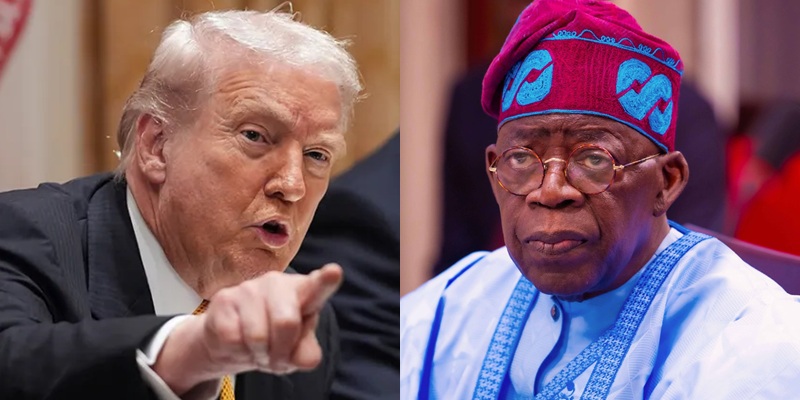
TDNigeria was plunged into grief and outrage on Tuesday after a series of coordinated suicide bombings ripped through Maiduguri, the capital of Borno State.

The attacks targeted a hospital, a bustling market, and a post office, leaving dozens dead and scores injured.
The scale of destruction has reignited fears about the country’s vulnerability to extremist violence and raised urgent questions about the government’s crisis response.
The tragedy quickly drew international attention.
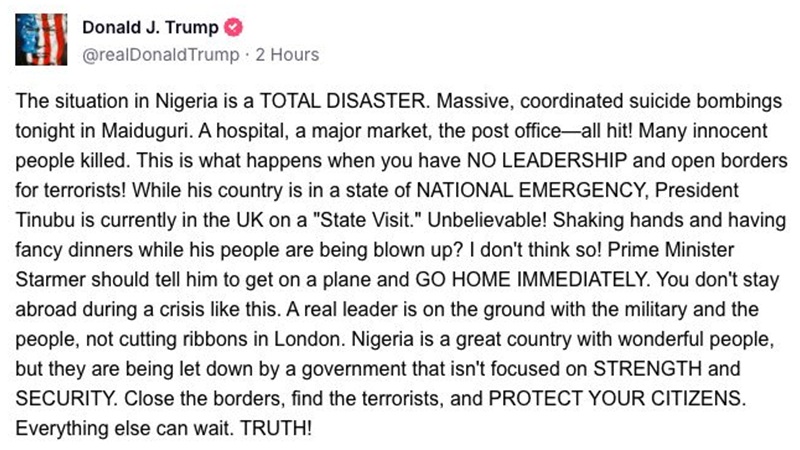
U.S. President Donald J. Trump issued a blistering statement on social media, calling the situation a “TOTAL DISASTER” and a “NATIONAL EMERGENCY.”
Trump lambasted Nigerian President Bola Tinubu for being abroad on a state visit to the United Kingdom during the attacks.
Trump urged him to “go home immediately” and demanding stronger leadership, border closures, and decisive action to protect citizens.
His post, which has already attracted tens of thousands of engagements, amplified global scrutiny of Nigeria’s leadership at a time of national trauma.
See post below:
Leadership Under Fire
Tinubu’s absence has become a lightning rod for criticism.
Opposition figures and civil society groups argue that his decision to remain overseas during such a crisis reflects a troubling disconnect between the presidency and the realities faced by ordinary Nigerians.
Analysts note that while state visits are important for diplomacy, the optics of being away during a national emergency risk undermining public confidence in leadership.
Political commentators warn that Tinubu’s government faces a credibility test: balancing international diplomacy with domestic security.
The president’s critics insist that his presence in Nigeria is essential to reassure citizens and coordinate a unified response.
Supporters, however, argue that state visits are planned months in advance and that governance requires both international engagement and domestic vigilance.
Scenes of Chaos in Maiduguri
Eyewitnesses described harrowing scenes as explosions tore through crowded areas.
Emergency responders rushed to the sites, but hospitals were quickly overwhelmed by the influx of casualties.
Families frantically searched for missing relatives, while survivors recounted the terror of fleeing through smoke and debris.
The attacks bear the hallmarks of extremist groups that have long destabilized northeastern Nigeria.
Particularly so are the Boko Haram and splinter factions of the Islamic State West Africa Province (ISWAP).
Maiduguri, often described as the epicenter of Nigeria’s insurgency, has endured repeated assaults over the past decade.
However, the scale and coordination of Tuesday’s bombings shocked even seasoned observers.
Global and Domestic Pressure
Trump’s remarks have added international weight to calls for urgent action.
Security experts stress the need for enhanced intelligence coordination, tighter border controls, and stronger community-based protection measures.
Domestically, Nigerians are demanding accountability and immediate steps to prevent further bloodshed.
The attacks have also reignited debate about whether Nigeria’s security forces are adequately equipped to confront the evolving tactics of insurgents.
Despite billions spent on defense, critics argue that corruption, poor training, and inadequate equipment continue to hamper effectiveness.
International partners, including the United States and the United Kingdom, may face renewed pressure to expand counterterrorism support.
A Nation at a Crossroads
As Nigeria mourns, the crisis has become more than a security challenge—it is a test of leadership, resilience, and trust.
The coming days will determine whether Tinubu’s administration can reassure citizens and restore confidence.
It waits to be seen if it will deliver the decisive action that both Nigerians and the international community are demanding.
For many Nigerians, the tragedy is a painful reminder of the fragility of peace in the northeast and the urgent need for reforms that go beyond military solutions.
Analysts suggest that without addressing root causes—poverty, unemployment, and political marginalization—the cycle of violence may continue.
The Maiduguri bombings have forced Nigeria into a moment of reckoning: a nation grappling with grief, demanding accountability.
Nigerians confront the stark reality that leadership in times of crisis is not just about diplomacy abroad, but presence and action at home.
It highlights both the human toll of the bombings and the broader implications of Trump’s intervention.
It positions Nigeria’s crisis as both a domestic tragedy and an international test of leadership.