THIS DAWN — In an unprecedented move with wide-ranging implications for U.S. immigration policy, the U.S. Department of Homeland Security (DHS) has directed U.S. Citizenship and Immigration Services (USCIS) to immediately pause and reassess all pending asylum applications.

Also to be reassessed is a broad category of immigration benefit requests filed by individuals from countries designated as “high-risk” under Presidential Proclamation 10949.
It could be recalled that President Donald Trump has announced sweeping new immigration measures, declaring a permanent pause on migration from what he termed “Third World Countries”.
President Trump directed U.S. authorities to reevaluate all green cards issued to nationals of 19 countries designated as “of concern.”
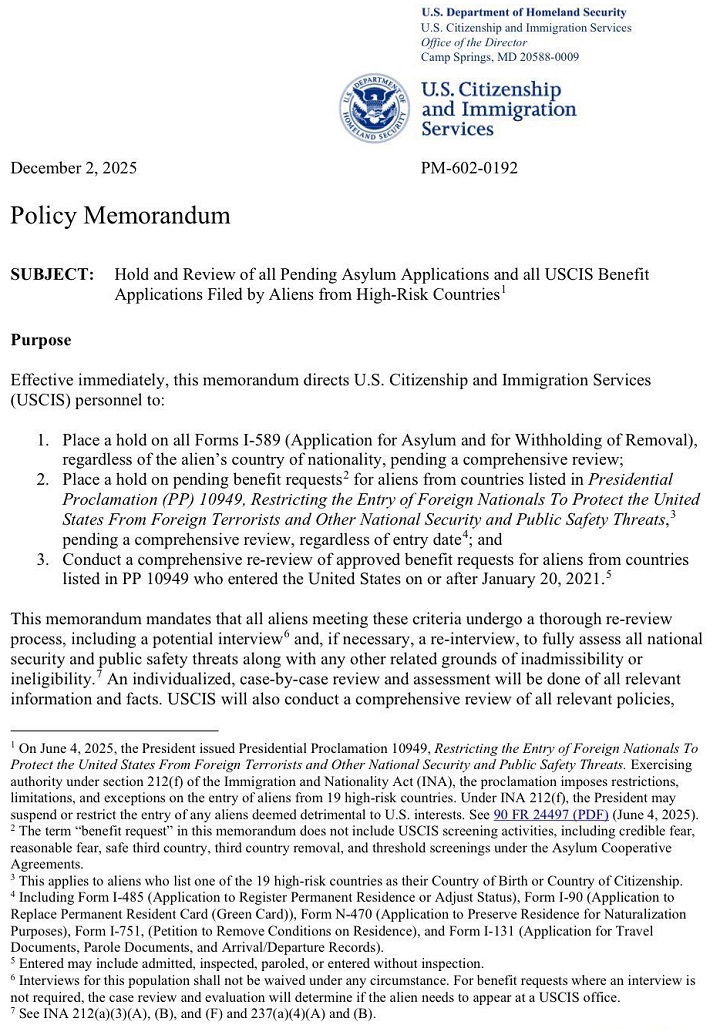
In the latest development, the policy memorandum, issued this week by the Office of the Director of USCIS, mandates a nationwide hold on all Form I-589 applications. (See the attached document below.)
Form I-589 is the primary form used to request asylum or withholding of removal.
The hold applies to every applicant, regardless of nationality, pending what the agency calls a “comprehensive review.”
19 countries listed in Presidential Proclamation 10949
Even more sweeping are the directives concerning immigrants from the 19 countries listed in Presidential Proclamation 10949.
The Proclamation restricts the entry of foreign nationals deemed potential national security or public safety threats.
Citing authority under Section 212(f) of the Immigration and Nationality Act, USCIS has ordered:
-
An immediate halt to all pending benefit applications from nationals or birth-country citizens of the listed countries, regardless of when they entered the United States; and
-
A full re-review of previously approved benefit requests for individuals from those countries who entered the United States on or after January 20, 2021.
According to the memorandum, the re-review process will include mandatory interviews, with no waivers permitted under any circumstance.
Cases that traditionally did not require interviews—such as certain green card renewals, travel document applications, or permanent residence adjustments—may now require in-person appearances at USCIS offices if deemed necessary during reevaluation.
The agency also clarified that the directive does not apply to initial screening activities such as credible fear or reasonable fear interviews, safe-third-country determinations, or asylum cooperative agreement screenings.
USCIS officials indicated that the purpose of the expanded security checks is to ensure all applicants are fully vetted against national security, terrorism, and public-safety criteria contained in multiple INA inadmissibility and deportability sections.
The memo states that each case will undergo individualized review, with adjudicators instructed to reassess “all relevant information, facts, and grounds of ineligibility.”
The directive represents one of the broadest security-based immigration reviews in recent years and is expected to slow adjudications significantly for affected categories while DHS conducts its policy reassessment.