THIS DAWN — The Christian doctrine of the Trinity—that God is one essence in three distinct Persons: Father, Son, and Holy Spirit—is central to Christian theology.

Yet students often wonder whether similar ideas existed in older religions and whether the Trinity was influenced by earlier traditions.
While triadic patterns did appear in many ancient religions, none of them taught what Christians mean by “one God in three co-equal Persons.”
Instead, earlier cultures typically grouped three separate gods together or depicted one deity in three forms, which is fundamentally different from the Christian concept.
To understand this distinction, it is useful to explore major triads in the ancient world—particularly in Greek mythology—and compare them with the Christian Trinity.
Triads in the Ancient World
1. Egyptian Religion
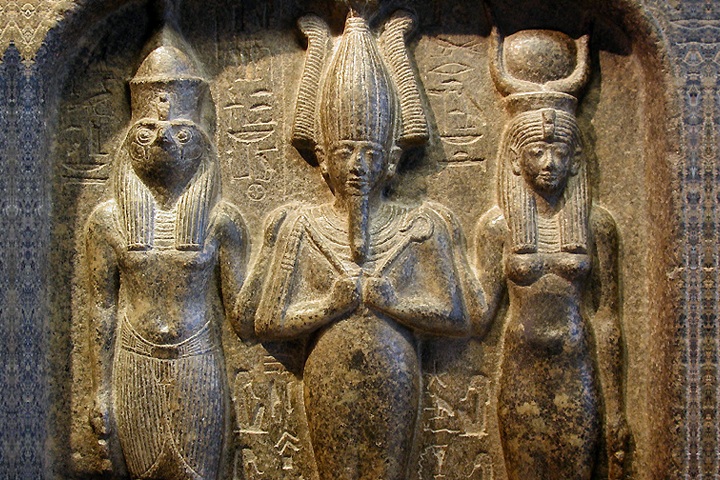
Ancient Egypt produced several important triads, such as Osiris, Isis, and Horus, a divine family of father, mother, and son.
Another example is the creator triad of Amun, Ra, and Ptah.
These groups were honoured together in worship, but they were clearly three individual gods, each with their own identity and powers.
Their triadic grouping offers an interesting cultural parallel, but it does not resemble the Christian idea of a single divine essence.
2. Mesopotamian and Indo-European Traditions
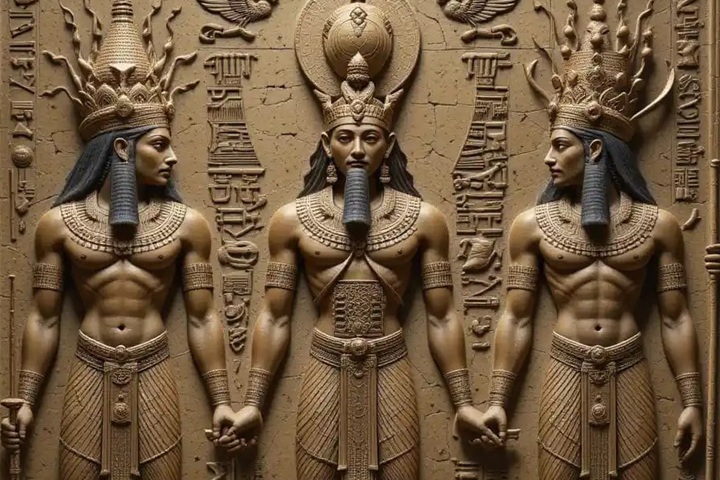
Sumerian and Babylonian religion also featured divine groupings, including the triad Anu (heaven), Enlil (air and authority), and Enki (water and knowledge).
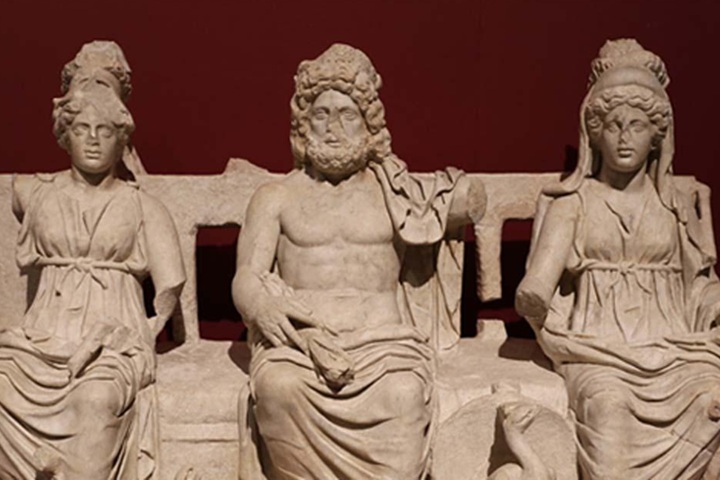
Likewise, Indo-European cultures, including the Greeks and Romans, regularly organised deities in groups of three, such as the Fates, the Graces, and the Capitoline Triad.
These arrangements show a human tendency to think symbolically in “threes,” but again they present multiple gods, not one God in three Persons.
3. Hinduism
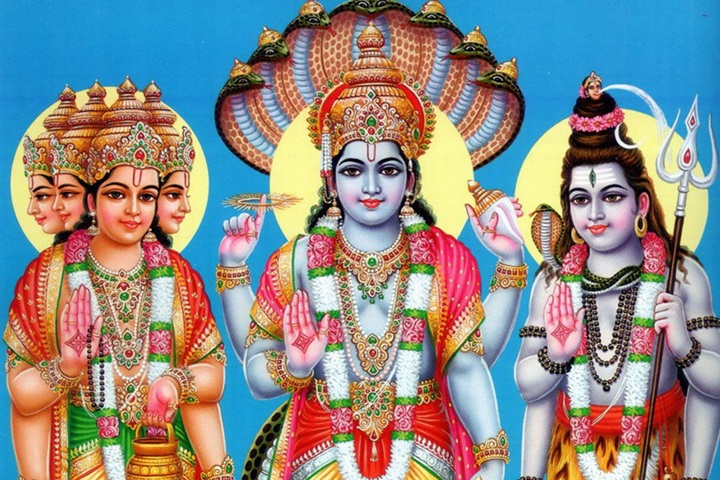
The Hindu Trimurti—Brahma the creator, Vishnu the preserver, and Shiva the destroyer—appears at first glance to resemble a trinitarian concept.
However, Hindu theology varies widely; sometimes these deities are seen as three aspects of the ultimate reality Brahman, and sometimes as wholly separate gods.
In either case, this is not the same as the Christian Trinity, which teaches neither three gods nor one God who merely takes on three “roles.”
4. Greek Philosophy
Among pre-Christian ideas, Greek philosophical thought comes closest to offering a conceptual parallel.
In Neoplatonism, for example, ultimate reality unfolds as:
- The One,
- The Divine Mind (Nous),
- The World Soul.
This triad is not a Trinity, but it is an attempt to explain how unity and diversity coexist within the divine.
Early Christian theologians were influenced by Greek philosophical categories, though the content of the Trinity came from Christian revelation, not pagan religion.
Triads in Greek Mythology
Greek mythology is especially rich in triadic symbolism. Several prominent examples include:
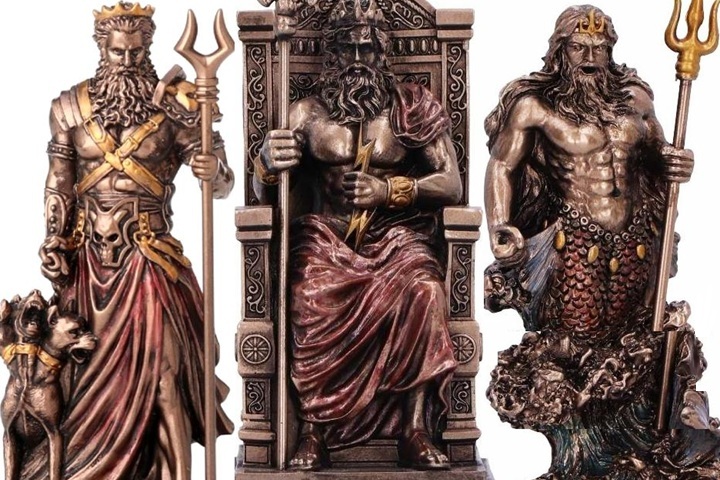
1. Zeus, Poseidon, and Hades
The three sons of Cronus divided the universe among sky, sea, and underworld. Though they are brothers, they remain three separate gods, each ruling a distinct domain.
2. The Moirai (Fates)
Clotho, Lachesis, and Atropos together govern human destiny. They function collectively, but they are fully distinct entities.
3. The Charites (Graces) and The Erinyes (Furies)
These triple goddesses represent beauty and vengeance respectively. Their grouping emphasises harmony or collective force, not unity of being.
4. Hecate, the Triple-Form Goddess
Hecate is sometimes portrayed as a single goddess with three faces or aspects, representing the crossroads, magic, and night.
Among Greek deities, she comes closest to a “three-in-one” motif, yet this is still a case of one goddess with three manifestations, which resembles modalism, a belief that Christianity itself rejects.
Are These Triads same as the Trinity?
Across these traditions, triads fall into two categories:
1.Three separate gods grouped together.
This is seen in Zeus, Poseidon, and Hades; the Fates; the Graces; and many others.
These examples are purely polytheistic.
2.One deity expressed in three forms or phases.
This appears in depictions of Hecate or certain Hindu interpretations of the Trimurti.
This resembles the idea of God showing Himself in different “modes,” which Christianity explicitly denies.
The Christian Trinity, by contrast, claims something distinct:
- One God
- Three distinct Persons
- Co-equal, co-eternal, and sharing one divine essence
No pre-Christian religion expresses this specific and carefully balanced doctrine.
Cultural triads may have helped early Christians explain the Trinity, but they did not create it.
Summary
Triads in ancient religions—from Greek mythology to Egyptian theology—demonstrate that the number three carried symbolic and religious significance long before Christianity.
These earlier triads often represented balance, completeness, or cosmic order. However, none of them taught the uniquely orthodox Christian belief in one God existing eternally as Father, Son, and Holy Spirit.
Rather than borrowing from earlier mythology, Christian thinkers drew from Scripture and early Christian experience of God while using familiar philosophical language to articulate their belief.
Understanding these similarities and differences helps students appreciate both the richness of ancient religious thought and the distinctiveness of the Christendom doctrine of the Trinity.
Is Trinity in the Bible?
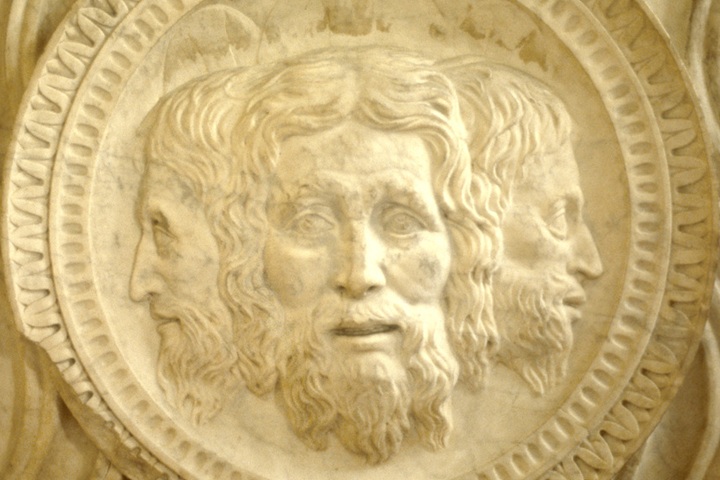
However, many theologians acknowledge two important facts:
1.The word “Trinity” does not appear anywhere in the Old Testament or New Testament.
2.The fully developed concept of the Trinity—as defined in later Christian creeds—also does not explicitly appear in the Bible.
This is a key topic in biblical and theological studies.
Below is a clear explanation that you can use for teaching or essays.
Does the Bible Contain the Trinity? What Theologians Actually Say
1. The word “Trinity” is not in the Bible
Almost all Christian theologians agree:
The term “Trinity” (Latin: Trinitas) and the formula “one God in three co-equal, co-eternal Persons” do not appear in Scripture.
The word was first used by Tertullian in the early 3rd century AD—almost 200 years after the New Testament was completed.
2. The full doctrine of the Trinity is not explicitly stated in Scripture
The Athanasian Creed (4th–5th century) and Nicene Creed (AD 325, 381) express a developed doctrine:
- one essence
- three persons
- co-equality
- co-eternity
- no mixing, no dividing
No biblical passage presents this systematic doctrine.
3. So why do Christians still claim the Trinity is biblical?
Most mainstream theologians argue that the raw ingredients for the Trinity are present in Scripture, even if the formal doctrine came later.
They point to passages like:
Old Testament “hints”
- God’s Spirit active in creation (Genesis 1:2)
- “Let us make man in our image” (Genesis 1:26) — though debated
- The “Angel of the Lord” acting as God
These are not trinitarian on their own, but some Christians see them as shadows or foreshadowings.
New Testament foundations
The New Testament gives a more complex picture:
a. Jesus is described as divine
- John 1 (“the Word was God”)
- Thomas: “My Lord and my God” (John 20:28)
- Colossians 1:15–20 (Christ as creator)
b. The Holy Spirit is also depicted as divine
- Acts 5:3–4 equates lying to the Spirit with lying to God
- The Spirit creates, teaches, guides, empowers
c. All three appear together
- Jesus’ baptism: Father speaks, Son is baptized, Spirit descends (Matthew 3:16–17)
- The Great Commission: “baptizing them in the name of the Father, Son, and Holy Spirit” (Matthew 28:19)
These passages do not define the Trinity, but they create what theologians call a trinitarian pattern.
4. So when did the full doctrine arise?
Most scholars say:
- 1st century: The New Testament has raw material but no doctrine.
- 2nd century: Early Christians debate Jesus’ divinity.
- 3rd century: Tertullian uses the word Trinitas.
- 4th century: The Councils of Nicaea (325) and Constantinople (381) formally define the Trinity.
So the doctrine is:
- post-biblical in wording
- post-biblical in structure
- based on biblical interpretations
5. What theologians mean when they say “the Trinity is biblical”
They do NOT mean:
- “The Bible uses the word Trinity,” or
- “The Bible gives a formal definition.”
They DO mean:
- “The Bible reveals God as Father, Son, and Spirit, and the doctrine of the Trinity explains that revelation.”
6. What theologians mean when they say “the Trinity is not in the Bible”
They mean:
- The Bible does not contain a complete, explicit doctrine.
- The Trinity was formulated later to make sense of the biblical witness.
- The Bible never says, “God is three persons in one essence.”
Conclusion
The word Trinity and the fully developed doctrine do not appear in the Old or New Testament.
However, many theologians argue that the New Testament presents God in a triadic pattern, which later Christians systematized into the doctrine of the Trinity in response to controversies about the identity of Jesus and the nature of God.