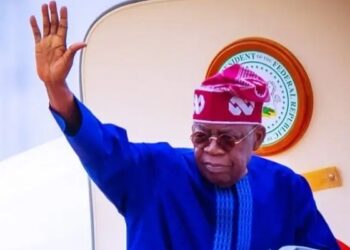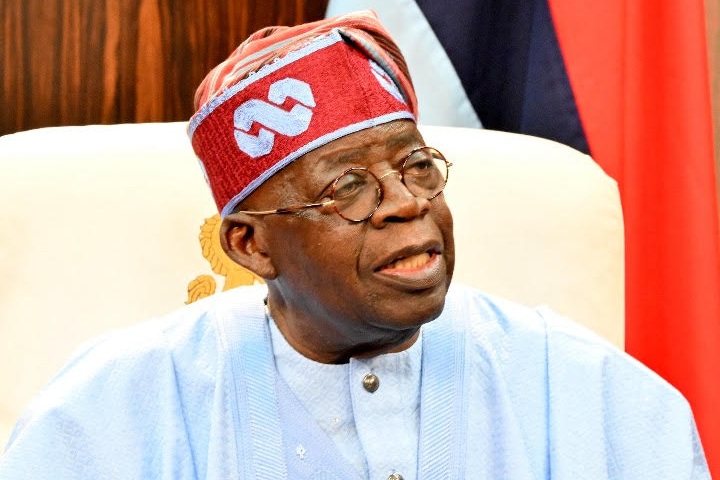
THIS DAWN — President Bola Ahmed Tinubu on Friday presented the ₦58.18 trillion 2026 Appropriation Bill to a joint session of the National Assembly, declaring that the new fiscal year will mark a decisive reset in Nigeria’s budget.

The President vowed that his administration would enforce stronger discipline in budget execution, end the era of overlapping budgets, and ensure that government spending translates into tangible improvements in the lives of Nigerians.
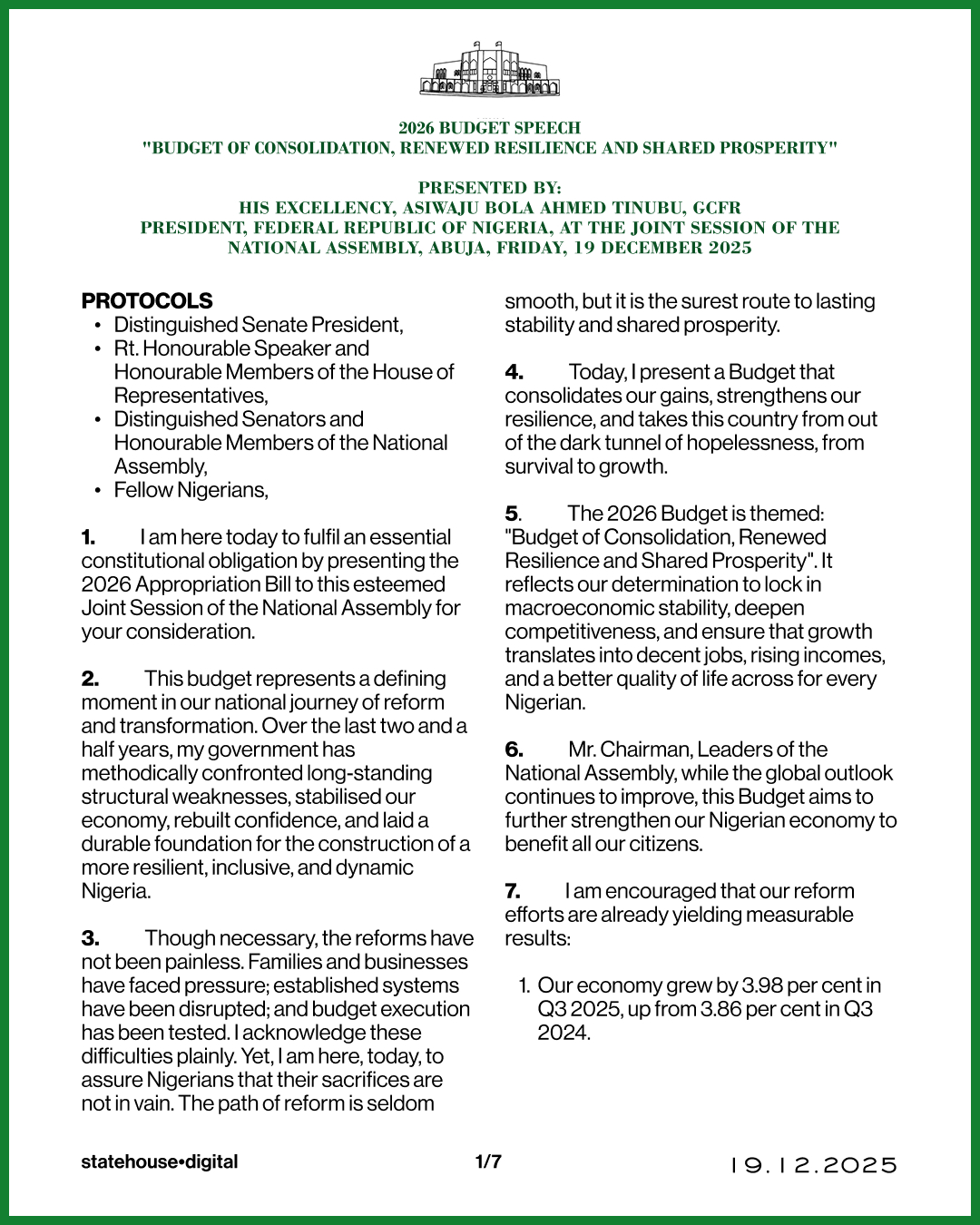
A Budget of “Consolidation, Renewed Resilience and Shared Prosperity”
The 2026 Appropriation Bill, christened the Budget of Consolidation, Renewed Resilience and Shared Prosperity, is designed to build on recent economic reforms and stabilising macroeconomic indicators.
Tinubu told lawmakers that the budget aims to consolidate gains from difficult policy choices, restore public trust in governance, and deliver results that Nigerians can feel in their households and communities.
“Before I go any further, let me be upfront. This is a reset, a very hard one,” the President said.
He stressed that the country must abandon the long‑standing practice of running multiple budgets simultaneously.
He declared that by March 31, 2026, all outstanding capital liabilities from previous years will be fully funded and closed.
Afterwards, he said, Nigeria will operate on a single budget backed by a single revenue cycle. “No overlaps, no excuses, no rollovers,” he emphasised.
Ending Fiscal Indiscipline
Tinubu lamented that the practice of piling up contractual obligations and running three budgets on one inflow has undermined effective governance and economic planning.
He said the new approach will enforce fiscal discipline and sustainable development.
To achieve this, he directed the Minister of Finance and Coordinating Minister of the Economy, the Minister of Budget and Economic Planning, the Accountant General of the Federation, and the Director General of the Budget Office to ensure strict adherence to appropriated details and timelines.
The President acknowledged that the 2025 budget implementation faced challenges of transition and competing demands.
As of the third quarter of 2025, Nigeria recorded ₦18.6 trillion in revenue, representing 61 percent of the target, and ₦24.66 trillion in expenditure, representing 60 percent of the target.
Only ₦3.10 trillion — about 17.7 percent of the 2025 capital budget — was released by Q3, reflecting the government’s emphasis on completing priority 2024 capital projects during the transition.
“2026 will be a year of stronger discipline in budget execution,” Tinubu declared.
He added that improved revenue performance is expected through the new National Tax Acts and reforms in the oil and gas sector, which are designed not just to raise revenue but to drive transparency, efficiency, fairness, and long‑term value.
Warning to Government-Owned Enterprises
Tinubu issued a stern warning to Government-Owned Enterprises (GOEs) and revenue-generating agencies, saying underperformance will no longer be tolerated.
“Nigeria can no longer afford leakages, inefficiencies, or underperformance in strategic agencies,” he said.
Heads of GOEs are now mandated to meet assigned revenue targets, with digitisation of revenue mobilisation to seal leakages and ensure verifiable compliance.
Standardised e‑collections, interoperable payment rails, automated reconciliation, and real‑time performance dashboards will be deployed, forming part of institutional scorecards and performance evaluations.
Economic Indicators Show Progress
The President highlighted recent economic indicators as evidence of reform gains.
Nigeria’s economy grew by 3.98 percent in Q3 2025, compared to 3.86 percent in the same period of 2024.
Inflation moderated for eight consecutive months, declining to 14.45 percent in November 2025 from 24.23 percent in March.
Oil production improved, non‑oil revenues expanded through better tax administration, investor confidence was renewed, and external reserves rose to a seven‑year high of about US$47 billion.
“These outcomes are not accidental. They reflect difficult but deliberate policy choices,” Tinubu said.
Fiscal Framework of the 2026 Budget
The 2026 Budget projects total expenditure of ₦58.18 trillion and expected revenue of ₦34.33 trillion.
Capital expenditure is estimated at ₦26.08 trillion, while recurrent non‑debt expenditure stands at ₦15.25 trillion.
Debt servicing is projected at ₦15.52 trillion, with a budget deficit of ₦23.85 trillion, representing 4.28 percent of GDP.
The budget is anchored on conservative assumptions: a crude oil benchmark of US$64.85 per barrel, daily oil production of 1.84 million barrels, and an exchange rate of ₦1,400 to the US dollar.
Tinubu said these assumptions reflect realism, prudence, and fiscal sustainability.
Key Priorities: Security, Infrastructure, Education, Health, Agriculture
Tinubu identified security, infrastructure, education, health, and agricultural productivity as the key priorities of the 2026 budget.
Proposed allocations include ₦5.41 trillion for defence and security, ₦3.56 trillion for infrastructure, ₦3.52 trillion for education, and ₦2.48 trillion for health.
He stressed that these priorities are interconnected: “Without security, investment will not thrive,” he said.
He added that educated and healthy citizens are essential for productivity and economic growth.
Security and Counter-Terrorism Doctrine
On security, Tinubu announced the establishment of a new national counter‑terrorism doctrine to confront terrorism, banditry, kidnapping for ransom, and other violent crimes.
“Our administration is resetting the national security architecture and establishing a new national counterterrorism doctrine — a holistic redesign anchored on unified command, intelligence, community stability, and counter‑insurgency,” he said.
The President vowed that the government will show no mercy to terrorists and violent criminal elements.
Health Sector Boost
Tinubu welcomed over US$500 million in grant funding secured through recent engagements with the United States government for targeted health interventions across Nigeria.
He described the support as a decisive vote of confidence in Nigeria’s reform agenda and health sector priorities.
The 2026 budget reinforces investments in healthcare delivery, disease prevention, maternal and child health, and health system strengthening, with accountability in the use of both domestic and international resources.
“A healthy population is essential to productivity, economic growth, and national resilience,” Tinubu said.
Infrastructure and Food Security
The President reaffirmed that projects under the Renewed Hope Agenda are steadily moving from vision to reality nationwide, with progress in transport and energy infrastructure, port modernisation, agricultural reforms, and strategic investments to unlock private capital.
Infrastructure development, he said, is critical to reducing the cost of doing business, expanding market access, creating jobs, and improving quality of life.
Food security remains a national priority.
The 2026 budget focuses on input financing and mechanisation, irrigation and climate‑resilient agriculture, storage and processing, and agro value chains.
“These measures will reduce post‑harvest losses, improve incomes for smallholders, deepen agro‑industrialisation, and build a more resilient, diversified economy,” Tinubu explained.
2026 Budget Restore Public Trust
Tinubu underscored that the focus on discipline and delivery is aimed at restoring public trust in the budget process.
“The greatest budget is not the one we announce. It is the one we deliver,” he said.
He commended Nigerians for their resilience and assured them that his administration remains committed to easing the burdens of transition to a more stable and prosperous nation.
“We promise to make sure that the benefits of reform reach households and communities across the Federation,” he concluded.
See page one of the seven-page speech below