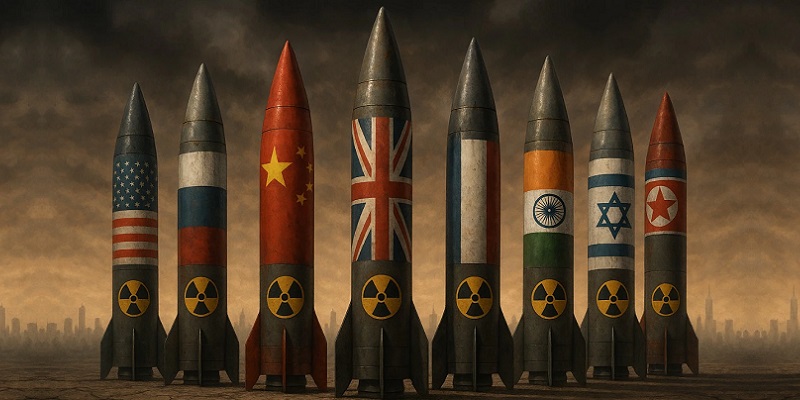
TDThe expiration of the New Strategic Arms Reduction Treaty (New START) next week will mark the end of more than half a century of nuclear arms control between the United States and Russia, raising alarms about a potential three-way arms race involving China.

The treaty, signed in 2010 and extended in 2021, limited each side to 1,550 deployed strategic warheads and established mechanisms for inspections, data exchanges, and compliance monitoring.
Its demise leaves the world’s two largest nuclear powers without any binding restrictions for the first time in decades.
Silence in Washington
Despite the gravity of the moment, the Trump administration has said little about the treaty’s expiration.
Congress has also remained largely quiet, with only a handful of Democrats delivering speeches earlier this month to highlight the risks of entering a world without nuclear limits.
President Trump, when asked about the treaty’s end, responded: “If it expires, it expires. We’ll do a better agreement.”
Yet analysts warn that no negotiations are currently underway, and the likelihood of a new deal appears slim.
A Dangerous New Era
The Bulletin of the Atomic Scientists recently moved its symbolic Doomsday Clock to 85 seconds before midnight, the closest it has ever been to global catastrophe.
The decision reflects growing fears that the absence of arms control will trigger rapid nuclear buildups.
For decades, nuclear arsenals steadily declined.
In 1986, the global stockpile peaked at 70,400 warheads; today, that number has dropped to about 12,500, thanks to successive agreements between Washington and Moscow.
New START was the last in a long line of treaties that began with the Strategic Arms Limitation Talks (SALT) in 1969.
Without New START, the restraints that kept arsenals in check will vanish. Analysts warn that the U.S., Russia, and China could embark on dangerous expansions, each seeking to outpace the other.
Trump’s Mixed Signals
President Trump has repeatedly voiced support for reducing nuclear weapons, even suggesting full denuclearization if Russia agreed to reciprocate. Yet his administration’s actions tell a different story.
- The State Department’s nuclear diplomacy staff was cut significantly.
- Trump openly discussed resuming nuclear testing, breaking a decades-long moratorium.
- The Pentagon has studied ways to add more warheads to existing missiles, reviving Multiple Independently targetable Re-entry Vehicle (MIRV) technology.
Currently, U.S. intercontinental ballistic missiles (ICBMs) carry one warhead each. With Trump’s approval, the military could “upload” additional warheads from storage, installing them onto the 400 ICBMs stationed across five Great Plains states.
Russia and China’s Expanding Arsenals
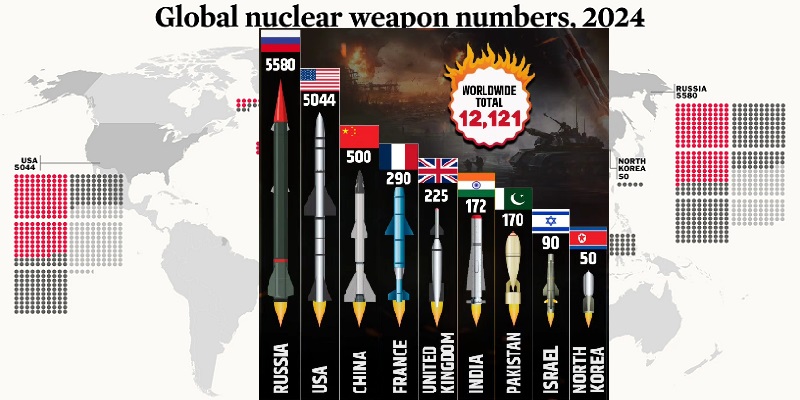
Russia never abandoned MIRV technology and could quickly expand its arsenal by installing stored warheads onto existing missiles. “They can sprint away from us in an upload campaign while we’re still struggling to get the technical wherewithal in place,” warned Rose Gottemoeller, chief U.S. negotiator for New START.
China, meanwhile, is undergoing a rapid nuclear buildup. Though it possesses far fewer warheads — an estimated 600 compared to America’s 3,700 and Russia’s 4,300 — Beijing is expanding at Cold War–level rates. Unlike Washington and Moscow, China has never signed an arms control agreement limiting its arsenal.
U.S. hawks argue that America should field as many nuclear weapons as Russia and China combined to maintain deterrence. This strategy, however, would require significant time and resources.
Risks of Escalation
Analysts warn that if the U.S. expands first, Russia will likely respond in kind. “It’s possible they would frame it as: ‘The Americans are the bad guys. They are building up their forces. We reserve the right to respond the same way,’” said Pavel Podvig, a Geneva-based expert on Russian nuclear forces.
Past treaties helped prevent such escalations by providing transparency and predictability. While imperfect, New START offered valuable insight into each side’s arsenal and intentions. Its end removes a critical safeguard at a time of heightened geopolitical tensions.
Putin’s Offer Left Unanswered
Russian President Vladimir Putin suspended his country’s participation in New START in 2023, citing U.S. support for Ukraine. However, he pledged to continue adhering to the treaty’s numerical limits and expressed willingness to extend them.
Trump has not responded to this offer, leaving a potential path for continued restraint unexplored. Analysts argue that even a one-year extension, coupled with restored inspections, could buy time for diplomacy and reassure allies in Europe.
Imperfect but Valuable
New START does not cover Russia’s tactical nuclear weapons or newer systems like the Poseidon submarine drone. Yet experts stress that the treaty still holds immense value. It kept Washington and Moscow engaged in dialogue, even when relations soured.
Without it, military planners on all sides must prepare for worst-case scenarios, increasing the risk of miscalculation.
Public Opinion Strongly Favors Limits
Despite the lack of political urgency, public opinion overwhelmingly supports arms control. A YouGov poll of 1,000 registered voters found 91 percent favor maintaining or reducing nuclear limits. Even if Americans are unfamiliar with New START by name, they recognize the importance of agreements that prevent unchecked buildups.
A Closing Window
The expiration of New START underscores the unraveling of Cold War–era arms control. With no new negotiations in sight, the world faces the prospect of unconstrained arsenals for the first time in decades.
“The world has come too far to allow the progress of the past half-century to slip away,” Hennigan wrote. “Without a new agreement, each side’s military is forced to plan for the worst. There’s a window of time to act. It might be closing fast, but it’s worth trying.”
The opinion article “The End of Nuclear Arms Control” was originally published in The New York Times.