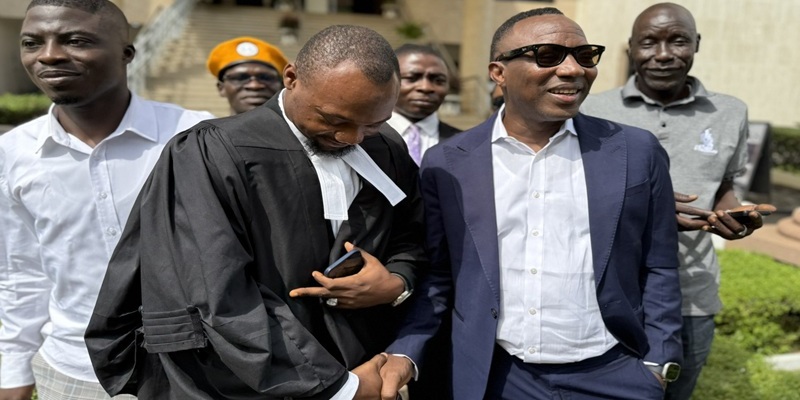

Omoyele Sowore clashed with a Senior Advocate of Nigeria at the Federal High Court in Abuja before his cyberstalking trial, igniting debate on free speech, activism, and courtroom protocol in Nigeria.
Abuja, Nigeria — March 24, 2026: A dramatic confrontation erupted Tuesday morning at the Federal High Court in Abuja.
when activist and publisher Omoyele Sowore engaged in a heated exchange with a Senior Advocate of Nigeria (SAN) ahead of his cyberstalking trial.
The case, centered on Sowore’s online posts labeling President Bola Tinubu a criminal, has already drawn widespread public interest and scrutiny.
The clash unfolded before the judge arrived, as Sowore addressed reporters inside the courtroom.
The SAN objected sharply, declaring that in over 30 years of legal practice he had never witnessed such conduct.
He insisted that courtrooms demand order and sanity, and that speaking to the press within the courtroom was improper.
Sowore countered, arguing that no law prohibits speaking to journalists before proceedings officially begin.
His defiance drew a crowd of lawyers, court staff, and observers, intensifying the atmosphere and sparking debate about the boundaries of courtroom protocol.
This incident underscores the broader tensions between activism and state authority in Nigeria.
Sowore, a former presidential candidate and outspoken critic of government policies, has long positioned himself as a defender of free speech and democratic accountability.
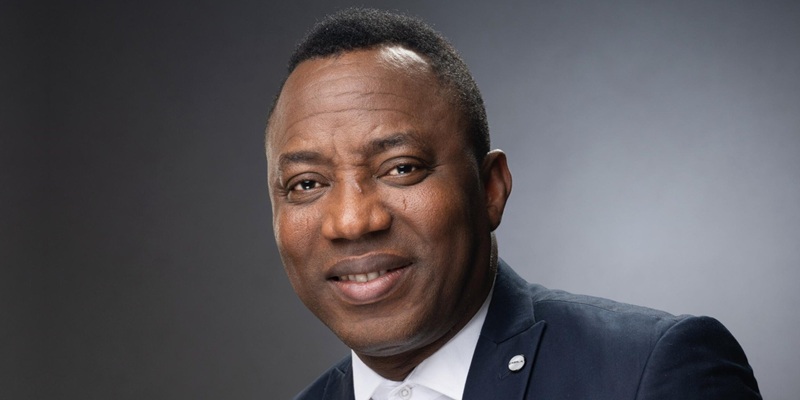
His trial over alleged cyberstalking highlights the growing friction between digital activism and legal restrictions in an era where social media amplifies dissenting voices.
Legal analysts are divided. Some argue Sowore’s actions reflect a legitimate push for transparency and public engagement, while others see them as disruptive and disrespectful to established norms of judicial conduct.
The confrontation has reignited discussions about whether Nigeria’s courts should adapt to the realities of modern political activism or maintain strict adherence to tradition.
Observers note that the case is emblematic of Nigeria’s ongoing struggle to balance constitutional rights with institutional order.
As Sowore’s trial proceeds, it is expected to test the judiciary’s stance on free expression and its willingness to accommodate activism within the bounds of law.
The outcome of Sowore’s trial may shape how Nigeria handles activism, free speech, and courtroom conduct in the future.