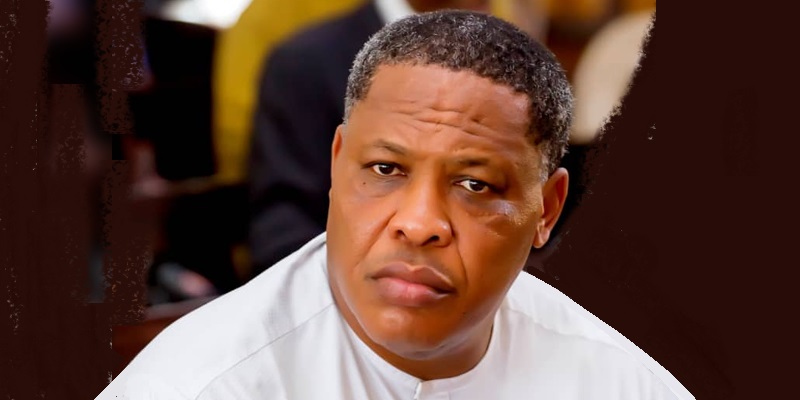
THIS DAWN — Rt. Hon. Obi Aguocha, Member representing Ikwuano, Umuahia North, and Umuahia South Federal Constituency of Abia State, issued a strongly worded statement condemning Governor Chukwuma Charles Soludo’s decision to shut down Onitsha Main Market for one week.

Hon. Aguocha’s remarks added new twist to the controversy surrounding Governor Soludo’s shut down order on the Onitsha market.
In an online media release, Aguocha accused Soludo of reigniting tensions in the South-East through what he described as “misguided ordinances and actions” aimed at ending the Monday sit-at-home practice.
Background: Soludo’s Market Closure
Governor Soludo had earlier ordered the closure of Onitsha Main Market for one week after traders failed to open for business on Monday, January 26, 2026.
Soludo noted that the failure was in defiance of repeated directives abolishing the sit-at-home practice.
The sit-at-home was originally linked to separatist agitations and security concerns.
It has been officially outlawed by the Anambra State Government as part of efforts to restore normalcy and boost economic activity.
Soludo has consistently warned that non-compliant markets, shops, or plazas would face sealing for one week, with longer sanctions for repeated violations.
The closure of Onitsha Main Market—one of Nigeria’s largest commercial hubs—was intended to send a strong message against lingering adherence to the sit-at-home order.

Aguocha’s Criticism
According to Aguocha, Soludo’s enforcement strategy has inadvertently “unleashed an army of silent agitators” who had previously helped reduce the significance of the sit-at-home ritual.
He noted that over the past three years, many markets, plazas, and shopping centres across the South-East had gradually returned to normalcy, operating freely without intimidation.
“I have worked tirelessly in this direction, and peace was steadily returning to our rural and commercial trading centres.
“But the Governor’s well-intentioned effort has been executed in the most unconstructive and unacceptable manner,” Aguocha said.
He warned that the punitive closure of Onitsha Main Market could rekindle old resentments, harden resistance, and plunge the region into renewed violence, serious crimes, and widespread criminality.
Rights of Business Owners
Aguocha argued that Soludo’s directive infringes on the fundamental rights of private business owners.
He stressed that no governor has the authority to compel traders to open or close their shops.
“Would the Governor also invoke the same punitive measures against those who choose to close their shops early on Wednesdays to attend mid-week religious services?” Aguocha asked rhetorically.
“Such decisions fall squarely within their rights and are not governed by any state, labour, or market-union relationship,’ he noted.
Wider Political Context
The lawmaker linked the persistence of sit-at-home observance to deeper political grievances, including what he described as:
- the continued detention of Mazi Nnamdi Kanu,
- alleged bias in Nigeria’s criminal justice system,
- ongoing Christian genocide, and,
- marginalisation, and entrenched hostility against the Igbo people.
He warned that unless these root causes are addressed, the South-East would remain locked in a “vicious cycle of resentment against the Nigerian state.”
“No reasonable person or political party should expect Igbo votes by any means whatsoever—whether coerced, manipulated, or compelled.
“Our votes will count. We will defend them, even at the cost of our lives,” Aguocha declared.
Call for Calm and Resistance
Despite his fiery rhetoric, Aguocha urged residents to remain calm and avoid the destruction of lives and property.
However, he encouraged them to stand firm and protest for their fundamental rights.
“As your representative, I bear the responsibility of choosing the best path to our cherished freedom and leading you along it.
“I pledge today to discharge this responsibility with every measure of strength and wisdom at my disposal—guided by your hopes, mindful of your concerns, and sustained by your prayers,” he said.
He concluded with a rallying cry: “Enough is enough!”
Aguocha’s intervention highlights the growing tension between state enforcement measures and grassroots political realities in the South-East.
Soludo, on one hand, insists on restoring full economic activity on Mondays.
However, critics like Aguocha argue that punitive closures risk inflaming deeper grievances tied to political exclusion and unresolved justice issues.
The clash underscores the delicate balance between governance, rights, and regional sensitivities as Nigeria heads toward the 2027 elections.