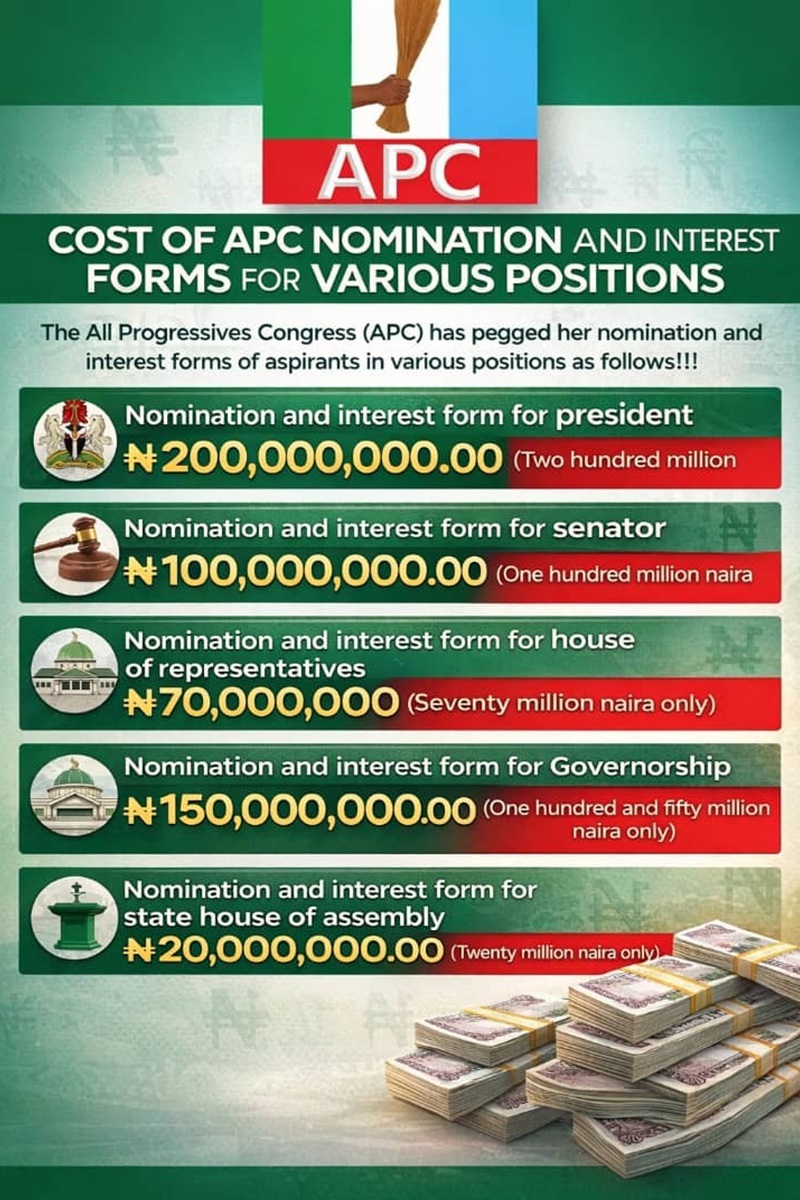
TDThe All Progressives Congress (APC) has announced jaw-dropping costs for its nomination and interest forms, sparking outrage across Nigeria.

The Price Tag
- President: ₦200 million
- Governor: ₦150 million
- Senator: ₦100 million
- House of Representatives: ₦70 million
- State House of Assembly: ₦20 million
These figures have stunned observers, with many describing them as a direct assault on democratic participation.
Voices of Outrage
Civil society groups and political analysts wasted no time in condemning the fees:
- Centre for Democracy and Development (CDD): “This is a democracy for billionaires. Ordinary Nigerians are being priced out of leadership.”
- Youth Rights Campaign (YRC): “How can young people or grassroots activists ever dream of contesting when the entry fee is higher than what most Nigerians will earn in a lifetime?”
- Political Analyst, Lagos: “Such fees encourage corruption. Candidates will see politics as an investment to be recouped, not service to the people.”
Implications for Nigerians
- Exclusion of the Poor: The fees effectively block middle-class and grassroots aspirants.
- Elite Capture: Politics risks becoming the exclusive playground of wealthy businessmen and political godfathers.
- Public Trust: Nigerians already skeptical of political elites may see this as proof that governance is for sale.
Wider Context
While nomination fees have always been high in Nigerian politics, APC’s latest figures are unprecedented. Analysts warn that this could set a dangerous precedent, pushing other parties to follow suit and deepening inequality in political access.
The APC’s announcement has ignited a storm of criticism, with many Nigerians questioning whether democracy is being auctioned off to the highest bidder. As one activist bluntly put it: “This is not democracy—it’s plutocracy.”
Comparative Nomination Fees
The APC’s nomination fees are the highest among Nigeria’s major parties, with presidential aspirants asked to pay ₦200 million compared to the PDP’s ₦35 million and Labour Party’s ₦15 million.
This stark contrast has fueled outrage, with critics warning that APC’s pricing entrenches elite dominance and undermines democratic access.
See table below:
| Position | APC Fees | PDP Fees | Labour Party Fees |
|---|---|---|---|
| President | ₦200 million | ₦35 million | ₦15 million |
| Governor | ₦150 million | ₦20 million | ₦10 million |
| Senator | ₦100 million | ₦3.5 million | ₦1.5 million |
| House of Representatives | ₦70 million | ₦2.5 million | ₦1 million |
| State House of Assembly | ₦20 million | ₦600,000 | ₦200,000 |
Public Reaction
- Civil Society Groups: Condemn APC’s fees as “anti-democratic” and “a plutocracy masquerading as democracy.”
- Analysts: Warn that such costs incentivize corruption, as candidates may view politics as an investment to recoup.
- Youth Activists: Argue that the fees effectively exclude young Nigerians and grassroots leaders from contesting.
Implications for Political Landscape
- Economic Inequality: APC’s fees are nearly six times higher than PDP’s and over ten times Labour’s, deepening exclusion.
- Elite Capture: Politics risks becoming the preserve of wealthy businessmen and political godfathers.
- Public Trust: Nigerians already skeptical of political elites see this as proof that governance is for sale.
Context
- APC: Justified the fees as necessary to “screen serious aspirants,” but critics say it prioritizes wealth over merit.
- PDP & Labour Party: Though not cheap, their fees are significantly lower, allowing broader participation.
- Trend: Rising costs across parties reflect a dangerous shift toward monetized politics, where financial muscle outweighs competence.
The APC’s ₦200 million presidential nomination fee dwarfs those of PDP and Labour Party, sparking outrage and raising urgent questions about the affordability of democracy in Nigeria. As one activist bluntly put it: “This is not democracy—it’s plutocracy.”