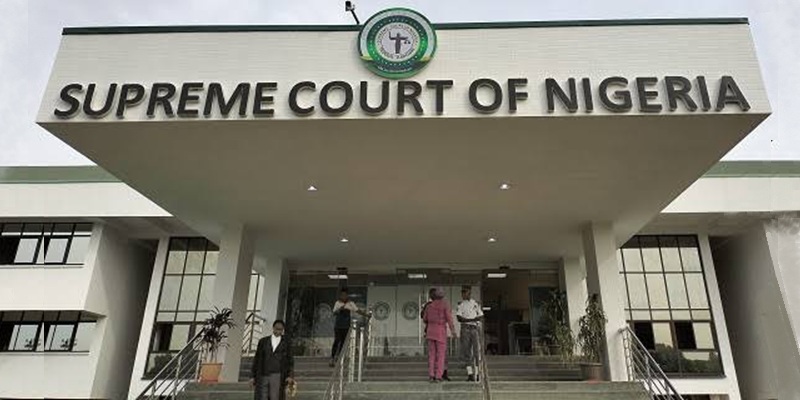
TDOn March 21, 2025, the Supreme Court of Nigeria delivered a landmark judgment in Senator Samuel Anyanwu v. Sunday Udey-Okoye & Peoples Democratic Party (PDP).

The apex court reinstated Senator Samuel Anyanwu as the authentic National Secretary of the PDP, overturning earlier decisions of the Federal High Court and Court of Appeal.
The principle established was clear: internal political party affairs, including leadership disputes, are not justiciable in court.
Justice Jamilu Tukur, delivering the lead judgment, emphasized that courts lack jurisdiction to interfere in matters purely internal to political parties.
Leadership disputes, he noted, must be governed by party constitutions, congresses, conventions, or arbitration panels—not judicial intervention.
This ruling set a binding precedent, curtailing judicial overreach and reinforcing party autonomy.
Supreme Court Ruling’s Implications for Political Parties and INEC
For Political Parties
- Leadership disputes must be resolved internally.
- Courts cannot be used as battlegrounds for factional struggles.
- Party constitutions and conventions remain the ultimate authority.
For INEC
- The Commission must respect party autonomy.
- INEC’s role is limited to monitoring compliance with electoral laws.
- It cannot adjudicate or interfere in internal party disputes unless expressly mandated by the Constitution or statute.

For Nigerian Democracy
- Reinforces separation of powers.
- Prevents abuse of judicial processes by politicians.
- Strengthens democratic institutions by ensuring parties manage their own affairs.
INEC’s Controversial Action in ADC Crisis
Despite this clear Supreme Court ruling, the Independent National Electoral Commission (INEC) recently took steps that appear inconsistent with the principle of non-interference.
The dispute within the African Democratic Congress (ADC) involved two factions:
- Senator David Mark’s group
- Hon. Nafiu Bala Gombe’s group
Following a Court of Appeal judgment dismissing David Mark’s appeal and ordering all parties to maintain the status quo, INEC issued a press statement outlining its position.
INEC’s Key Measures
- Status Quo Maintained
- INEC reverted to the situation before September 2, 2025.
- No recognition of any disputed leadership claims.
- No Recognition of Either Side
- Refused to recognise Gombe as Acting Chairman.
- Effectively stepped back from recognising David Mark’s group.
- Freeze on Party Engagement
- INEC will not accept communications from any faction.
- It will not monitor or attend ADC meetings, congresses, or conventions.
- No validation of actions by either group.
- Removal from INEC Portal
- Names of the current ADC leadership (David Mark’s group) were removed from INEC’s official records.
Why INEC’s Action Contradicts Supreme Court Ruling
The Supreme Court has already established that internal party affairs are not justiciable.
By removing ADC leadership names from its portal and suspending recognition of the party’s leadership, INEC effectively inserted itself into an internal dispute.
This action goes beyond INEC’s constitutional mandate, which is limited to monitoring compliance with electoral laws.
The Commission is not empowered to freeze party operations or determine leadership legitimacy in the absence of a final judicial pronouncement.
The Court of Appeal’s directive was clear: maintain the status quo and avoid prejudicing the final judgment.
INEC’s decision to suspend recognition and delete leadership records arguably prejudices the matter, undermining the principle of neutrality.

Related Judicial Precedents
The Supreme Court had earlier ruled in ENANG v. ASUQUO (2023), involving APC primaries in Akwa Ibom, that courts must exercise caution in interfering with internal party matters unless they directly affect constitutional or statutory provisions.
This reinforces the principle that both courts and INEC must avoid meddling in disputes that are strictly internal to political parties.
INEC’s intervention in the ADC crisis—removing leadership names and suspending recognition—appears inconsistent with this principle.
Strategic Implications of Supreme Court Judgment
- For ADC: INEC’s freeze has effectively paused the party’s operations, pending resolution at the Federal High Court.
- For INEC: The Commission risks overstepping its mandate and contradicting Supreme Court precedent.
- For Democracy: Such actions could set a dangerous precedent, allowing INEC to interfere in party affairs under the guise of neutrality.
The Supreme Court’s ruling in Anyanwu v. PDP is now the leading authority affirming that political party affairs are not justiciable.
By dabbling into internal party disputes, INEC risks undermining the autonomy of political parties and contradicting the apex court’s binding precedent.
The Commission must realign its actions with constitutional boundaries.
It must ensure that Nigerian democracy remains anchored on the rule of law and respect for party independence.