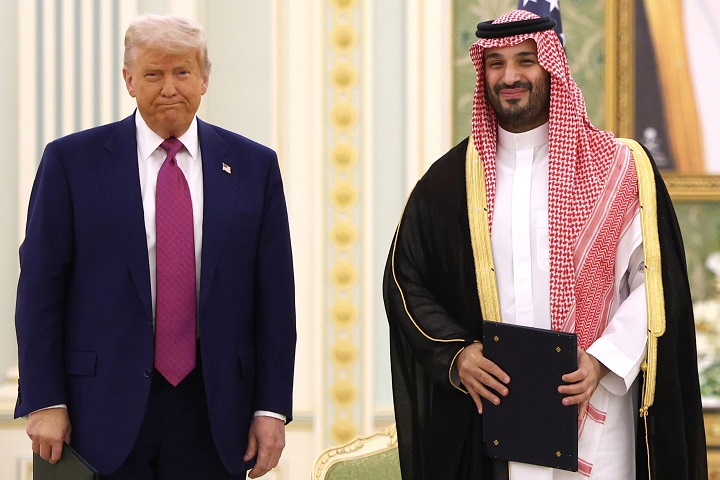
TDSaudi Crown Prince Mohammed bin Salman has urged U.S. President Donald Trump to maintain pressure on Iran.

Salman also called for sustained military operations and even strikes on Iranian energy infrastructure in a statement issued on Tuesday in Riyadh.
The Crown Prince’s appeal, analysts note, underscores Riyadh’s determination to weaken Tehran’s hard-line government and secure Gulf stability amid escalating regional tensions.
The conflict had begun on February 28, when U.S. and Israeli forces launched coordinated attacks on Iran’s military and nuclear facilities.
Iran retaliated with missile strikes and disruptions in the Strait of Hormuz, a vital global oil artery.
The move sparked fears of prolonged instability and driving energy prices sharply upward.
President Trump has sent mixed signals—reinforcing U.S. troop deployments while simultaneously floating the possibility of negotiations.
Saudi officials, for their part, continue to publicly emphasize diplomacy, even as military operations intensify behind the scenes.
Not Declaration of War
Social media claims that Saudi Arabia and the United Arab Emirates (UAE) have formally declared war on Iran are false.
Investigations shows that neither Gulf state has issued an official declaration of war.
Instead, both countries have taken significant steps that align them more closely with the U.S.-Israel campaign against Tehran.
Riyadh has granted the U.S. military access to King Fahd Air Base in Taif, reversing a long-standing policy that barred operations against Iran from Saudi soil.
This move represents a major strategic shift, signaling deeper logistical cooperation with Washington.
The UAE has shuttered all Iranian-run institutions in Dubai, including schools, hospitals, and cultural centers.
Its air defense systems have also intercepted multiple projectiles launched from Iran, confirming active defensive engagement and heightened readiness.
These actions demonstrate growing alignment with U.S. and Israeli operations but remain short of a formal declaration of war.
The Bigger Picture
The U.S. and Israel are already conducting strikes against Iran, targeting military and nuclear infrastructure.
Saudi and UAE actions suggest preparations for deeper involvement, but their role remains limited to defensive measures and logistical support rather than direct offensive participation.
Iranian President Masoud Pezeshkian has condemned the escalation, warning that Gulf states risk being drawn into a wider regional war.
Meanwhile, Riyadh and Abu Dhabi are tightening their stance against Tehran, balancing between deterrence and diplomacy.
Regional analysts note that Saudi Arabia and the UAE are walking a fine line: supporting U.S. and Israeli operations without crossing the threshold into formal war declarations.
This cautious approach reflects both domestic considerations and the desire to avoid triggering broader international repercussions.
Global Outlook
Saudi Arabia and the UAE are edging closer to active involvement in the Iran conflict by granting base access, intercepting attacks, and shutting down Iranian institutions.
Yet talk of outright war declarations is misinformation.
The situation is escalating, but diplomacy and caution still frame their official positions.
Riyadh and Abu Dhabi are tightening their stance against Iran, but neither has formally declared war.
The conflict is intensifying, and while Gulf states are aligning more closely with U.S. and Israeli operations, official declarations remain absent.
This report is meant to highlight the growing complexity of the Gulf’s role in the Iran crisis—caught between military alignment and diplomatic restraint.