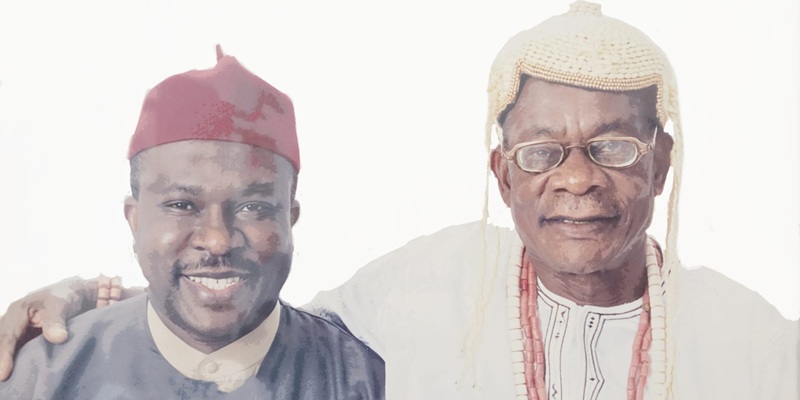
TDLorji Nwekeukwu, a community deeply rooted in tradition and legacy that traces its roots to the Aro, leadership is not merely about occupying a position — it is about preserving heritage while shaping the future.

At the center of this delicate balance stands Dr. Ugorji Okechukwu Ugorji, the Regent of Lorji Nwekeukwu Autonomous Community and a rising figure in Imo State’s evolving political landscape.
As conversations quietly build around his 2027 Governorship ambition, many in Mbaise are not just asking whether he can lead Imo State, but how he has already led his own people.
In answering that question, they return to one defining responsibility: how he has honored the legacy of his father, the late Eze Stephen Nwabueze Ugorji.
In many royal lineages, the passing of a traditional ruler often triggers succession battles, family tensions, and prolonged uncertainty. But in Lorji Nwekeukwu, the story has taken a different turn.
As the first son (Opara) of the late Eze, Dr. Ugorji stood before the council of traditional rulers in Aboh Mbaise and made an unexpected declaration— he was not interested in ascending the throne.
The declaration was sequel to his installation as Regent, entrusted with his father’s staff of office — not as a king, but as a custodian of continuity. The position has no salary or allowances attached to it.
More significantly, he affirmed that the stool was not meant to remain within one family but will rotate among the villages of the community. It is an equity thing, he declared.
That decision, widely described as selfless and stabilizing, reflected his father’s lifelong struggle for equity and freedom at Lorji.
For many elders, that moment defined his leadership philosophy: power is not to be owned, but to be preserved for the people.
To understand how Dr. Ugorji has honored his father, one must first understand the legacy he inherited.
The late Eze Stephen Nwabueze Ugorji followed the path of his (Eze Ugorji’s) own grandfather (Ugorji Onyeukwu) — credited with bringing formal western education to Lorji through what became known as the Liverpool School, now known as the Community School Lorji.
This history, documented in Eze Ugorji’s autobiography titled “Eziokwu bu ndu,” reflects a family deeply invested in education as a tool for transformation.
Today, that legacy continues. Dr. Ugorji, believed in the community to be the reincarnate of Ugorji Onyeukwu, went on to earn a Doctorate degree in Education by the age of twenty-nine (29).
Residents confirm that he has introduced incentives to boost school enrollment, encouraged families to send their children to school, paid examination fees for scores of indigenous pupils and students and strengthened the population of Community School Lorji.
For many parents, this is not just policy — it is a continuation of a generational vision. Beyond education, his contributions extend to faith and social cohesion.
Community members point to his role in supporting the establishment and sustenance of the St. Andrews Catholic Parish in Lorji, describing it as part of a broader effort to strengthen both spiritual and communal bonds, which is also a legacy left by his late traditional ruler father.
See Ugorji’s vision of the church in the near future:

Yet perhaps his most defining act of leadership came during a moment of potential division. Following his father’s passing, the community issued restrictions in some family and communal activities, in respect of the one-year mourning period for the late Eze.
The Regent was the first to obey those restrictions and incurred great expense to enforce those restrictions and respect for his father, despite resistance from some quarters.
That decision ultimately brought calm, order, discipline and respect for tradition — a move widely interpreted as a profound act of honoring his father’s memory above personal or political interests.
While rooted in tradition, Dr. Ugorji’s leadership has also introduced modern governance practices into the affairs of the community.
According to the Palace Secretary Nze Emeka Njoku, the Regent has brought accountability and transparency into the workings of the Eze-in-Council— a structure that traditionally operates on custom rather than formal administrative systems.
This transformation is echoed by Youth Leader Hon. Magnus Emenogu who highlights a series of reforms:
- Structured council sittings with improved efficiency;
- Introduction of allowances for council members;
- provision of welfare, including feeding during meetings; and,
- Increased participation and higher morale within the council.
What was once seen as a routine traditional gathering has now become a functional governance system, where participation is valued and rewarded and leadership is responsive.
For many young people in the community, this has made the council more accessible, relevant, and impactful.
Perhaps one of the most tangible demonstrations of Dr. Ugorji’s commitment lies in his handling of community welfare obligations.
According to community member Victor Chi Chi Njoku, salaries owed to vigilante officers and community school teachers — which had accumulated after the passing of the late Eze— were fully cleared under Dr. Ugorji’s regency.
More striking is the claim that he personally contributed heavily to the clearing of these community obligations.
In a rural setting where such payments directly affect security, education, and family welfare, this intervention did more than settle arrears— it restored dignity, motivation, and functionality within critical community institutions.
Unlike some regents who distance themselves from local realities, residents describe Dr. Ugorji as deeply connected to his community. Though he resides in Owerri, he is frequently in the community on a weekly basis, sometimes daily.
They say that he remains accessible and engaged, maintaining strong relationships with the tilted persons (Nzes and Chiefs) the Eze-in-Council, Youth leaders, women’s groups in the community and grassroots stakeholders.
See Ugorji’s planned sports facility for the community below: