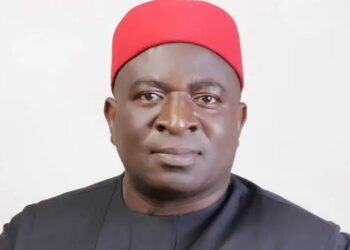
THIS DAWN — As 2025 drew to a close, Nze Tobe Osigwe, an Igbo consciousness advocate, described the sentencing of Mazi Nnamdi Kanu as one of the most remarkable developments for Ndi Igbo in the past year.

In a strongly worded reflection, Osigwe expressed gratitude to the “gods, ancestors, and the Nigerian judiciary” for what he termed a decisive step toward ending years of insecurity and disruption in the South-East.
Osigwe voiced optimism that 2026 would mark the end of the “senseless Monday Sit-at-Home” protests that had paralyzed economic and social life in parts of Ala Igbo.
He argued that the sentencing of Kanu, alongside Simon Ekpa and the neutralization of figures such as Simon Ekpa“Gentle the Yahoo,” had already brought a “breath of fresh air” to the region.
According to him, the dismantling of IPOB and ESN camps created space for communities to reclaim normalcy.
Rise of Young Igbo Voices
A key highlight of Osigwe’s remarks was his recognition of young Igbo voices who openly condemned the activities of IPOB.
He praised certain individuals for their consistent messaging against what he described as IPOB’s “well-oiled propaganda machine”.
These include:
- Precious Umunnakwe,
- Chioma Amaryllis Ahaghotu,
- Ijele the King of the Game,
- Wise Igbo Man, and,
- Ikechukwu Emeka Oyia
He also acknowledged youths including Maazi Ogbonnaya Okoro, Mazi Ejiomofo Opara, Udo Amuzienwa, Charles Ogbu, Zara Onyinye, Gaius Chibueze, Nnamudi Wenga Ikwuazom, Nwoba Chika Nwoba, Adobi Onyele, Ude Uzochukwu, Onyedikachukwu Anambra, Amarachi Atammah, and Ifeanyi Aniago.
These voices, he said, refused to be emotionally blackmailed into viewing IPOB agitation as an Igbo collective struggle.
Osigwe further commended youths in volatile Igbo communities who “took the bull by the horn” to rid their areas of criminals masquerading as freedom fighters.
He described them as the “biggest Igbo MVPs of 2025,” hailing their courage in confronting insecurity at the grassroots level.
Role of State Governors
The consciousness teacher extended appreciation to political leaders for empowering state vigilantes and federal security forces to clear forests of IPOB-linked criminal groups.
These include Governors Charles Chukwuma Soludo of Anambra and Hope Uzodimma of Imo States
He argued that such decisive action was critical in restoring peace and security across the South-East.
Osigwe also singled out Senator Orji Uzor Kalu, a former governor of Abia State, for his televised interview.
During the interview, he reminded Nigerians that more than 30,000 Igbo people had fallen victim to the agitation spearheaded by Nnamdi Kanu.
He posed a rhetorical question: “Who is asking for justice for these victims?”
For Osigwe, Kalu’s intervention was a powerful reminder of the human cost of the agitation.
Criticism of Elders and Intellectuals
In sharp contrast, Osigwe criticized Igbo elders, political leaders, traditional authorities, intellectuals, and online influencers who either defended Kanu or remained silent.
He accused them of hypocrisy and cowardice, warning that they would “reap the hypocrisy they sowed.”
He likened their behavior to playing the ostrich, ignoring the damage inflicted on their communities.
Reflecting on 2025, Osigwe declared that Ndi Igbo had “broken the yoke of senseless agitation” and insisted that it must remain broken forever.
He cautioned, however, that the struggle was not yet over, urging continued vigilance against attempts to revive the agitation.
Call for Unity and Renewal
In his closing remarks, Osigwe issued a rallying cry for unity across Igbo land, Nigeria, and Africa.
He emphasized that the fight against criminality disguised as freedom struggle was part of a broader quest for continental renewal.
Nze Tobe Osigwe’s reflections capture a pivotal moment in the South-East’s struggle against insecurity and agitation.
By highlighting the sentencing of Nnamdi Kanu and Simon Ekpa, the neutralization of criminal networks, and the courage of young Igbo voices, he framed 2025 as a turning point.
His message combined gratitude, recognition, criticism, and a call to action, underscoring the need for sustained vigilance and unity.
For Osigwe, the events of 2025 were not merely political milestones but cultural and spiritual victories.
As Ndi Igbo enter 2026, his words serve both as a celebration of progress and a reminder that “it is not yet Uhuru.”