
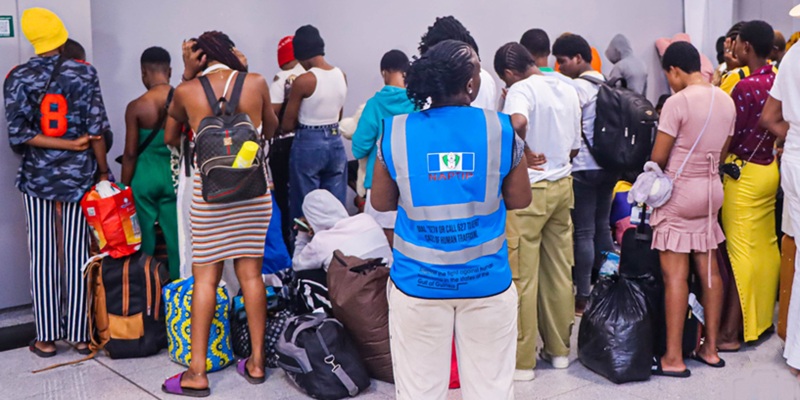
TDOperatives of the Osun State Police Command have uncovered a suspected cross-border human trafficking operation in Osogbo, rescuing 15 young foreign nationals during a targeted intelligence-driven raid.

The operation, carried out on February 26 at a three-bedroom apartment in Adeleke Estate, led to the arrest of one suspect.
The suspect was identified as a house agent who allegedly rented the property to members of the trafficking syndicate.
Other suspects reportedly fled before security operatives secured the premises.
Victims Allegedly Lured with False Promises
Authorities believe the victims — nationals of Togo, Benin Republic, and Niger — were enticed into Nigeria under the pretense of securing well-paying jobs and better living opportunities.
Instead, investigators say they were confined under suspicious conditions, possibly awaiting transfer for forced labour or sexual exploitation.
The rescued individuals, aged between 20 and 30, include both men and women.
They have been identified as Moise Nanga (30, male), Myriam Yakouba (28, female), Rostand Joseph (29, male), and Mouris Kassoko (26, male).
Others are Bicosso Nadia (22, female), Samoru Ilan Azote (20, male), Doris Samnat (23, female), Zogo Miichelle (25, female), and Nebi Sera (21, female).
The rest are Moeva Loure (23, female), Awa Asoka (25, female), Sonara Rene (26, male), Ella Cadore (24, male), Odil Mapa (25, female), and Madji Sanni (22, female).
They have been placed in protective custody, where they are receiving medical care, psychological counseling, and other support services.
Further assistance will be pending outcome of investigation and arrangements for safe repatriation and reintegration.
Police Confirm Intelligence-Led Operation
In a statement, Osun State Police spokesperson DSP Abiodun Ojelabi said the rescue followed credible intelligence gathered by the State Intelligence Department.
“The Osun State Police Command has successfully rescued fifteen young persons who were victims of a suspected human trafficking syndicate during a coordinated, intelligence-led operation,” he stated.
Commissioner of Police Ibrahim Gotan reaffirmed the command’s resolve to combat trafficking and related crimes.
He urged members of the public — particularly parents, guardians, landlords, and community leaders — to report suspicious recruitment activities or unusual housing arrangements.
“We are actively pursuing the fleeing suspects,” the commissioner added, assuring residents that surveillance and enforcement measures have been intensified.
Nigeria’s Ongoing Trafficking Challenge
The incident highlights the continuing threat of human trafficking in Nigeria and across West Africa.
According to international assessments, Nigeria remains one of the countries most affected by modern slavery on the continent.
Nigeria, it was revealed, functions as a source, transit, and destination hub for trafficking networks.
Recent global estimates suggest that approximately 1.6 million people in Nigeria are trapped in various forms of modern slavery, including forced labour, sexual exploitation, domestic servitude, and debt bondage.
Official data also indicate hundreds of trafficking investigations annually, with thousands of victims identified for protection services.
Experts attribute the persistence of trafficking to multiple structural factors, including poverty, youth unemployment, insecurity, porous borders, and the dominance of informal economic systems that can mask illicit financial flows.
Women and girls remain disproportionately vulnerable, while children constitute a significant share of confirmed victims in West Africa.
Profits and Networks
International organizations estimate that human trafficking generates hundreds of billions of dollars globally each year.
This is driven largely by forced sexual exploitation and labour exploitation.
In West Africa, criminal networks operate across borders, exploiting weak regulatory systems and economic desperation.
Internal trafficking accounts for the majority of cases in Nigeria, but cross-border recruitment — often facilitated through deceptive employment schemes — remains a major concern.
Government Response and Regional Cooperation
Nigeria’s National Agency for the Prohibition of Trafficking in Persons (NAPTIP) continues to implement its 2022–2026 National Action Plan aimed at strengthening prevention, prosecution, and victim support.
The agency operates a 24-hour hotline and works with international partners to disrupt trafficking routes.
However, corruption and limited resources have been cited as obstacles to fully dismantling entrenched networks.
Analysts stress that stronger regional collaboration, particularly through ECOWAS frameworks, is critical to curbing cross-border operations.
A Step Forward Amid Broader Crisis
The Osogbo rescue represents a significant intervention amid ongoing regional challenges.
Broader socioeconomic pressures — including inflation, displacement, food insecurity, and conflict — continue to heighten vulnerability to exploitation across Sub-Saharan Africa.
Authorities emphasize that public vigilance remains a vital component of prevention efforts.
Community awareness, timely reporting of suspicious activities, and stronger institutional accountability are seen as essential tools in the fight against trafficking.
Investigations into the Osogbo case are ongoing as security agencies work to apprehend additional suspects and dismantle the broader network behind the operation.