
TDBy any measure, Omoyele Sowore has become the loudest heckler in Nigeria’s political theatre, a man whose voice carries more venom than vision.

His latest outburst—branding Peter Obi’s “Obidient” movement a “political Ponzi scheme”—is not only reckless but exposes the hollowness of his own political relevance.
Rather than building bridges within the opposition, Sowore has chosen the path of perpetual antagonism, attacking Obi, government institutions, and even the judiciary with a bitterness that reeks of envy and desperation.
The Rascality of Antagonism
The timing of his remarks is telling.
On March 22, Obi met with Rabiu Kwankwaso, a move widely interpreted as a strategic step toward forging a broader alliance ahead of the 2027 elections.
The meeting drew cheers across Nigeria’s opposition circles, signaling hope for unity against the entrenched dominance of the APC.
Yet Omoyele, instead of welcoming the possibility of coalition-building, dismissed the enthusiasm as hypocrisy, claiming it was rooted in envy of his own Aba protest turnout.
This is the politics of resentment, not leadership.
The Obidient movement responded swiftly, circulating videos of Obi drawing massive solo crowds at Kano’s Singer Market.
These images underscored what Sowore cannot admit: Obi’s popularity is organic, rooted in genuine grassroots support, not manufactured spectacle.
Sowore’s attempt to belittle this movement betrays his own insecurity.
Omoyele Sowore Versus Igbo Leaders Cum Unusual Fancy on Peter Obi
It is no coincidence that his attacks often target prominent Igbo leaders—Obi and Abia Governor Alex Otti.
That suggests a pattern of divisive rhetoric aimed at undermining figures who command real followership.
If Omoyele Sowore’s words were merely bluster, they might be ignored. But his persistent attacks on institutions of governance and the judiciary reveal a deeper problem.
He has cultivated a politics of destruction, where every establishment is painted as corrupt, every rival as fraudulent, and every outcome that does not favor him as illegitimate.
This scorched-earth approach may win applause from a fringe audience, but it alienates the broader electorate who seek constructive opposition, not perpetual chaos.
StatiSense’s Brutal Dissection
The numbers tell the story more starkly than any rhetoric.
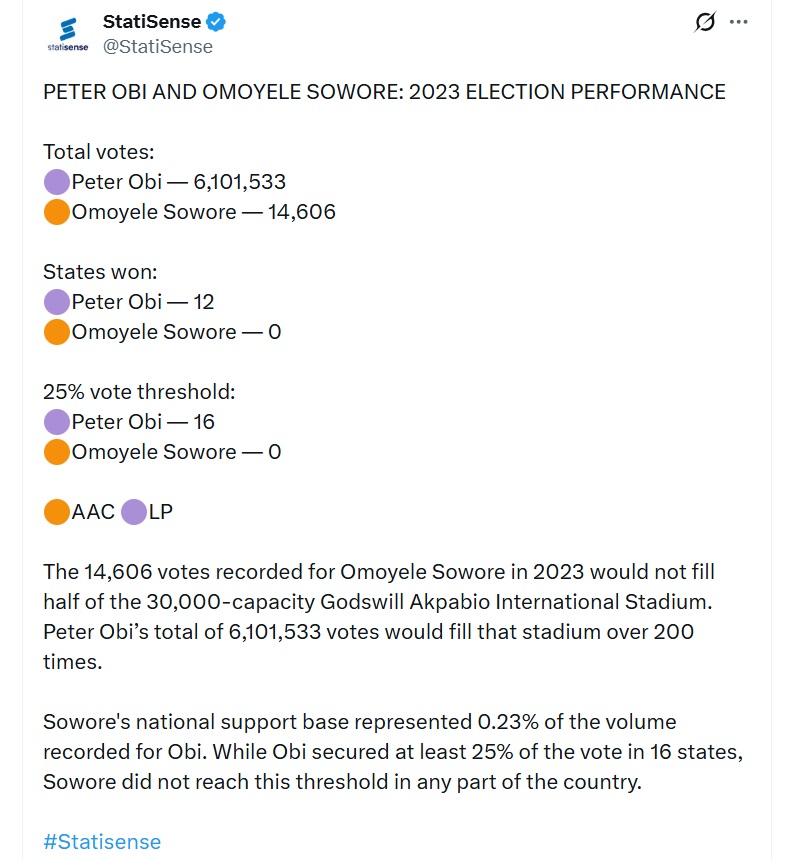
Data analytics platform StatiSense dismantled Sowore’s claims with cold, hard facts from the 2023 presidential election:
- Peter Obi secured 6,101,533 votes, winning 12 states and reaching the 25% threshold in 16.
- Omoyele Sowore managed just 14,606 votes, winning no states and failing to reach 25% anywhere.
To put it plainly, Sowore’s national support base represented a mere 0.23% of Obi’s vote volume.
His tally would not fill half of the 30,000-capacity Godswill Akpabio International Stadium, while Obi’s votes could fill it more than 200 times.
See the table below:
These figures expose the absurdity of Sowore’s attempt to dismiss Obi’s movement as a Ponzi scheme.
If anything, it is Sowore’s political career that resembles a pyramid—built on noise at the top but collapsing under the weight of irrelevance at the base.
Little wonder many believe he is an agent of President Bola Ahmed Tinubu despite Sowore’s occasional surges of attack against him!
The recent release of his seized international passport on my mind.
Omoyele Sowore and Coalition Building
Nigeria’s opposition politics faces a critical test as 2027 approaches. The APC remains dominant, and only a united opposition can mount a credible challenge.
Obi’s meeting with Kwankwaso was a step toward that unity. Sowore’s intervention, however, highlights the fragility of opposition cohesion.
His remarks, dismissed by many as politically motivated, underscore how personal ambition and ideological rigidity can derail coalition-building.
What Omoyele fails to grasp is that opposition politics is not a contest of who can shout the loudest or insult the most.
It is about building trust, forging alliances, and presenting Nigerians with a credible alternative.
Obi has demonstrated the ability to mobilize millions, inspire hope, and command respect across ethnic and regional divides.
Sowore, by contrast, has reduced himself to a perpetual critic, a man more interested in tearing down than lifting up.
The Hollowness of Omoyele Sowore’s Self Importance
The judiciary, government establishments, and rival movements have all been targets of his vitriol. Yet what has Sowore built?
What institutions has he strengthened? What constituencies has he nurtured? The answer is none.
His politics begins and ends with outrage, a cycle that may sustain his relevance on social media but leaves him stranded in the real world of electoral politics.
In the end, Omoyele’s attacks on Obi and the Obidient movement reveal more about his own failures than Obi’s.
He is a man haunted by irrelevance, lashing out at those who have achieved what he could not.
His hostility toward institutions reflects a refusal to engage constructively, and his envy of Obi’s popularity exposes the emptiness of his own political base.
Nigeria deserves better than this politics of destruction.
If Sowore cannot rise above bitterness and contribute to genuine opposition unity, then he should step aside and allow those with real followership and vision to lead.
The stakes in 2027 are too high for Nigeria’s future to be left at the mercy of petty rivalries and personal vendettas.
This writer can only but best describe Omoyele Sowore as a butterfly chat calls itself a bird.
But time will tell…