Spectrum Sale Scandal
TDA petition submitted to the EFCC has thrown the National Broadcasting Commission (NBC) into the spotlight, accusing its Director General, Mr. Charles Ebuebu, of secretly selling the 600MHz broadcasting spectrum to the Nigerian Communications Commission (NCC) for ₦35 billion.

The figure, it was alleged, was far below its true market value.
A whistleblower, who spoke to This Dawn strictly on condition of anonymity, claimed that only ₦10 billion was received, with the remaining ₦25 billion unaccounted for.
The petition highlights that in 2014, just 1MHz of spectrum was sold for ₦34 billion, suggesting that the 2024 deal grossly undervalued the asset.
“It is rumored that the sale amount was ₦35,000,000,000… significantly undervalued,” the petition states.
It raised suspicions of deliberate underpricing and exclusion of key management staff from the transaction.
Interestingly, this is not the first time the NBC and NCC were caught in a web of controversy over the sale of spectrum.
Read also: Was NBC Right to Release 700MHZ Spectrum to MTN Nigeria?
Misrepresentation and Court Defiance
To mask the deal, staff were reportedly told the ₦10 billion was a grant from NCC for the Digital Switch Over (DSO) project.
Yet, no records of such a grant exist, and the DSO remains stalled.
Adding to the controversy, the Setup Box Manufacturers Association secured a court injunction ordering parties to maintain the status quo pending resolution of their lawsuit against NBC.
Despite this, the DG allegedly continued spending the funds, raising concerns of contempt of court and disregard for judicial authority.
What is Spectrum?
Spectrum refers to the range of electromagnetic frequencies
Spectrum (more precisely radio frequency spectrum) refers to the range of electromagnetic frequencies used for wireless communication such as radio, television broadcasting, mobile phones and satellite transmission.
Governments regulate and license portions of this spectrum because it is a limited and highly valuable national resource.
It is the invisible infrastructure that enables technologies such as:
-
Mobile phone networks
-
Television broadcasting
-
Radio broadcasting
-
Satellite communications
-
Wi-Fi and Bluetooth
-
Radar systems
In simple terms, spectrum is the “airwave highway” through which wireless communication travels.
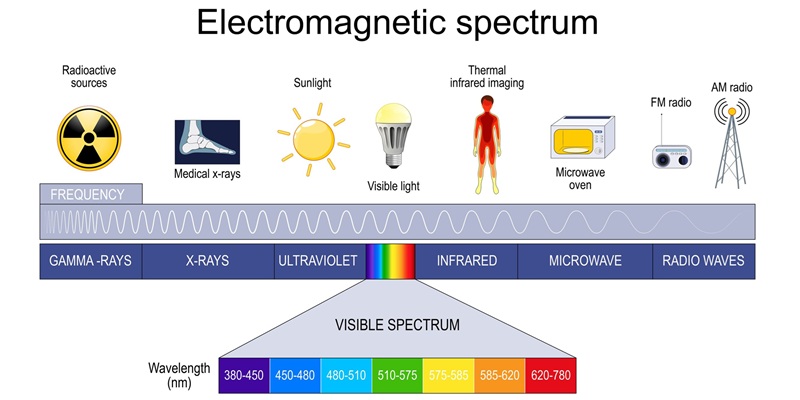
It ranges from:
| Type | Example Use |
|---|---|
| Radio waves | TV, radio broadcasting |
| Microwaves | mobile phones, Wi-Fi |
| Infrared | remote controls |
| Visible light | human vision |
| Ultraviolet | sterilization |
| X-rays | medical imaging |
| Gamma rays | nuclear reactions |
For telecommunications, the radio spectrum (radio frequencies) is the most important portion.
2. What Spectrum Means in Telecommunications
In telecom policy and regulation, spectrum means specific frequency bands assigned for wireless services.
Example:
| Frequency band | Common use |
|---|---|
| 88–108 MHz | FM radio |
| 470–694 MHz | Television broadcasting |
| 700 MHz | mobile broadband (4G/5G) |
| 2.4 GHz | Wi-Fi |
| 3.5 GHz | 5G networks |
Because many devices cannot transmit on the same frequency simultaneously, governments must allocate spectrum carefully.

3. Why Spectrum Is Extremely Valuable
Spectrum is considered a strategic national resource because:
-
It is finite (limited frequencies available)
-
It enables telecommunications infrastructure
-
It generates huge government revenue
Countries often auction spectrum to telecom companies.
Examples:
-
Germany once raised €6.5 billion from spectrum auctions.
-
India raised over $19 billion in one 5G spectrum auction.
-
Nigeria has earned hundreds of billions of naira from spectrum licensing.
This is why spectrum allocation decisions often become politically controversial.
4. Who Owns Spectrum in Nigeria
Legally, the spectrum belongs to the Federal Government of Nigeria.
However, different agencies manage different parts:
| Institution | Role |
|---|---|
| Federal Government | Ultimate owner |
| National Frequency Management Council | coordination |
| Nigerian Communications Commission (NCC) | telecom spectrum |
| National Broadcasting Commission (NBC) | broadcasting frequencies |
5. The “Digital Dividend”
When countries switch from analogue TV to digital broadcasting, large portions of spectrum become free.
This freed spectrum is called the digital dividend. The most valuable part is the 700 MHz band.
It is ideal for:
-
4G networks
-
5G broadband
-
rural internet coverage
This is the same band involved in the Nigerian spectrum controversy you are investigating.
Procurement Irregularities
The DG, Mr. Ebuebu, is accused of flouting the Public Procurement Act by awarding contracts without due process.
One such contract for Audience Measurement was reportedly given to First Media Limited, a company allegedly linked to him.
Contracts were reportedly issued without advertisement, tendering, or committee approval.
Staff allege that funds are being dissipated on “unnecessary items” to justify dwindling reserves, undermining NBC’s ability to fulfill its core mandate.
Vindictive Transfers
Senior staff across departments—including Accounts, Engineering, Legal, and Audit—were allegedly transferred to remote offices as punishment for resisting irregular practices.
In some cases, senior officers were made subordinate to juniors, disrupting workflow and morale.
“Currently, the Director General has continued to transfer staff members… as a form of punishment or retaliation,” the petition alleges.
Examples include:
- Finance Department: Senior officers redeployed to zonal offices, replaced by outsiders allegedly loyal to the DG.
- Engineering Department: Key staff transferred despite shortages at headquarters.
- Legal & Audit: Experienced officers sidelined, replaced by less qualified personnel, allegedly to conceal irregular transactions.
Staff Welfare Neglect
Established allowances such as Productivity, Overtime, and Monitoring have reportedly been denied, even as funds are spent elsewhere.
Staff morale is said to be at an all-time low, with welfare packages abandoned since the DG’s assumption of office.
The DG is also accused of being absent from duty, allegedly appearing at the office only once every two weeks.
He reportedly fails to delegate authority during travels, leaving a vacuum in leadership and disrupting NBC’s operations.
The Bigger Picture
The petition was signed by Femi Adesina of Save the Soul Transparency & Eagle Eyes International Foundation.
It urges the EFCC to investigate allegations of embezzlement, abuse of office, breach of promotion procedures, procurement irregularities, and denial of staff welfare packages.
It warns that without urgent intervention, the NBC risks collapse, jeopardizing Nigeria’s broadcasting sector and derailing the Federal Government’s Digital Switch Over agenda.
This petition paints a picture of a Commission in crisis—where allegations of corruption, favoritism, and executive lawlessness threaten not just staff morale but the integrity of Nigeria’s broadcasting future.
The EFCC’s response will determine whether these claims mark the beginning of a long-overdue reckoning or fade into yet another unresolved scandal.
Efforts by This Dawn correspondent to elicit response from the NBC MD failed to yield results as he did not respond to messages sent to his phone.