
TDNigeria’s evolving electoral calendar is fast becoming more than an administrative adjustment.

President Bola Ahmed Tinubu’s alignment with the Independent National Electoral Commission’s (INEC) revised timetable has introduced new strategic pressures across the political spectrum — but none more visibly than within the African Democratic Congress (ADC).
At the centre of the unfolding tension lies a structural constraint: the tenure of the ADC’s current National Executive Committee (NEC) is expected to expire on 30 April 2026.
Under a conventional electoral timeline, the party would have had adequate breathing space to conduct ward, local government, state, and national congresses in an orderly sequence before proceeding to primaries.
The compressed schedule alters that calculus entirely.
A Narrow Operational Window
Between 23 April and 30 May — the projected window for candidate selection — the ADC must now decide between two high-risk pathways.
Option One: Proceed with existing state executives to conduct primaries before the NEC tenure expires.
Option Two: Attempt to conduct congresses, restructure leadership across multiple tiers, and organise primaries almost simultaneously within a matter of weeks.
Both scenarios are fraught with instability.
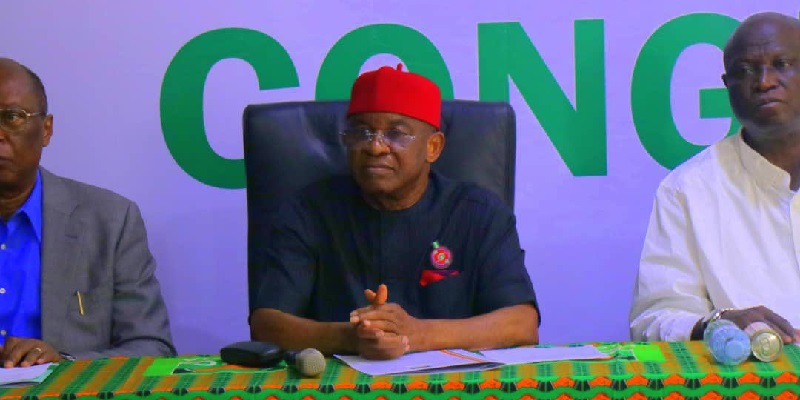
Relying on current structures may trigger legitimacy disputes, particularly from aspirants who perceive the process as exclusionary or administratively rushed.
Nigeria’s political history shows that aggrieved aspirants often turn to litigation, factional alignments, or parallel congresses — outcomes that can destabilise opposition parties long before ballots are cast.
Conversely, compressing congresses and primaries into a single high-pressure cycle risks producing precisely those internal fractures the party seeks to avoid.
Leadership transitions under time duress rarely produce consensus. Instead, they generate contestation over delegate lists, recognition battles, and competing claims of authority.
In practical terms, the ADC could find itself in reactive crisis management rather than proactive electoral mobilisation.
From Consolidation to Survival Mode
For an opposition platform seeking to position itself as a credible alternative to the All Progressives Congress (APC), the strategic imperative should be consolidation — harmonising state chapters, expanding grassroots structures, building voter databases, and refining messaging.
Instead, the revised timetable risks forcing the ADC into survival mode.
Political analysts note that institutional fragility becomes magnified under compressed deadlines. Internal arbitration mechanisms are tested.
Financial planning becomes erratic. Coordination between national and state chapters weakens. Momentum — the lifeblood of insurgent campaigns — dissipates.
The situation has reportedly generated confusion and heightened tension across several state chapters, with insiders describing the atmosphere in blunt terms: there is chaos.
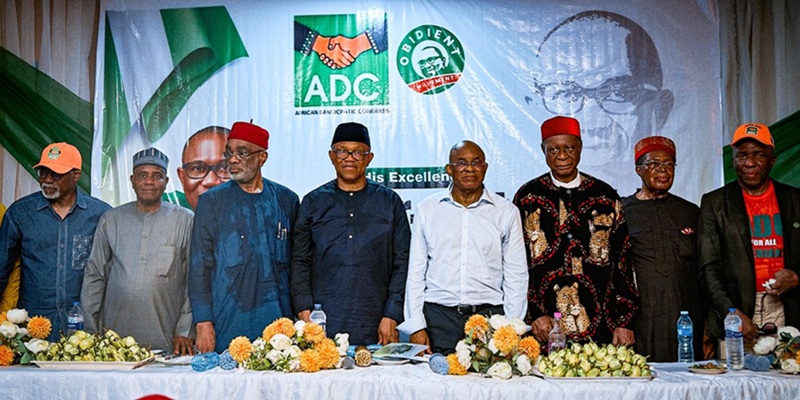
The Incumbency Advantage
The timetable is not without implications for the APC.
In states where succession politics remain unsettled, accelerated primaries could intensify internal competition. Incumbents facing term limits may struggle to manage rival ambitions within truncated timelines.
However, the structural asymmetry between ruling and opposition parties remains decisive.
The APC benefits from incumbency leverage, deeper institutional networks, broader access to funding streams, and entrenched administrative experience. These buffers absorb shocks that might otherwise destabilise a less established party.
For the ADC, lacking comparable institutional depth, any organisational miscalculation could carry disproportionate consequences.
The Financial Burden of a Prolonged Campaign
Another underappreciated dimension of the new timetable is the extended campaign window — approximately seven months, from May 2026 to January 2027.
While on paper this offers increased voter engagement time, the financial implications are severe. Sustained statewide and national campaigning over such a duration demands:
- Continuous media presence
- Logistics coordination across constituencies
- Security arrangements
- Staff retention and volunteer management
- Persistent fundraising
Opposition parties traditionally struggle more than incumbents to maintain financial stamina over prolonged cycles.
Donor fatigue, inconsistent funding streams, and limited access to institutional backers can quickly erode campaign viability.
Thus, what appears procedurally neutral may, in practice, amplify structural inequalities.
A Strategic Reset — or Strategic Disarray?
Beyond dates and deadlines, the revised timetable fundamentally reshapes political strategy. It compresses internal decision-making cycles, heightens risk exposure, and tests leadership discipline.
For the ADC, the coming weeks represent a critical inflection point. The party must transition from structural uncertainty to operational clarity without fracturing its base.
That requires:
- Clear legal and procedural guidance on NEC tenure implications
- Transparent communication with aspirants
- Rapid but credible conflict resolution frameworks
- Coordinated state-by-state alignment
Failure to manage these variables could entrench internal instability just as the general election cycle intensifies.
In Nigerian politics, timing is often strategy. Whether intentional or incidental, the new electoral alignment has introduced asymmetrical pressure points.
The ruling party may navigate them with institutional cushioning. The opposition must do so without comparable safeguards.
As the countdown accelerates, the question is no longer whether the timetable is compressed.
It is whether the ADC can transform compression into cohesion — or whether internal disorder will undermine its electoral ambitions before campaigning fully begins.