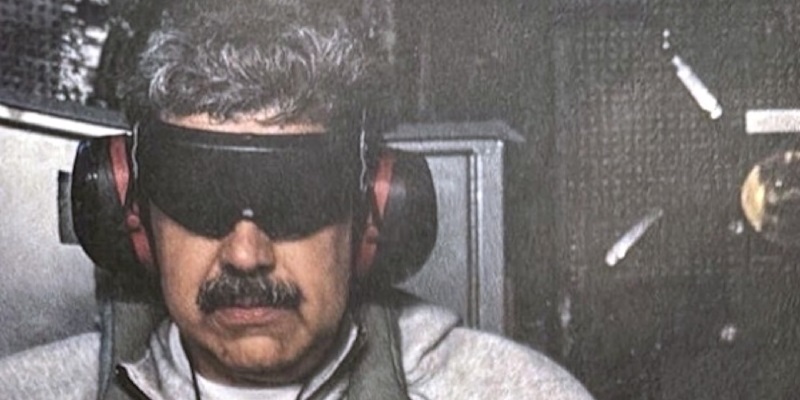
THIS DAWN — In the annals of modern geopolitics, few events have captured the raw drama of power’s impermanence like the stunning announcement that Venezuelan President Nicolás Maduro and his wife, Cilia Flores, have been captured by U.S. forces. Once the commanding figure atop Venezuela’s political pyramid, Maduro now finds himself behind bars, facing criminal charges in a foreign land. The transformation is as swift as it is symbolic: yesterday a president, today a prisoner.

President Donald Trump’s declaration that Maduro was apprehended by the elite Delta Force and flown out of Venezuela has sent shockwaves through Latin America and beyond. The implications are vast—legal, diplomatic, and psychological—but at the heart of this moment lies a timeless truth: power is fleeting.
The Illusion of Permanence
Maduro’s rise to power was steeped in revolutionary rhetoric and populist appeal. As Hugo Chávez’s chosen successor, he inherited a nation already polarized, battered by economic mismanagement, and gripped by ideological fervor. For years, Maduro wielded the instruments of state—military loyalty, judicial control, and oil wealth—to maintain his grip. He outlasted protests, sanctions, and international condemnation. He seemed immovable.
But power, no matter how entrenched, is never permanent. It is borrowed from the people, sustained by institutions, and vulnerable to the tides of history. Maduro’s fall is a reminder that no leader, however defiant, can escape the consequences of governance divorced from accountability.
From Sovereign to Suspect
The Trump administration’s framing of Maduro as the head of a “narco-terrorist organization” rather than a legitimate head of state marks a radical shift in diplomatic norms.
The Cartel de Los Soles, allegedly tied to Venezuela’s military elite, has long been accused of trafficking cocaine into the United States. By treating Maduro as a criminal syndicate leader, Washington has bypassed traditional channels of international law and asserted a new doctrine: sovereignty does not shield criminality.
Attorney General Pamela Bondi’s announcement of indictments—including narco-terrorism conspiracy and possession of destructive devices—underscores the gravity of the charges. Maduro is not merely being removed from office; he is being stripped of the very legitimacy that once protected him.
Carcas in Caracas
In Venezuela, the response has been predictably volatile. Vice President Delcy Rodríguez demanded proof of life, accusing the U.S. of fabricating narratives. Defense Chief Vladimir Padrino López vowed resistance, pledging that the armed forces would not surrender. These statements reflect not just outrage but existential panic. The removal of Maduro threatens to unravel the fragile equilibrium that has kept Venezuela’s ruling class intact.
Opposition leader María Corina Machado, meanwhile, declared readiness to assume power. Her words signal a potential transition—but also a looming power struggle. The vacuum left by Maduro’s capture could ignite internal rivalries, military defections, and civil unrest. Venezuela stands at a crossroads, and the path forward is anything but clear.
The Global Stage
Maduro’s capture is not just a Venezuelan story—it is a global one. It challenges the norms of international diplomacy, tests the limits of U.S. extraterritorial jurisdiction, and redefines the boundaries of executive power. The Southern District of New York, now tasked with prosecuting a sitting foreign president, becomes the stage for a legal drama with geopolitical consequences.
For the United States, the operation is a bold assertion of its commitment to combating narco-terrorism. It reflects a fusion of military precision and legal strategy, a coordinated effort across branches of government. Trump’s announcement from Mar-a-Lago, promising transparency and public accountability, frames the mission as both a national security triumph and a moral imperative.
The Lesson of Transience
But beyond the headlines and indictments lies a deeper lesson—one that transcends borders and ideologies. Maduro’s fall is a case study in the transience of power. It is a reminder that leadership is not a fortress but a flame, vulnerable to the winds of justice, history, and public will.
Yesterday, Maduro stood atop a nation, flanked by generals and loyalists. Today, he faces trial in a foreign court, his legacy reduced to a list of criminal charges. The contrast is stark, the symbolism profound. It is a warning to all who wield power without restraint: the throne is never permanent.
A Cautionary Tale
History is replete with leaders who believed themselves untouchable—only to be humbled by time. From dictators to democrats, emperors to revolutionaries, the arc of power bends toward accountability. Maduro’s story joins that lineage, a cautionary tale for those who mistake control for invincibility.
In the end, the measure of leadership is not how long one holds power, but how one uses it. Maduro’s legacy, now tainted by allegations of corruption and violence, will be judged not by his rhetoric but by his record. And that record, if proven in court, will stand as a testament to the cost of governance without conscience.
“Maduro: Yesterday a President, Today a Prisoner” is more than a headline—it is a parable. It speaks to the fragility of authority, the inevitability of justice, and the enduring power of truth. As Venezuela grapples with uncertainty and the world watches the legal proceedings unfold, one truth remains clear: power may elevate, but it never guarantees permanence.
In the corridors of history, Maduro’s name will echo not as a symbol of strength, but as a reminder that even the highest office cannot shield one from the reckoning of justice. And in that echo, future leaders may find humility, nations may find resolve, and citizens may find hope.