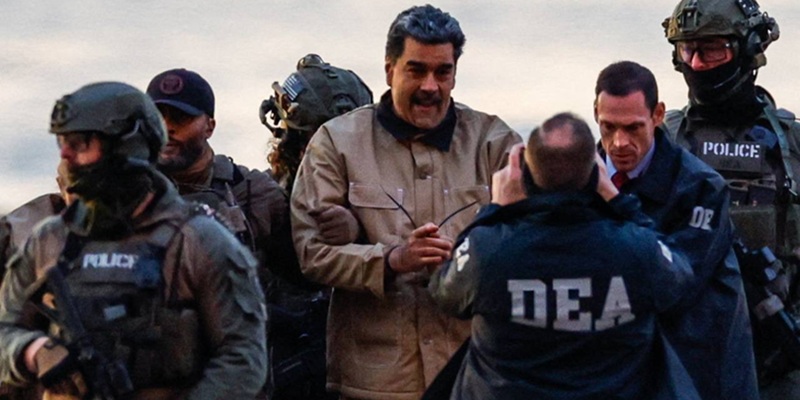
THIS DAWN — Deposed Venezuelan President Nicolás Maduro has arrived in New York City by helicopter ahead of his highly anticipated first appearance in a U.S. courtroom.

The dramatic arrival underscores the gravity of the charges he faces and the unprecedented nature of his capture by American forces.
What’s Next
-
Court Appearance:
Maduro appeared before a federal judge today on narco-terrorism charges that the Trump administration cited to justify his detention.
-
Legal Rights:
As a criminal defendant, Maduro will be afforded the same rights as any other accused person in the U.S., including the right to a jury trial.
-
Defense Strategy:
His lawyers are expected to argue that he is immune from prosecution as a sovereign head of state, setting the stage for a prolonged legal battle.
Political Reactions
- In Venezuela:
Interim President Delcy Rodríguez has demanded Maduro’s return but also struck a conciliatory tone, calling for “respectful relations” with the U.S.
- In Washington:
President Donald Trump’s intervention in Venezuela has sparked debate within the Republican Party.
Some lawmakers are uneasy about his comments that the U.S. could “run” Venezuela and tap its oil reserves.
Maduro’s arrival in New York marks the beginning of a historic trial that could reshape U.S. foreign policy and test the limits of international law.
It also places Venezuela’s political crisis squarely in the global spotlight, with implications for both American politics and Latin American stability.
The brief but required legal proceeding will serve as the formal start of what is likely to be a prolonged fight over whether Maduro can be tried in the United States.
As a criminal defendant, he will be afforded the same rights as any other person accused of a crime under the U.S. legal system — including the right to a jury trial composed of ordinary New Yorkers.
Legal Arguments and Sovereignty Claims
Maduro’s lawyers are expected to challenge the legality of his arrest, arguing that he is immune from prosecution as a sovereign head of state.
This defense will likely hinge on principles of international law and diplomatic immunity, raising questions about whether the U.S. has overstepped its authority in detaining a foreign leader.
The case is unprecedented in modern U.S. history.
While American courts have tried foreign officials before, the trial of a sitting or recently deposed head of state carries enormous implications for international relations.
If the court rejects Maduro’s immunity claim, it could set a precedent for how the U.S. handles future cases involving foreign leaders accused of crimes.
Venezuela’s Interim Government Responds
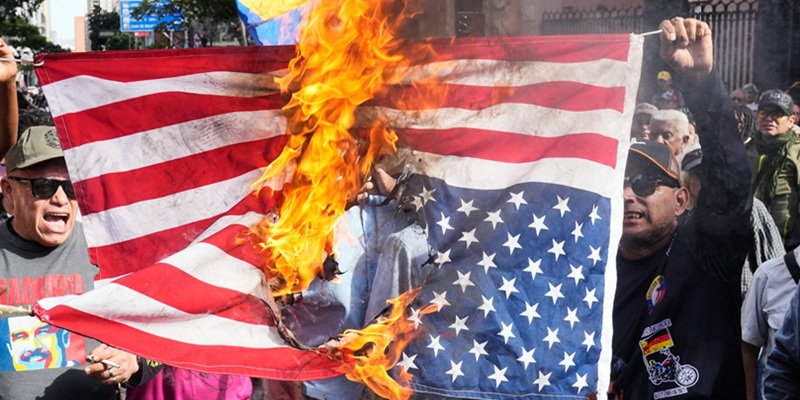
In Caracas, Venezuela’s new interim president, Delcy Rodríguez, has demanded that the U.S. return Maduro.
Rodríguez, who assumed leadership following Maduro’s capture, initially struck a defiant tone, insisting that the detention was illegal and an affront to Venezuelan sovereignty.
However, in a surprising shift late Sunday, Rodríguez adopted a more conciliatory stance in a social media post.
She invited collaboration with President Donald Trump and called for “respectful relations” between the U.S. and Venezuela.
Analysts suggest this dual approach reflects the delicate balance Rodríguez must strike between appeasing domestic supporters and navigating international diplomacy.
Trump’s Intervention and Political Fallout
The U.S. military intervention in Venezuela, which led to Maduro’s capture, is already reshaping the political landscape in Washington.
For President Trump, the move represents both a bold foreign policy gamble and a potential liability as he seeks to maintain unity within the Republican Party during a challenging election year.
Initially, most Republicans rallied behind Trump, praising the decisive action. Yet cracks have begun to appear within the coalition.
Trump’s comments about the U.S. positioning itself to “run” Venezuela raised concerns among some conservatives that he is abandoning his long-touted “America First” philosophy.
Oil, Iraq, and Familiar Critiques
Trump’s recent remarks about revitalizing Venezuela’s oil industry echo his earlier critiques of U.S. policy in Iraq.
As far back as 2013, during a speech at the Conservative Political Action Conference, Trump argued that the U.S. should have “taken” Iraq’s oil to “pay ourselves back.”
His current rhetoric suggests a similar approach to Venezuela, raising fears that economic interests may overshadow democratic principles in U.S. foreign policy.
This has fueled criticism from both allies and opponents.
Representative Marjorie Taylor Greene of Georgia, once a staunch Trump supporter, announced her resignation from Congress while denouncing the intervention.
In an interview with NBC’s Meet the Press, Greene said:
“This is the same Washington playbook that we are so sick and tired of that doesn’t serve the American people, but actually serves the big corporations, the banks and the oil executives.”
What Lies Ahead
Maduro’s court appearance is only the beginning of a complex legal and political saga.
The trial will likely stretch for months, if not years, as lawyers argue over jurisdiction, immunity, and the evidence of narco-terrorism.
Meanwhile, the case will continue to reverberate across Venezuela, where supporters and opponents of Maduro remain deeply divided.
For Trump, the intervention represents a high-stakes gamble.
Success could bolster his image as a strong leader willing to confront adversaries abroad.
Failure, however, could deepen divisions within his party and raise questions about the wisdom of U.S. involvement in Venezuela’s internal affairs.
As Nicolás Maduro steps into a U.S. courtroom for the first time, the world will be watching closely.
The outcome of this case will not only determine the fate of Venezuela’s former president.
It will also shape the trajectory of U.S. foreign policy and domestic politics in 2026.
With legal battles looming and political tensions rising, Maduro’s trial promises to be one of the defining stories of the year.