TDTensions in the Middle East escalated sharply after Iran reportedly struck another vessel, a Kuwaiti crude oil tanker, near the Strait of Hormuz, damning threats form U.S. President Donald Trump, amid ongoing military activities.

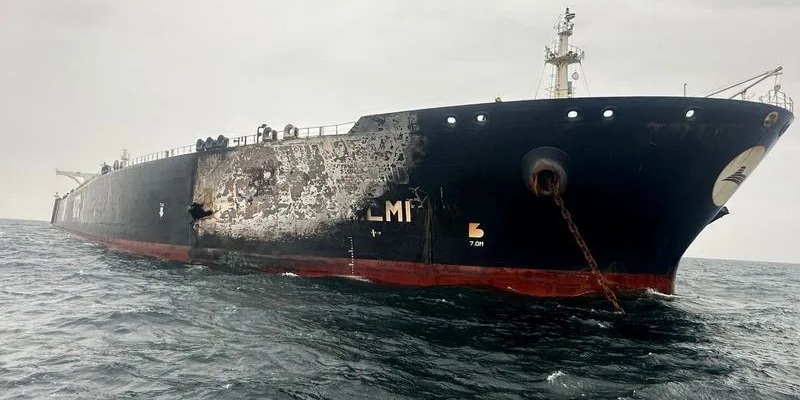
According to multiple reports, the tanker—identified as Al Salmi—was hit by an Iranian drone attack off the coast of Dubai, sparking a fire and damaging the vessel’s hull.
All 24 crew members were safely rescued, and no immediate casualties were reported, though authorities raised concerns about potential environmental risks.
The attack is the latest in a series of escalating incidents linked to the ongoing 2026 Strait of Hormuz crisis.
Iran had been targeting commercial shipping in the region in response to U.S. and allied military actions.
Damned Threats
Iran has accused the United States of aggression in the region, particularly following threats by Trump to target Iran’s energy infrastructure and intensify military operations if tensions persist.
The U.S. leader has also pushed for stronger international action to secure the strategic waterway, a key global oil transit route.
The Strait of Hormuz, which carries roughly 20% of the world’s oil supply, has become a focal point of the conflict.
Disruptions in the area have already triggered global energy concerns, with shipping traffic reduced and oil prices rising sharply.
Trump’s Threats and Allied Frustration
President Trump threatened to obliterate Iran’s energy infrastructure if Tehran refused to reopen the strait, a critical artery for global oil shipments now effectively blocked.
He criticized allies such as France and Britain for failing to contribute militarily, urging them to show “some delayed courage” to secure their own oil supplies.
Reports say that France had denied U.S. requests to use its airspace for transporting weapons, underscoring divisions among Western allies over the conflict.
U.S. Warning and Escalation
The United States warned on Tuesday that the coming days in the war against Iran would be decisive.
U.S. Defense Secretary Pete Hegseth declared that Washington was prepared to intensify the conflict if Iran refused to negotiate.
Hegseth urged Tehran to accept peace proposals as tensions escalated with a fresh attack on a Kuwaiti oil tanker in the Strait of Hormuz.
“We have more and more options, and they have less.
“In only one month we set the terms, the upcoming days will be decisive,” Hegseth said in Washington.
He emphasized that Iran’s military capabilities were being steadily degraded through targeted strikes.
Hegseth’s comments followed a dramatic incident earlier in the day when Iran set ablaze the Kuwait-flagged Al-Salmi, a fully loaded crude oil tanker off Dubai.
Authorities confirmed the fire was contained without casualties, though the vessel’s hull sustained damage.
The tanker was transporting 1.2 million barrels of Saudi crude and 800,000 barrels of Kuwaiti crude bound for Qingdao, China.
Iran’s Revolutionary Guards later claimed they had targeted a container ship linked to Israel.
Shipping data suggested the Al-Salmi may have been struck by mistake, as it was anchored near the Singapore-flagged Haiphong Express.

Oil Prices Surge
The month-old war has already killed thousands and disrupted energy supplies across the Middle East, rattling global markets.
Brent crude surged above $114 per barrel, heading for a record monthly gain.
In the United States, gasoline prices crossed $4 per gallon for the first time in over three years.
These developments have raised political risks for Trump and his Republican Party ahead of November’s midterm elections.
Analysts warn that prolonged disruption could tip the global economy into recession.
Expanding Regional Conflict
The fighting has spread across multiple fronts:
- Iran-aligned Houthis in Yemen have launched attacks on Israel.
- Turkey reported shooting down an Iranian ballistic missile that entered its airspace.
- Hezbollah has re-engaged in clashes with Israel.
- U.S. forces, including thousands from the 82nd Airborne Division, have deployed to the Middle East, raising the possibility of a ground assault.
Israel confirmed overnight strikes in Tehran targeting missile warhead factories, weapons research sites, and launch systems.
Meanwhile, Iranian officials reported casualties from a strike on a Shi’ite congregation hall in Zanjan, where three people were killed.
Mediation Attempts
Pakistan has stepped forward as a mediator, with Foreign Minister Ishaq Dar meeting Chinese officials after hosting talks with Turkey, Egypt, and Saudi Arabia.
The European Union’s energy chief has warned member states to prepare for “prolonged disruption” to energy markets if peace remains elusive.
Iran, however, has dismissed U.S. proposals as “unrealistic, illogical and excessive,” signaling little appetite for compromise despite heavy losses.
Oil markets are getting more rattled, regional conflicts intensifying, and diplomacy is stalling.
The next few days may determine whether the war escalates into a broader confrontation or shifts toward negotiation.
The Strait of Hormuz, through which nearly a fifth of the world’s oil passes, remains the flashpoint — and the world watches anxiously as the crisis deepens.