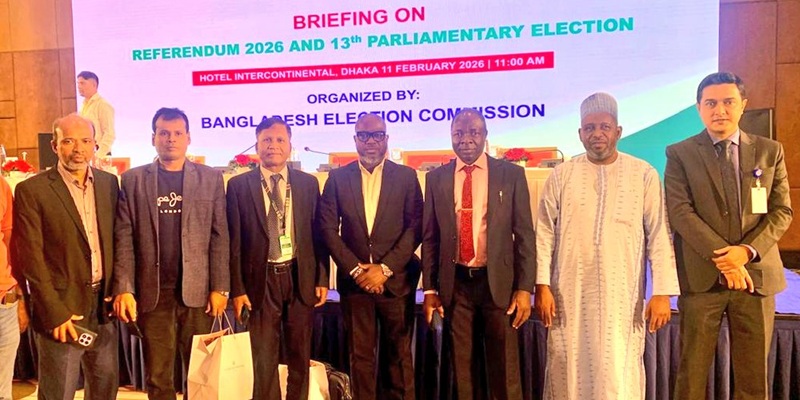

A high-level delegation from Nigeria’s Independent National Electoral Commission (INEC) has arrived in Dhaka to monitor Bangladesh’s 13th Parliamentary Elections and a concurrent National Referendum scheduled for February 12, 2026.
The visit underscores Nigeria’s commitment to strengthening democratic practices through international electoral observation.
Briefing of Observers
At a formal session for national and international observers, the Chief Election Commissioner (CEC) of Bangladesh, Mr. A M M Nasir Uddin, addressed participants alongside four other commissioners.
The commission revealed that nearly 128 million voters are expected to cast ballots across 299 constituencies, choosing from 2,028 candidates representing 50 political parties.
Voters will also decide on the “July National Charter” referendum, a landmark proposal for constitutional and institutional reform.

Scale of Participation
The elections have drawn immense international interest:
- 330 international observers, including 220 from the European Union
- Over 160 foreign journalists
- Domestically, 45,000 local observers and 60,000 journalists have been accredited
Observers were also taken on a guided tour of the Jatiya Sangsad (National Parliament) to deepen their understanding of Bangladesh’s legislative history.
Security and Logistics
To ensure a peaceful and credible process, the Bangladesh Election Commission (BEC) has coordinated a massive security operation, deploying 900,000 security agents nationwide.
Voting will take place in a single-day window, from 7:30 AM to 4:30 PM.
Representing INEC Chairman Professor Joash Amupitan, SAN, the Nigerian delegation is led by National Commissioner Prof. Sunday Ajah.
The team includes:
- Mallam Mohammed Abubakar Sadiq, Resident Electoral Commissioner for Plateau State
- Mr. Adedayo Oketola, CPS/Media Adviser to the INEC Chairman
The Showdown
The delegation has already commenced pre-election activities, visiting polling stations across Dhaka to observe final logistical deployments.
Bangladesh’s 2026 parliamentary elections and referendum mark a pivotal moment in the country’s democratic evolution.
With Nigeria’s INEC delegation among the international observers, the exercise highlights the importance of cross-border collaboration in safeguarding electoral integrity.
The outcome of the referendum and polls will not only shape Bangladesh’s governance but also serve as a case study for electoral reforms across developing democracies.