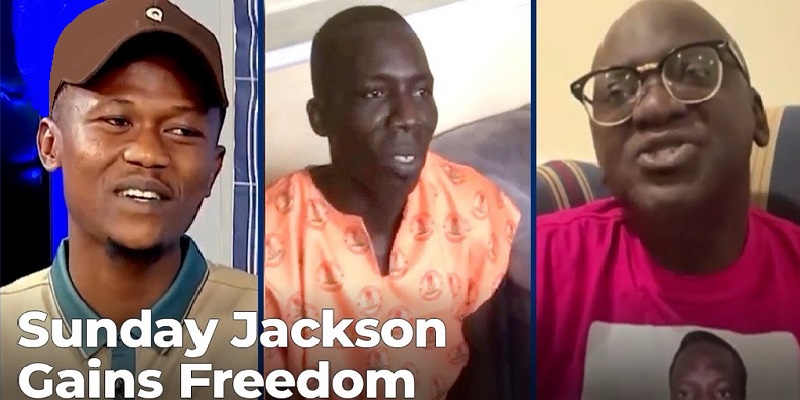
THIS DAWN — In a recent episode of INSIDER SOURCES, host Laolu Akande sat down with human rights lawyer Emmanuel Ogebe to discuss the remarkable journey that led to the pardon of Sunday Jackson following a landmark Supreme Court verdict.

The conversation shed light on the intricate interplay between law, advocacy, and executive discretion in Nigeria’s justice system.
This report distills the insights from that interview, offering a comprehensive account of how Jackson’s freedom was ultimately secured.
Background of the Case
Sunday Jackson’s ordeal began with a conviction that many observers believed was marred by procedural irregularities and questionable evidence.
His case became emblematic of broader concerns about due process and the protection of fundamental rights.
After years of appeals, the Supreme Court delivered a decisive ruling that recognized the flaws in the trial and affirmed Jackson’s entitlement to relief.
Yet, as Emmanuel Ogebe explained, “A Supreme Court verdict is not the end of the road—it is the beginning of another struggle to ensure that the judgment is implemented.”
Legal Foundations
Ogebe emphasized that the first step after the verdict was to translate the court’s decision into actionable demands.
His team prepared a detailed legal brief that highlighted the constitutional violations Jackson had endured and underscored the binding nature of the Supreme Court’s ruling.
“We had to make it clear that this was not a favor we were asking for,” Ogebe noted. “It was a constitutional imperative.”
This brief became the cornerstone of their petition to the executive branch, framing the pardon as a matter of justice rather than benevolence.
Advocacy Beyond the Courtroom
The interview revealed that legal arguments alone were insufficient. Public advocacy played a critical role in sustaining momentum.
Ogebe and his colleagues engaged civil society organizations, human rights groups, and the media to amplify Jackson’s plight.
By shaping the narrative, they ensured that the pardon request could not be quietly ignored.
Ogebe explained: “We understood that silence was our enemy.
“If the public forgot about Jackson, the authorities could delay indefinitely.”
Editorials, interviews, and press releases framed the pardon as a test of Nigeria’s commitment to justice.
This strategy created reputational pressure on decision‑makers, making inaction politically costly.
Negotiations with the Executive
Securing a pardon required direct engagement with the Ministry of Justice and the Presidency.
Ogebe described a series of meetings in which his team presented the Supreme Court verdict as both a legal directive and a moral obligation.
He said: “We had to balance diplomacy with firmness.
“We respected the institutions, but we insisted that justice delayed was justice denied.”
These negotiations were often protracted, with bureaucratic hurdles and political considerations threatening to stall progress. Persistence proved essential.
Each meeting moved the process incrementally forward, demonstrating that sustained pressure could overcome inertia.
Challenges Encountered
Ogebe candidly acknowledged the obstacles his team faced. Bureaucratic delays, shifting political priorities, and skepticism from some officials created significant hurdles.
At one point, there were fears that Jackson’s case might be overshadowed by other national issues.
To counter this, the team maintained constant communication with stakeholders and ensured that Jackson’s name remained visible in public discourse.
“We refused to let his case fade into obscurity,” Ogebe recalled. “Visibility was our shield against neglect.”
The Turning Point
According to Ogebe, the turning point came when the advocacy campaign reached a critical mass.
Civil society groups rallied behind Jackson, and international observers began to take notice.
The combination of legal clarity, public pressure, and diplomatic engagement created a context in which granting the pardon became the most viable option for the executive.
“At that stage, denying the pardon would have been indefensible,” Ogebe remarked.
Ultimately, the Presidency announced a full pardon for Sunday Jackson. The decision was met with widespread relief and celebration.
Jackson’s family expressed gratitude, while human rights advocates hailed the outcome as a victory for justice.
Ogebe reflected on the moment: “It was the culmination of years of struggle.
“The Supreme Court gave us the legal foundation, but it took collective effort to translate that into freedom.”
Lessons from the Experience
The interview highlighted several key lessons:
- Legal clarity is essential. A Supreme Court verdict must be distilled into actionable arguments for the executive.
- Public advocacy strengthens legal efforts. Mobilizing opinion ensures that justice cannot be quietly deferred.
- Persistence is critical. Negotiations with authorities require resilience in the face of delays.
- Justice requires vigilance. Even after a favorable ruling, additional steps are often necessary to secure true freedom.
Ogebe stressed that Jackson’s case should serve as a precedent for future efforts to ensure that judicial decisions are respected and implemented.
Broader Implications
Beyond Jackson’s personal freedom, the case carries broader implications for Nigeria’s justice system.
It underscores the importance of collaboration between the judiciary, civil society, and the executive in upholding the rule of law.
It also highlights the need for reforms to ensure that Supreme Court verdicts are implemented swiftly and without unnecessary obstacles.
“Justice must not only be declared—it must be delivered,” Ogebe concluded.
The interview with Emmanuel Ogebe on INSIDER SOURCES offered a compelling narrative of perseverance, advocacy, and legal strategy.
Securing Sunday Jackson’s pardon after the Supreme Court verdict was a landmark achievement that demonstrated the power of coordinated action.
It reaffirmed the principle that justice is not complete until it is both pronounced and enforced.
Jackson’s freedom stands as a testament to the enduring value of resilience, public engagement, and the rule of law.