THIS DAWN — The spectacle of Nicolás Maduro’s extraction from Caracas was dramatic enough to dominate headlines.

Yet the true story of that operation lies not in the palace corridors but in the skies above Venezuela.
While the world focused on the images of Special Forces storming the compound, the decisive battle was fought invisibly—in the electromagnetic spectrum and the stealth corridors of modern air warfare.
What unfolded was not just a military raid but a demonstration of how the United States has redefined the art of neutralizing advanced air defenses in minutes.
The Decision to Sideline the F-16
The U.S. Air Force’s choice to bypass its venerable F-16 fleet was telling.
For decades, the F-16 has been the backbone of American air power, a versatile fighter capable of precision strikes and dogfights alike. But Venezuela was no ordinary target.
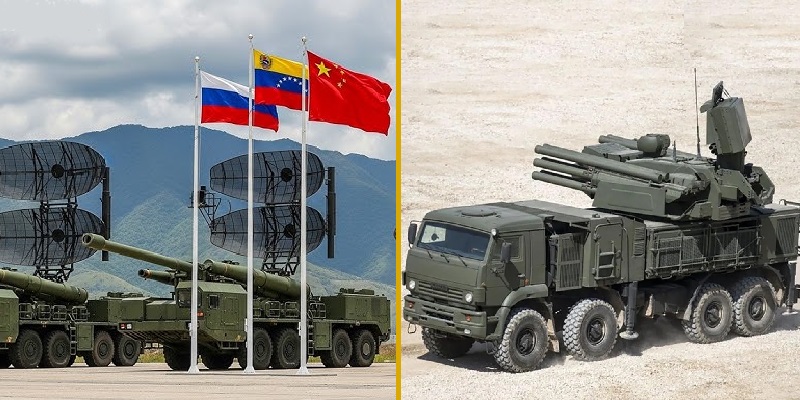
Its skies were guarded by a fortress of Russian S-300VM systems, Chinese radar networks, and Iranian-sourced Shahed drones.
This was a “highly lethal” environment where non-stealth aircraft would have been detected, tracked, and destroyed long before reaching their objectives.
Deploying F-16s against such a dense, integrated air defense grid would have been akin to lighting them up “like a Christmas tree” miles from the coast.
The U.S. understood this risk and instead turned to its crown jewel: the F-35 Lightning II.
The F-35 Advantage: Stealth Meets Sensor Fusion
The F-35 is more than a fighter jet—it is a flying supercomputer. Its stealth profile allows it to slip past radar detection, but its true strength lies in sensor fusion.
By integrating data from multiple sources—satellites, ships, drones, and other aircraft—the F-35 creates a real-time picture of the battlespace.
In Venezuela, this capability was decisive.
Launching from Puerto Rico and sea-based platforms, F-35s identified and targeted mobile air defense sites in real time.
The dense radar grids and missile batteries that once made Caracas a fortress were reduced to expensive lawn ornaments.
Russian S-300s, Chinese radar networks, and Iranian drones—all formidable on paper—were neutralized before they could mount a coherent defense.
Command and Control: A Floating Headquarters
The operation was not just about stealth aircraft.
The U.S. deployed a command and control juggernaut: eight destroyers and three amphibious assault ships transformed the Caribbean into a floating headquarters.
This naval presence provided redundancy, resilience, and overwhelming electronic warfare capabilities.
It ensured that the electromagnetic spectrum was dominated by U.S. forces, jamming hostile signals and coordinating strikes with precision.
This integration of sea and air power reflects a broader shift in American doctrine.
Modern warfare is no longer about isolated platforms but about networks—systems that talk to each other, share data, and act as one cohesive force.
In Venezuela, that doctrine proved its worth.
The Collapse of Venezuelan Air Defenses
By the time Venezuela’s aging Su-30MK2 fighters scrambled, the digital war was already over.
These aircraft, relics of a previous era, were hopelessly outmatched.
Against stealth jets guided by sensor fusion and backed by naval command ships, they were little more than symbolic gestures of resistance.
Within fifteen minutes of the order, Venezuelan targets were reached. The S-300s, once touted as Russia’s answer to American air superiority, were rendered inert.
China’s radar networks, designed to provide early warning, were blinded. Iranian drones, cheap but numerous, were swatted from the sky.
The fortress had crumbled, not through brute force but through technological dominance.
Lessons for Global Air Defense
The Venezuelan operation offers sobering lessons for nations relying on Russian or Chinese air defense systems.
The S-300VM, Buk-M2 units, and dense radar grids are formidable when facing conventional aircraft.
But against stealth platforms like the F-35, integrated with naval and satellite assets, they are vulnerable.
The electromagnetic spectrum has become the new battlefield, and traditional air defense doctrines are struggling to adapt.
For Russia and China, this is a wake-up call.
Their systems, once marketed as impenetrable shields, were exposed as brittle when confronted with American sensor fusion and stealth.
For smaller nations investing heavily in these defenses, the message is clear: without the ability to counter stealth and electronic warfare, their skies remain vulnerable.
The Symbolism of Speed
Perhaps the most striking aspect of the operation was its speed. Venezuelan defenses collapsed within fifteen minutes.
In military terms, this is astonishing. It underscores the reality that modern warfare is not about prolonged battles but about decisive strikes.
The U.S. demonstrated that it could dismantle a fortress of integrated defenses in less time than it takes to play a football match.
This speed carries symbolic weight. It sends a message to adversaries that American forces can act swiftly, decisively, and with overwhelming technological superiority.
It also reassures allies that U.S. commitments are backed by capabilities that can deliver results in minutes, not days.
The Future of Air Warfare
The Venezuelan operation is a glimpse into the future of air warfare.
Stealth, sensor fusion, and electromagnetic dominance are the new pillars of military power.
Traditional notions of dogfights and missile duels are giving way to digital wars fought in invisible corridors.
The battlefield is no longer defined by geography but by networks of data, signals, and stealth platforms.
For the U.S., this operation was not just a tactical victory but a strategic demonstration. It showcased the integration of air, sea, and electronic warfare in a seamless campaign.
It highlighted the value of the F-35 as more than a fighter jet—as a command node in a digital battlespace.
And it underscored the importance of speed, precision, and technological dominance in modern conflict.
In the end, Venezuela’s Russian S-300s, Chinese radar networks, and Iranian drones were reduced to expensive lawn ornaments.
They looked impressive, they sounded formidable, but they were powerless against the invisible war waged by American forces.
The extraction of Maduro was the visible climax, but the real victory was won in the electromagnetic spectrum.
Watch the AI-generated video below: