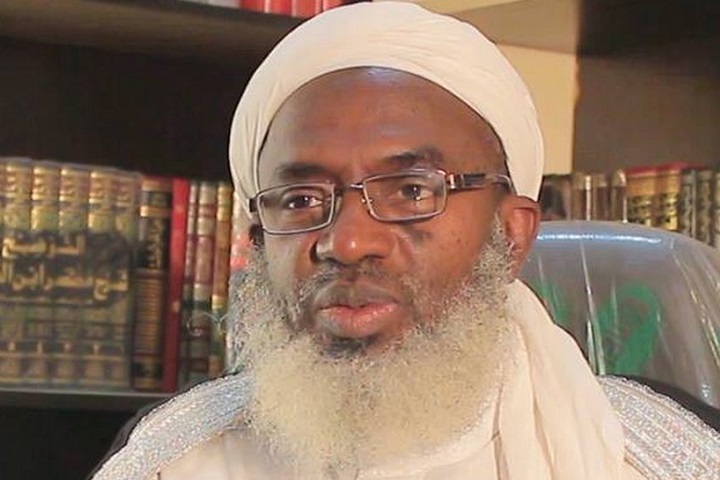
THIS DAWN — Prominent Islamic cleric, Sheikh Ahmad Abubakar Mahmud Gumi, has issued a stern warning to the Federal Government over the recent airstrikes on terrorists’ strongholds by the United States military.

Sheikh Gumi cautioned that Nigeria is making a grave mistake by permitting foreign military involvement, particularly from the United States.
His remarks on airstrikes in Sokoto, have sparked debate about sovereignty, security, and religious harmony in the country.
Gumi Posits on Foreign Intervention
In a Facebook post, Gumi argued that foreign military powers claim to fight terrorism, instead create chaos and bloodshed.
He insisted that “terrorists don’t fight terrorists in truth; they may only kill innocent people and have ulterior motives behind the drama of fighting terror.”
According to him, sovereign nations should not allow its territory to become a theater of war.
He also urged such nations not to turn their neighboring countries into enemies.
He suggested that if Nigeria genuinely requires external military support, it should seek assistance from other countries.
His choice of such countries include China, Turkey, or Pakistan.
He expressed belief they could provide effective help without the destabilizing consequences associated with U.S. involvement.
Gumi Warns of Polarization and Sovereignty Risks
Sheikh Gumi cautioned that the presence of U.S. forces in Nigeria would inevitably attract genuine anti‑U.S. elements, turning the country into a battleground.
He further warned that claims of protecting Christians could deepen divisions and polarize Nigeria along religious lines.
“The USA’s involvement in Nigeria, citing coming to ‘protect Christians’, will ultimately polarize our nation and infringe on our sovereignty,” he said.
He urged the Federal Government to immediately halt all military cooperation with the United States.
He described America’s global military footprint as imperialistic.
Symbolism of the Sokoto Strike
Gumi described the alleged U.S. strike in Sokoto as symbolic of a “neo‑Crusade war against Islam.”
He noted that Sokoto, where 90 percent of the population is Muslim, was not facing imminent danger of terrorism.
The cleric compared it to Maiduguri in Borno State, which remains a hotbed of Boko Haram and ISWAP activity.
He questioned the timing of the strike, which reportedly occurred on Christmas Eve, suggesting the U.S. framed it as protection against Christian genocide.
“Attack on Sokoto, while the real threat is in Maiduguri, says a lot.
“We believe the terror is manufactured and sustained by the same people claiming to fight it,” he declared.
The cleric emphasized that dropping bombs “here and there” cannot solve Nigeria’s terrorism problem.
Instead, he called for serious military deployment on the ground, arguing that Nigeria has enough manpower if the government is committed.
He also urged communities affected by the strikes to upload videos and pictures of casualties to expose the true impact of foreign intervention.
Call for Domestic Solutions
Sheikh Gumi’s remarks highlight growing unease among sections of Nigeria’s religious and political elite about foreign military involvement.
His warning reflects concerns that external powers may exploit Nigeria’s insecurity for strategic interests, while inadvertently worsening sectarian tensions.
Analysts note that his comments could influence public discourse ahead of the 2027 elections, as he explicitly suggested that foreign intervention would become a campaign issue.
They also debated his call for Nigeria to seek partnerships with non‑Western countries such as China, Turkey and Pakistan.
Analysts say it underscores shifting geopolitical alignments in Africa, where Western influence is increasingly in contest.
Sheikh Ahmad Gumi’s intervention adds a powerful voice to the debate over Nigeria’s security strategy.
By framing U.S. involvement as a threat to sovereignty, unity, and stability, he has challenged the government to reconsider its reliance on foreign military powers.
As Nigeria grapples with persistent terrorism, banditry, and communal violence, the cleric’s warning underscores the delicate balance between seeking external assistance and safeguarding national independence.
Whether the government heeds his call to halt cooperation with the United States will become.
Meanwhile, his statement has already intensified scrutiny of Nigeria’s security partnerships and their long‑term implications.