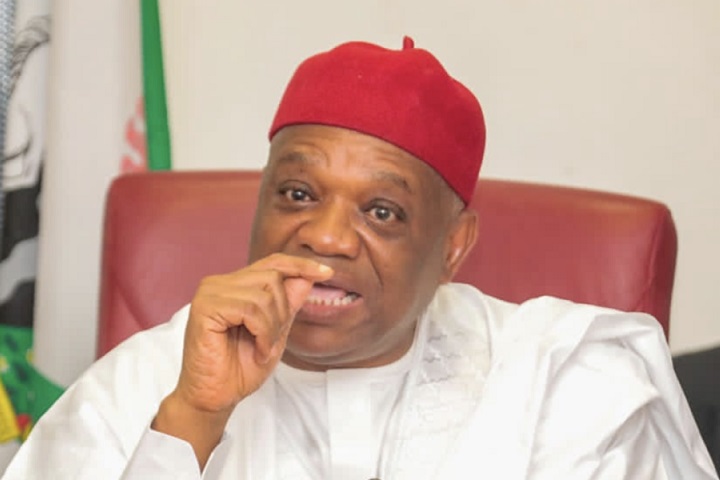
THIS DAWN — Among the class of governors elected in 1999, Chief Orji Uzor Kalu—then Governor of Abia State—was widely regarded as one of the most influential and promising figures of his generation. It was the zenith of the Peoples Democratic Party (PDP) era, and power in Abia was consolidated not only through formal institutions but also through informal networks. Chief among these was the formidable influence of Kalu’s mother, whose home became a political clearinghouse of sorts.

Commissioners, permanent secretaries, contractors, local government chairmen, and other power brokers routinely gathered there for the now-infamous “egusi peeling.” Participation was not optional for anyone serious about remaining relevant in Abia’s political ecosystem. My late aunt, who served in that administration, was among those compelled to attend.
In 2001, I had the rare opportunity to listen to Orji Uzor Kalu speak at the Ohaneze Ndigbo Annual General Assembly in Enugu. I attended at the invitation of the late Professor Ben Nwabueze. The gathering was a formidable convergence of Igbo intellectual and moral authority: eminent scholars, traditional rulers, professionals, clergy, governors of the five South-East states, ministers, and elected representatives.
Among those present were the late Chief Chukwuemeka Odumegwu Ojukwu, Professor Ben Nwabueze, Chief MCK Ajuluchukwu, retired Justice Eze Ozobu, Chief Evan Enwerem, and Dr. Alex Ekwueme—all of blessed memory.
When it was Orji Uzor Kalu’s turn to speak, he launched into a tirade that stunned the assembly. He accused Igbo leaders and elder statesmen of trading the collective interests of the Igbo people for contracts from Abuja, dismissively branding them “glorified errand boys.”
It was during this same address that he first publicly floated the idea of an “Igbo presidency project.” Rather than galvanising consensus, his remarks deeply offended the very leaders whose support such a project would require. In protest, they walked out of the meeting one after another.
Ironically, while the elders exited in indignation, Ohaneze Ndigbo youths hoisted Kalu shoulder-high, convinced they were witnessing the emergence of a bold, uncompromising young Igbo leader. In retrospect, that moment marked not the rebirth of Igbo political cohesion, but the beginning of the erosion of Ohaneze’s moral authority and influence.
By 2003, the contradictions had become undeniable. At the PDP presidential convention in Abuja, Orji Uzor Kalu—still Governor of Abia State and, by alphabetical order, the first delegate to cast a vote—stood at a defining crossroads. The contest pitched Dr. Alex Ekwueme, an illustrious Igbo statesman, against the incumbent President, Olusegun Obasanjo. The expectation among many was clear. Yet, when the vote was cast, Kalu openly voted for Obasanjo. He later justified his decision as a vote for “continuity,” citing loyalty to his friend, then Vice President Atiku Abubakar.
For many Igbos, that vote symbolised a profound betrayal.
In the years that followed, the pattern only hardened perceptions. Kalu publicly boasted of implementing the controversial RUGA policy in Abia State. He became so unpopular that he was reportedly stoned in Aba. Yet today, this same figure postures as a political kingmaker, assembling what many Abians regard as the very “hawks and vultures” that have preyed on the state for over two decades, while threatening to unseat the current governor, Chief Alex Otti.
In a functional and accountable society, such a record would invite lasting legal and moral consequences. For many in Abia, the verdict is already settled. The state rejects him—collectively and unequivocally.
Collins Obinwanne Nwanguru
Abiriba Online