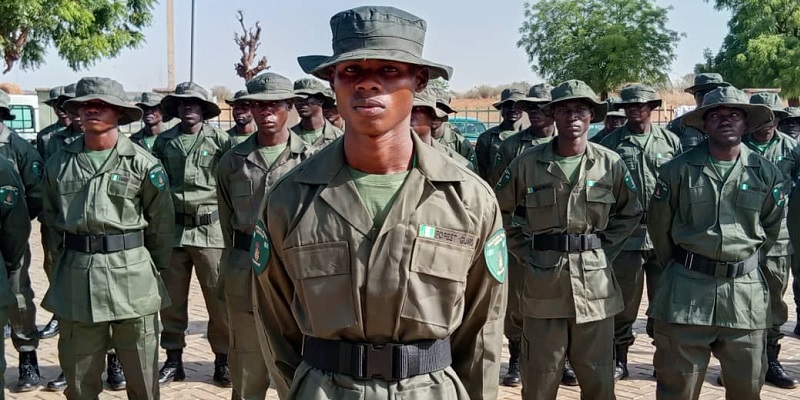
THIS DAWN — The Federal Government of Nigeria has announced the graduation of over 7,000 newly recruited Forest Guards under the Presidential Forest Guards Initiative, a landmark security programme launched by President Bola Ahmed Tinubu in May 2025. The initiative, coordinated by the Office of the National Security Adviser (ONSA), aims to reclaim Nigeria’s forests from criminal exploitation and strengthen internal security across vulnerable regions.

Graduation ceremonies were held simultaneously across seven frontline states—Borno, Sokoto, Yobe, Adamawa, Niger, Kwara, and Kebbi—marking the conclusion of an intensive three-month training programme. The initiative represents a strategic Federal–State collaboration designed to deny terrorists, bandits, kidnappers, and other criminal groups sanctuary within Nigeria’s forested and hard-to-reach terrains.
Rigorous Training for a New Security Force
The training programme was deliberately structured to be physically and mentally demanding, transforming loyal and committed Nigerians into agile, disciplined, and mission-ready field operatives. Trainees underwent endurance exercises, obstacle-crossing drills, and long-range patrol simulations to prepare them for sustained forest operations.
In addition to physical conditioning, the curriculum emphasized tactical fieldcraft, including movement techniques, enemy-contact drills, ambush response, rescue operations, and coordinated offensive actions. These skills are intended to equip the Forest Guards to operate effectively in hostile environments and disrupt criminal networks embedded in forest zones.
The programme also integrated environmental conservation principles with advanced security competencies, ensuring that operatives are not only defenders of national security but also stewards of Nigeria’s natural resources.
Ethics and Professionalism at the Core
A central pillar of the training was the emphasis on ethics, legality, and professionalism. Trainees received instruction in human rights, International Humanitarian Law (IHL), gender rights, and the protection of civilians. Arms handling and use-of-force protocols were strictly regulated under an Arms Management Manual jointly agreed upon by all participating agencies.
The training programme recorded a 98.2 percent completion rate. A total of 81 trainees were disqualified on disciplinary grounds, while two trainees passed away due to pre-existing medical conditions. All successful participants have been fully certified and cleared for operational service.
Immediate Deployment and Community Integration
Speaking at the ceremonies, National Security Adviser Nuhu Ribadu described the initiative as a decisive step toward restoring state authority and protecting vulnerable communities. “These Forest Guards are not just uniformed personnel. They are first responders, community protectors, and a critical layer of Nigeria’s security architecture,” Ribadu stated. “They will hold ground, gather intelligence, and support security agencies in reclaiming territories previously overtaken by criminal elements.”
The NSA confirmed that deployment would begin immediately, with no delay between graduation and operational duty. “Salaries and allowances will commence immediately, and every certified guard will proceed directly to assigned duty posts,” he added.
Importantly, the Forest Guards are indigenous to their respective local government areas, allowing them to leverage terrain familiarity and community trust in countering banditry, kidnapping, and illegal exploitation of forest resources.
Inter-Agency Coordination and Strategic Oversight
The Nigerian Forest Guard is an inter-agency national security initiative established under the strategic guidance of the National Security Adviser, in collaboration with the Federal Ministry of Environment. Operational coordination is provided by the Department of State Services (DSS) and the National Park Service.
The programme also draws doctrine and strategic input from the Defence Headquarters, Nigerian Army, Nigerian Navy, Nigeria Police Force, and the Nigeria Security and Civil Defence Corps (NSCDC), ensuring unity of command and operational effectiveness.
Governors and Deputy Governors from the seven participating states attended the ceremonies, including Governor AbdulRahman AbdulRazaq of Kwara State and Governor Mai Mala Buni of Yobe State, with other states represented by their Deputy Governors.
Reaffirming the Federal Government’s commitment, Ribadu concluded: “By protecting our forests, we are securing our territory. And by securing our territory, we are protecting our people. The Federal Government will not relent. This initiative will expand nationwide as part of our sustained effort to build a safer and more secure Nigeria.”