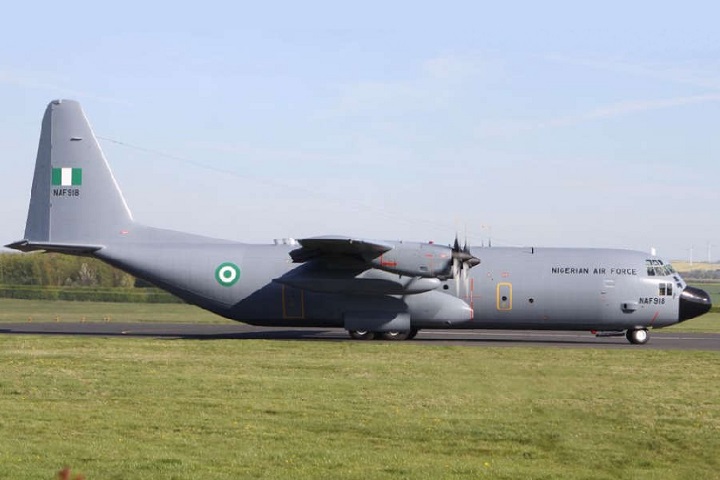
THIS DAWN — Claims circulating on social media and some online platforms that Burkinabè investigators have conclusively established that a Nigerian Air Force (NAF) C-130 aircraft did NOT make an emergency landing in Burkina Faso remain unsubstantiated, based on available public records and credible reporting.

The controversy centres on a December 2025 incident in which a Nigerian military C-130 aircraft landed in Bobo-Dioulasso, Burkina Faso.
Since then, conflicting narratives have emerged from Nigerian authorities, regional blocs, and independent commentators, fuelling speculation and diplomatic tension.
A review of publicly available information shows no independent or verifiable investigative report released by Burkinabè aviation authorities, the Burkina Faso government, or an international aviation body confirming that the landing was not an emergency.
What Burkina Faso and AES Have Said
The Confederation of Sahel States (AES)—a regional bloc comprising Burkina Faso, Mali, and Niger—issued statements alleging that the Nigerian aircraft entered Burkinabè airspace without proper authorisation.
According to AES-linked commentary reported by The Conclave Nigeria, Burkinabè authorities “investigated” the incident and concluded that the aircraft lacked clearance.
AES further characterised the incident as a violation of Burkina Faso’s sovereignty.
However, analysts note that these statements reflect political and security accusations, not the findings of a transparent, independent aviation safety investigation.
Crucially, no formal investigative report from Burkina Faso’s civil aviation authority or any recognised accident investigation body has been made public to support the assertion that the landing was not an emergency.

Nigerian Air Force’s Official Position
In contrast, the Nigerian Air Force has maintained that the aircraft made a precautionary or emergency landing after developing a technical issue mid-flight.
According to official NAF statements report, the aircraft diverted to the nearest suitable airfield in line with international aviation safety procedures.
The NAF also said the aircraft was on a ferry mission to Portugal, that the crew and personnel were unharmed, and that they initially received cordial treatment on the ground in Burkina Faso.
Media Coverage Shows Conflicting Narratives
International and Nigerian media reports largely reflect these competing claims.
Major international outlets, including AP News, have described the landing as an emergency or precautionary diversion linked to technical concerns, consistent with the Nigerian Air Force’s explanation.
At the same time, Nigerian outlets have reported AES claims that the aircraft lacked authorisation to be in Burkinabè airspace, noting that these claims are based on regional security assessments rather than an aviation safety probe.
What Has Not Been Established
As of now:
-
There is no publicly released investigative report from Burkina Faso confirming the landing was not an emergency.
-
There is no statement from the International Civil Aviation Organization (ICAO) contradicting the Nigerian Air Force’s account.
-
No independent international aviation investigation body has published findings on the incident.
Without such documentation, the claim that Burkinabè investigators have “established as fact” that the landing was not an emergency cannot be independently verified.
Analysts and Online Reactions
Despite the absence of verifiable evidence, several analysts and commentators have made strong claims online.
A social media user identified as Sahel Revolutionary Soldier alleged that detained Nigerian military personnel admitted to acting under orders, suggesting serious legal consequences.
Sahel Revolutionary Soldier wrote:
“The 11 Nigerian military detainee told Burkinabe investigators that they were only following orders, and it was not a decision they took on their own, to infiltrate sensitive Burkinabe sites.
“This is a serious matter; these guys could face the death penalty or a very long term in Burkina Faso’s custody.
“Be in no doubt, they are not going home any time soon.”
He added:
“It was not an emergency landing, that fact has been established by Burkinabè investigators.”
Aniboy, @ani_umoren1, responded:
“If it’s an emergency landing, it can be verified. It might take days. Burkina will do a proper check.
“Even if it means hiring Russian NTSBs who are experts; they will issue a verifiable report accordingly.
“You can’t just walk in and walk out of someone’s sovereign state.”
Taking a legal consequential angle, Chukwukadibia, @real_Igwekala, noted:
“If we had a reasonable senate, Tinubu should be facing impeachment and prosecution for the deployment of national assets for a foreign country without any good reason or due process…
“However, our national assembly is a rubber stamp… totally useless.”
These assertions, however, remain unverified opinions, not official statements from Burkina Faso’s government or judiciary.
Other commentators argued that if the landing was truly an emergency, it could be verified through technical inspection and a formal report—potentially involving external experts.
Meanwhile, some Nigerian commentators framed the incident within broader domestic political criticism, including calls for legislative oversight.
Conclusion
In summary, while Burkinabè authorities and the AES have alleged an airspace violation, there is no authoritative, publicly available investigation confirming that the landing was not an emergency.
The Nigerian Air Force maintains that the diversion was due to a technical issue, consistent with international aviation norms.
Until a recognised aviation investigative body publishes a formal report, claims that the emergency explanation has been disproven remain unverified and should be treated with caution.