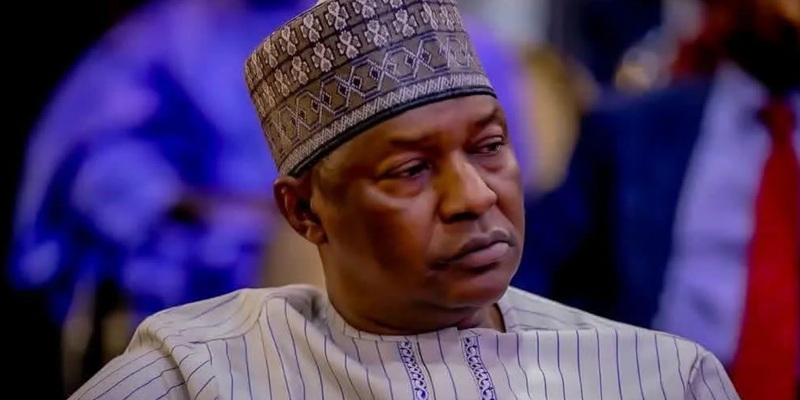
TDFormer Attorney General of the Federation Abubakar Malami and his son Abdulaziz were arraigned today before the Federal High Court in Abuja on five counts related to terrorism financing, aiding and abetting terrorism, and illegal possession of firearms.

The Department of State Services (DSS) brought the charges, accusing Malami of deliberately failing to prosecute known terrorism financiers during his tenure.
Meanwhile, both father and son are alleged to have unlawfully possessed a firearm and ammunition at their residence.
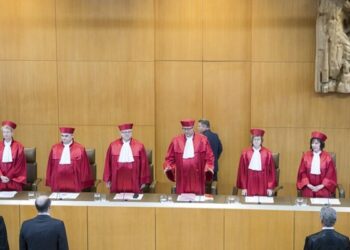
The arraignment, held before Justice Joyce Abdulmalik, marks a significant escalation in the scrutiny of high-profile figures from the administration of former President Muhammadu Buhari.
Malami, who served as AGF from 2015 to 2023, has long been a controversial figure.
He was criticized for what many perceived as selective enforcement of the law.
Included in the controversial cases were his handling of corruption cases and his role in the extradition of separatist leader, Nnamdi Kanu, from Kenya in 2021.
This latest case appears to stem from investigations into his official conduct and personal affairs.
It comes on the heels of his recent release from custody in a separate corruption probe by the Economic and Financial Crimes Commission (EFCC).
According to the charge sheet marked FHC/ABJ/CR/63/2026, the first count specifically targets Malami for “knowingly abetting terrorism financing” in November 2022.
Prosecutors allege that, while at the Federal Ministry of Justice in Maitama, Abuja, he refused to pursue legal action against terrorism financiers whose files were forwarded to his office.
This offense is punishable under Section 26(2) of the Terrorism (Prevention and Prohibition) Act, 2022.
The remaining four counts implicate both Malami and Abdulaziz in preparatory acts for terrorism and violations of the Firearms Act.
In December 2025, at their home in Gesse Phase II Area, Birnin Kebbi, Kebbi State, they allegedly possessed a Sturm Magnum 17-0101 firearm without a license, along with 16 live Redstar AAA 5.20 cartridges and 27 expended ones.
These charges fall under Section 29 of the Terrorism Act and Sections 3 and 8(1) of the Firearms Act, 2004, with penalties outlined in Section 27(1).
During the proceedings, DSS counsel Dr. Callistus Eze read the charges to the defendants, who pleaded not guilty to all counts.
Eze then requested a trial date and urged the court to remand the pair in DSS custody.
Defense counsel Shuaibu Arua, SAN, made an oral bail application, citing the defendants’ two-week detention and recent hospital visits.
However, Justice Abdulmalik rejected the oral plea, insisting on a formal written application since the court is “a court of record.”
She ordered their remand in DSS custody and adjourned the case to February 20, 2026, for bail hearing and trial commencement.
This case unfolds against a backdrop of Malami’s turbulent post-office life.
Just last month, he was granted bail of N500 million in an EFCC case involving N8.7 billion in alleged money laundering through family-linked entities.
He was rearrested by the DSS almost immediately upon release from Kuje Correctional Centre.
The arrest highlights the intense focus on former Buhari officials amid Nigeria’s ongoing anti-corruption and counter-terrorism efforts.
Critics have long accused Malami of shielding allies while aggressively pursuing opponents.
Included are his controversial decisions on Boko Haram-related prosecutions and his public statements in Hausa and Fulfulde during national broadcasts.
Public reaction has been swift and polarized, particularly on social media platform X (formerly Twitter).
Posts flooded in shortly after the arraignment, with users like @BiaPulse linking the charges to Malami’s involvement in Kanu’s case, calling it ironic justice for a man accused of terrorism links himself.
Investigative outlet @fijnigeria highlighted the counts, sparking discussions on accountability.
Security analyst Deji Adesogan shared updates, noting the broader implications for post-Buhari governance.
Many expressed skepticism about the timing, suggesting political motivations, while others hailed it as a step toward ending impunity.
The Sturm Magnum firearm at the center of the charges is a high-caliber weapon, and the presence of live and spent ammunition raises questions about its use.
Legal experts suggest the terrorism linkage could stem from intent to arm non-state actors, though details remain sparse.
As Nigeria grapples with persistent security challenges, including Boko Haram insurgency in the northeast, this high-profile case underscores the government’s commitment to holding even top officials accountable—or, as some argue, settling old scores.
Malami’s legal team has yet to comment publicly, but the February 20 hearing is anticipated to reveal more about the evidence and defenses.
With terrorism financing a global concern, international observers may watch closely, especially given Nigeria’s role in regional counter-terrorism initiatives.
This prosecution could redefine accountability in Nigerian politics, potentially encouraging further probes into the Buhari era.
For now, Malami and his son remain in custody, their fates hanging on the upcoming court date.