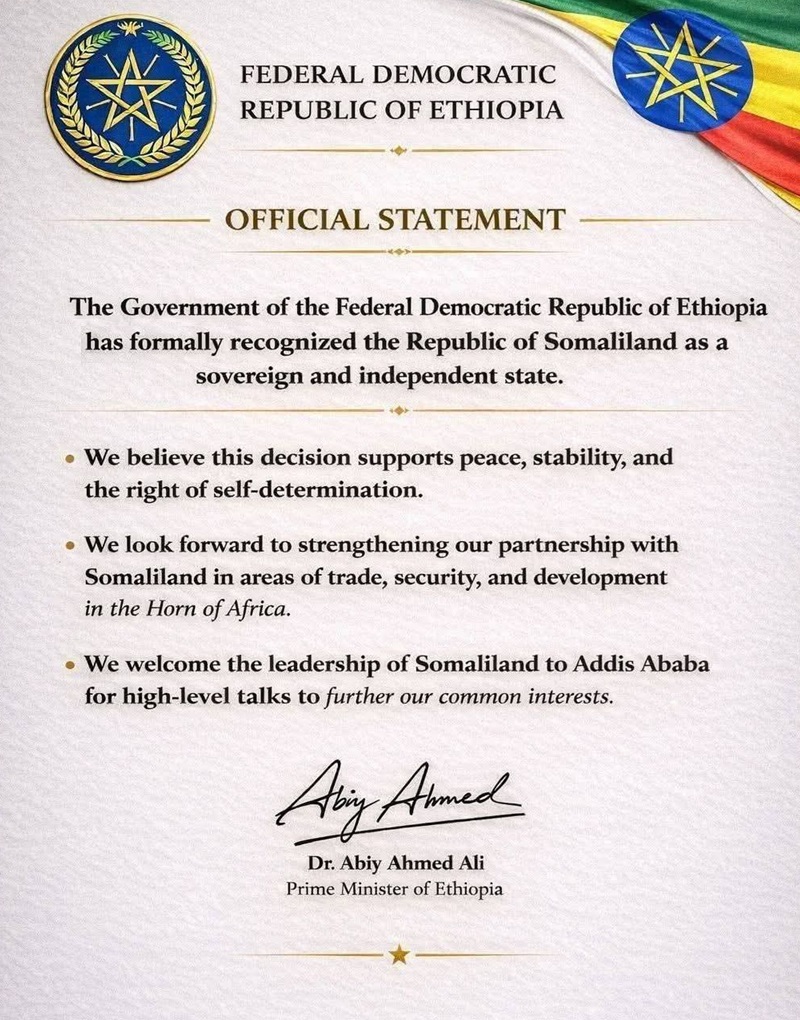
THIS DAWN — In a landmark diplomatic move, the Government of the Federal Democratic Republic of Ethiopia has formally recognized the Republic of Somaliland as a sovereign and independent state.

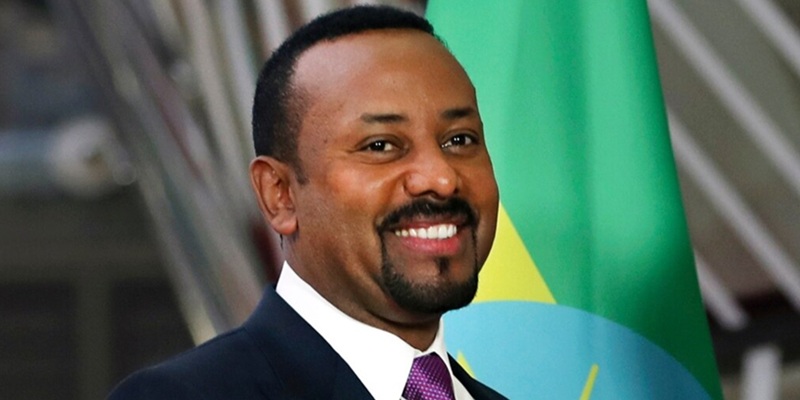
The announcement, signed by Prime Minister Dr. Abiy Ahmed Ali, marks a significant shift in regional politics and could reshape alliances, trade, and security dynamics across the Horn of Africa.
Official Statement from Ethiopia
The Ethiopian government’s statement emphasized three core principles behind the recognition:
- Support for peace and stability in the region
- Affirmation of the right to self-determination
- Commitment to strengthening bilateral partnerships in trade, security, and development
The statement also welcomed Somaliland’s leadership to Addis Ababa for high-level talks aimed at advancing mutual interests.
This gesture signals Ethiopia’s intent to deepen diplomatic engagement and formalize cooperation with Hargeisa.
Historical Context
Somaliland declared independence from Somalia in 1991 following the collapse of the central government in Mogadishu.
Despite functioning as a stable, democratic entity with its own institutions, currency, and military, Somaliland has struggled to gain international recognition.
Ethiopia’s decision to formally recognize Somaliland breaks with the African Union’s longstanding position on territorial integrity and could encourage other nations to reconsider their stance.
It also comes amid growing frustration in Somaliland over decades of diplomatic isolation despite its relative stability and democratic progress.
Strategic and Economic Implications
Addis Ababa’s recognition of Somaliland carries significant strategic and economic implications:
- Access to Ports:
Ethiopia, a landlocked country, has long relied on Djibouti for maritime access.
Recognition of Somaliland opens the door for expanded use of Berbera Port.
It will also potentially diversify Ethiopia’s trade routes and reducing dependency on Djibouti.
- Security Cooperation:
Both countries face threats from extremist groups and regional instability.
Formal ties could enhance intelligence sharing, border security, and counterterrorism efforts.
- Trade and Infrastructure:
Ethiopia and Somaliland have previously collaborated on road and logistics projects.
Recognition could accelerate joint infrastructure development, boosting regional connectivity and commerce.
Regional Reactions
The move is expected to provoke strong reactions across the Horn of Africa:
- Somalia:
Mogadishu has consistently opposed any recognition of Somaliland’s independence, viewing it as a violation of national sovereignty.
Ethiopia’s decision may strain diplomatic ties and trigger political backlash.
- African Union:
The AU has historically upheld the principle of territorial integrity, discouraging member states from recognizing breakaway regions.
Addis Ababa’s action could challenge this norm and prompt debate within the continental body.
- Gulf States and Global Powers:
Countries like the UAE and Saudi Arabia have shown interest in Somaliland’s strategic location.
Ethiopia’s recognition may accelerate foreign investment and geopolitical engagement in the region.
Somaliland’s Response
Somaliland is expected to welcome Ethiopia’s recognition as a historic breakthrough.
The government in Hargeisa has long argued that its democratic governance, stability, and contributions to regional security merit international recognition.
The invitation to Addis Ababa for high-level talks suggests that Somaliland’s leadership is eager to formalize diplomatic relations and explore new avenues for cooperation.
Broader Diplomatic Impact for Ethiopia
Ethiopia’s move could set a precedent for other African and non-African countries to reconsider their positions on Somaliland.
It also reflects a growing trend of pragmatic diplomacy, where stability and governance are prioritized over rigid adherence to colonial-era borders.
If more countries follow their lead, Somaliland could gain access to international institutions.
It may also gain development aid, and broader diplomatic engagement—transforming its status on the global stage.
Ethiopia’s formal recognition of Somaliland as a sovereign state marks a turning point in Horn of Africa diplomacy.
By endorsing Somaliland’s right to self-determination and committing to deeper bilateral ties, Ethiopia has challenged regional norms and opened the door to new strategic partnerships.
As high-level talks commence, the world will be watching closely to see how this bold move reshapes political dynamics, economic cooperation, and security architecture in one of Africa’s most complex and contested regions.
See document showing Ethiopia’s formal recognition of Somaliland below: