TD Nigeria spent ₦3.14 trillion servicing its domestic debt obligations in the first quarter of 2026, representing a 20.3 per cent increase from the ₦2.61 trillion recorded in the corresponding period of 2025.
The latest figures from the Debt Management Office (DMO) highlight the growing cost of domestic borrowing and the pressure high interest rates are placing on the Federal Government’s finances.
The Q1 2026 debt-service bill also represents a 37.5 per cent increase from the ₦2.28 trillion recorded in the fourth quarter of 2025.
Of the ₦3.14 trillion spent during the quarter, approximately ₦2.97 trillion, or 95 per cent, went to interest payments, while only ₦169.68 billion was used for principal repayments.
The figures underline the extent to which government borrowing is increasingly generating interest obligations rather than reducing the underlying debt stock.
Debt Service Rose Sharply Through the Quarter
The DMO data show that domestic debt servicing increased significantly between January and March.
The Federal Government spent ₦741.82 billion in January, rising to ₦967.67 billion in February, before reaching ₦1.43 trillion in March.

Interest payments accounted for ₦726.38 billion in January, ₦967.67 billion in February and ₦1.28 trillion in March.
For perspective, the Q1 figure of ₦3.14 trillion works out to an average of roughly ₦34.5 billion every day during the three-month period.
FGN Bonds and Treasury Bills Drive Interest Costs
Federal Government bonds accounted for the largest portion of interest payments during the quarter.
The government paid approximately ₦1.96 trillion in interest on FGN bonds, including about ₦1.90 trillion on domestic FGN bonds and ₦61.97 billion on the FGN US Dollar Bond.
Treasury Bills accounted for another ₦1.003 trillion in interest payments.

FGN Savings Bonds attracted approximately ₦4.24 billion.
The dominance of interest payments means that for every ₦100 spent servicing domestic debt during the quarter, approximately ₦95 went to interest and only ₦5 to principal repayment.

High Yields Are Increasing the Cost of Government Borrowing
The rising debt-service burden is closely connected to elevated yields on Nigerian government securities.
Treasury Bills and FGN bonds have offered relatively high yields as the government competes for domestic funds while monetary and fiscal conditions remain tight.
High yields make government securities attractive to banks, pension funds, institutional investors and other fixed-income investors. However, the same yields increase the cost of borrowing for the government.

The result is a potentially damaging cycle: large fiscal deficits require more borrowing; increased borrowing raises the supply of government securities; high yields are required to attract investors; and those yields subsequently increase future debt-service obligations.
As existing securities mature, refinancing them at elevated rates can further compound the government’s interest burden.
Private Sector Faces Crowding-Out Pressure
The consequences extend beyond government finances.
When government securities offer attractive returns with relatively low credit risk, financial institutions and institutional investors may have stronger incentives to hold Treasury Bills and government bonds rather than extend credit to businesses.
This creates a crowding-out effect in which substantial government demand for domestic financing competes with private-sector borrowers for available funds.
Businesses consequently face higher borrowing costs, making it more expensive to finance expansion, acquire equipment, establish new facilities or increase working capital.
For small and medium-sized enterprises, which already face significant financing constraints, elevated interest rates can make investment projects economically unviable.
Over time, weaker private investment can affect employment creation, productivity and economic growth.
Investors Benefit From High Yields
The high-yield environment is not entirely negative.
Investors holding government securities receive substantial interest income. Pension funds, banks, asset managers, institutional investors and individual savers with exposure to government securities benefit from the elevated returns.
In this sense, the interest payments represent a transfer of resources from government revenues to holders of government debt.
High yields can also help the government attract domestic financing and, under certain circumstances, foreign portfolio investment. They can therefore provide an important source of funding when access to cheaper external financing is constrained.
However, the fiscal cost remains significant when the government itself is the borrower.
Public Debt Reaches ₦159.35 Trillion
The rising interest burden comes against the backdrop of a substantial increase in Nigeria’s public debt stock.
According to the DMO, Nigeria’s total public debt stood at approximately ₦159.35 trillion as of March 31, 2026, compared with ₦159.28 trillion at the end of December 2025.
For comparison, total public debt stood at approximately ₦87.38 trillion as of June 30, 2023, shortly after President Bola Ahmed Tinubu assumed office.
The figures illustrate the scale of borrowing undertaken in recent years to finance government expenditure and budget deficits.
BudgIT Questions Returns From Borrowing
Civic technology organisation BudgIT has drawn attention to the growing debt-service burden, arguing that the central question should no longer be limited to how much Nigeria owes.
The organisation noted that ₦3.14 trillion in three months represents an enormous financial commitment at a time when the government continues to borrow to finance its budget.
BudgIT’s analysis projects approximately ₦15.81 trillion in total debt-service expenditure for 2026, describing the amount as close to half of projected federal revenue.
The concern is therefore increasingly about the economic returns Nigerians receive from borrowed funds.
Fiscal Space Under Pressure
The growing cost of debt servicing reduces the resources available for other government priorities.
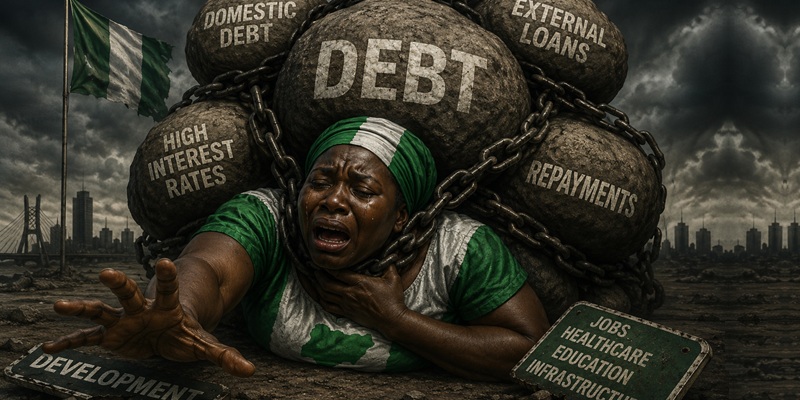
Every naira allocated to interest payments is a naira that cannot simultaneously be spent on infrastructure, healthcare, education, social protection or other development programmes.
If borrowing continues at elevated rates, debt service can consume an increasingly large share of government revenue, leaving policymakers with less fiscal space to respond to economic shocks.
The challenge is particularly acute because Nigeria is still borrowing to finance expenditure while simultaneously allocating increasingly large sums to servicing existing debt.
The Bigger Question: What Is Nigeria Borrowing For?
The Q1 2026 figures expose a fundamental fiscal dilemma.
Borrowing can be economically beneficial when it finances productive investments capable of generating future revenues, increasing productivity and expanding the economy.
But when borrowing primarily finances recurrent expenditure or is repeatedly rolled over at high interest rates, the government can become trapped in a cycle of borrowing, refinancing and escalating debt-service costs.
Nigeria’s ₦3.14 trillion domestic debt-service bill in the first quarter therefore represents more than a statistic.
It highlights the growing opportunity cost of high-cost borrowing and raises a fundamental question about fiscal policy: if Nigerians are assuming increasingly expensive debt, what measurable economic and social returns are they receiving from it?