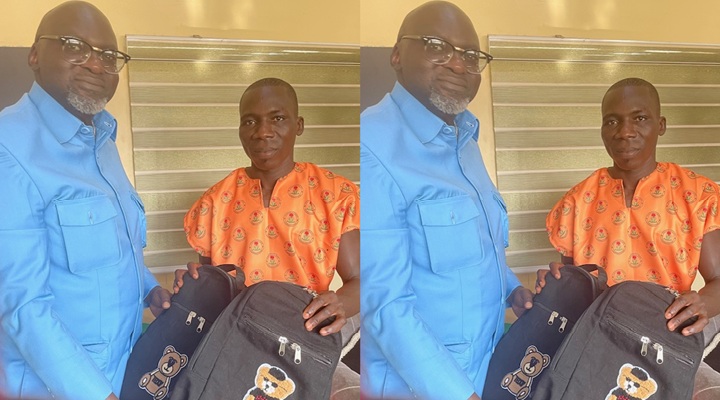
THIS DAWN — An emotional moment unfolded on Nigeria’s death row this Christmas season as Sunday Jackson, a condemned inmate who has spent more than a decade awaiting execution, sent a gift to a 10-year-old daughter he has never met and did not even know existed for years.

International human rights lawyer, Emmanuel Ogebe, revealed this in a memo, following his recent prison visit with Jackson.
Jackson’s case notably drew widespread condemnation from rights advocates locally and internationally.
Death Row for Self-Defence?
Jackson has been on death row for 10 years and 10 months following his conviction for killing an armed Fulani herdsman who violently attacked him on his farm in Adamawa State in February 2015.
Human rights groups have consistently described the incident as an act of self-defence.
They said authorities wrongly prosecuted and unjustly punished him with a death sentence.
According to Ogebe, Jackson had only one child at the time of his arrest.
However, during Ogebe’s first visit to him at Yola prison in 2021 — six years after the conviction — he made a startling discovery.
“I told him I had just seen his children,” Ogebe recounted. “Jackson looked puzzled and corrected me that he had only one child.
“That was when I realised he had not been informed that his wife had delivered another child after he was arrested.”
Ogebe said he immediately contacted Jackson’s uncle from the prison to confirm the details.
“I have never experienced anything like this in over 30 years as a human rights lawyer.
“I was the one who broke the news to Jackson that he had a second child — a girl — and she was already six years old at that point.”
Similar encounters
Ogebe said he has encountered similar moments of delayed family revelations in past humanitarian work.
This includes the repatriation of a Nigerian death row inmate from Indonesia and the reunion of a pastor freed from Boko Haram captivity.
However, he said Jackson’s situation was far more painful.
“Those were pleasant surprises,” he explained. “Jackson’s was different.
“He had a daughter who didn’t know him, and he didn’t know her.
“Worse still, he was facing execution and might never see her, yet she would live with the stigma.”
Ogebe disclosed that Jackson was also unaware his wife remarried and that she has since died.
“There was no hope, and that is why he was kept in the dark,” he said.
Yet, during a recent prison visit, a flicker of hope emerged.
Jackson handed Ogebe two schoolbags — one for the daughter he had raised before his arrest, and one for the daughter he had never met.
Handmade donations by fellow inmates
The bags, Ogebe revealed, were handmade by Jackson’s fellow inmates at the prison’s vocational skills centre.
“Jackson had no money,” Ogebe said.
“His co-prisoners donated the bags so he could send something to his daughters for Christmas,” he noted.
The lawyer said the gesture was deeply moving.
“When he gave me the bags, I could see that hope had come into his life.”
Jackson’s case, however, has continued to unravel in tragedy.
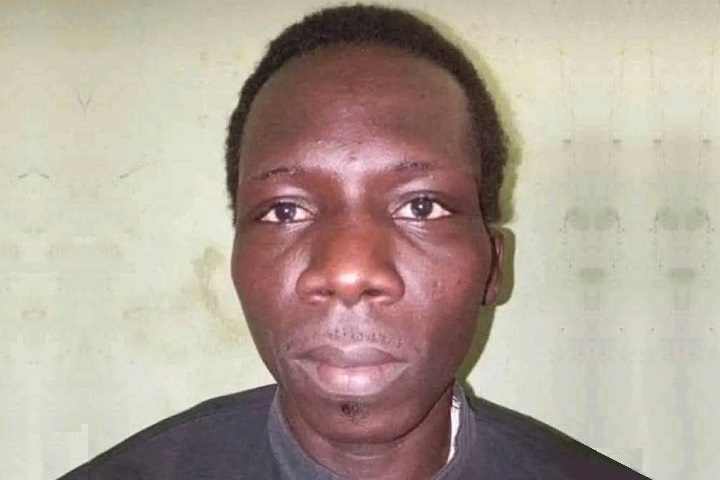
Earlier this year, after the Supreme Court upheld his death sentence, Ogebe and his team attempted to source a photograph of him for advocacy efforts.
They discovered that bandits destroyed Jackson’s home during a violent attack on his village.
They discovered that his former wife — the last known holder of his photos — had died.
“We had to take his photograph in prison.
“Otherwise, there would have been nothing left on earth as a memory of him,” Ogebe said.
In August, Ogebe visited Jackson’s children in Adamawa.
Wearing a “Free Jackson” T-shirt, he said the girls pointed at him excitedly.
Their aunt translated their words: “See daddy’s picture.”
Another emotional moment for the death row inmate
A similar emotional moment occurred when Ogebe showed Jackson’s mother her son’s photograph in March — her first time seeing his face in 10 years.
“These are the moments that touch you most as a human rights advocate.
“Who can put a price on hope? Now the child knows her father’s face.
“She knows he did not do bad, but that bad was done to him,” Ogebe narrated.
Ogebe added that the global advocacy on behalf of Jackson astonished him.
Prison authorities even permitted him to view photographs of his daughters for the first time.
Drawing a stark comparison, Ogebe questioned Nigeria’s justice system.
He cited a recent case in Australia where a Muslim immigrant who acted in self-defence against a terrorist attack received over $1 million in public donations.
“But in Nigeria, Jackson is on death row awaiting execution after almost 11 years in prison. How is this okay?” he asked.