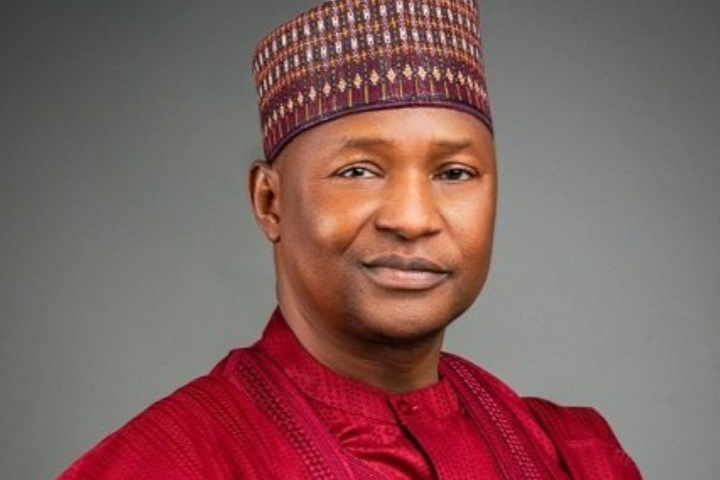
THIS DAWN — The Economic and Financial Crimes Commission (EFCC) has filed a 16-count charge of money laundering against former Attorney-General of the Federation (AGF), Abubakar Malami (SAN).

Also indicted by the EFCC are his son Abdulaziz Malami and an employee of Rahamaniyya Properties Limited, Hajia Bashir Asabe.
The charges were lodged before a Federal High Court in Abuja.
EFCC alleged that Malami laundered approximately N9 billion to acquire choice properties in Abuja, Kebbi, Kano, and other locations.
The EFCC further claims that Malami must account for 30 houses valued at N212.8 billion, allegedly acquired during his eight-year tenure as AGF between 2015 and 2023.
The EFCC has signaled its intention to invoke the Non-Conviction Asset Forfeiture clause of its Establishment Act.
The law allows the Commission to seize assets suspected to be proceeds of unlawful activity even without a conviction.
Interested parties have a 14-day window to show cause why the properties should not be forfeited to the federal government.
Breakdown of Charges against Malami
The 16 charges detail how Malami allegedly used Metropolitan Auto Tech Limited and other entities to conceal or disguise the origins of illicit funds.
Key highlights include:
- Charge 1: Concealment of N1.014 billion in a Sterling Bank account between July 2022 and June 2025.
- Charge 2: Concealment of N600 million between September 2020 and February 2021.
- Charge 3: Retention of N600 million as collateral for a loan to Rayhaan Hotels Ltd.
- Charge 4: Payment of N500 million to Efab Properties Ltd for a luxury duplex in Maitama, Abuja.
- Charge 5: Conspiracy to disguise N1.049 billion through Meethaq Hotels Ltd accounts.
- Charge 6: Control of N1.362 billion through Meethaq Hotels Ltd’s Union Bank account.
- Charge 7: Concealment of N700 million used to purchase Harmonia Hotels Ltd in Garki, Abuja.
- Charge 8: Concealment of N850 million for Meethaq Hotels Ltd property in Jabi District.
- Charge 9: Acquisition of property at Rhine Street, Maitama, Abuja for N430 million.
- Charge 10: Concealment of N210 million for property in Asokoro District, Abuja.
- Charge 11: Concealment of N325 million for property at Yakubu Gowon Crescent, Asokoro.
- Charge 12: Concealment of N120 million for property at Efab Estate, Gwarimpa, Abuja.
- Charge 13: Conspiracy to conceal funds for a luxury duplex in Maitama, Abuja.
- Charge 14: Acquisition of landed properties between 2016 and 2022 with illicit funds.
- Charge 15: Concealment of N537 million for properties in Abuja, Kebbi, and Kano.
- Charge 16: Concealment of N415 million for multiple properties including land in Kebbi and Kano.
Properties Under Scrutiny
The EFCC alleges that Malami’s acquisitions include universities, hotels, schools, factories, residential estates, and commercial complexes, with valuations spread across:
- Kebbi State: N162 billion
- Kano State: N16 billion
- FCT (Abuja): N34.6 billion
These properties, according to investigators, were acquired during Malami’s tenure as AGF and are now subject to forfeiture proceedings.
Bail Granted by Court, Denied by EFCC
In a related development, Malami has alleged that the EFCC has refused to accept the ruling of the court which granted him bail.
Malami, who spoke through his media aide, said the commission chased away the bailiff and insisted on his continued detention, citing a high court order that expires today.
Malami, in the statement, also called on the international community and Nigerians of conscience to speak out against the actions of the EFCC.
He said that no agency is above the law.
Implications for Malami
The charges against Malami mark one of the most significant anti-corruption cases involving a former top government official in recent years.
Nigeria continues to grapple with systemic corruption by people entrusted with public oversight.
The case is expected to test the strength of the EFCC’s prosecutorial powers and the judiciary’s resolve in handling politically sensitive cases.
Legal analysts note that the reliance on the Non-Conviction Asset Forfeiture clause could set a precedent for future cases.
It can also allow the EFCC to seize assets even before a conviction is secured.
With the EFCC’s charges now before the court, the spotlight is firmly on Malami, his family, and associates.
The case underscores Nigeria’s ongoing struggle to enforce accountability at the highest levels of government.
The coming weeks will determine whether the properties worth over N212 billion will be forfeited to the federal government.
On the other hand, it may determine whether Malami and his co-defendants can successfully challenge the EFCC’s claims.