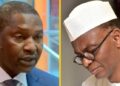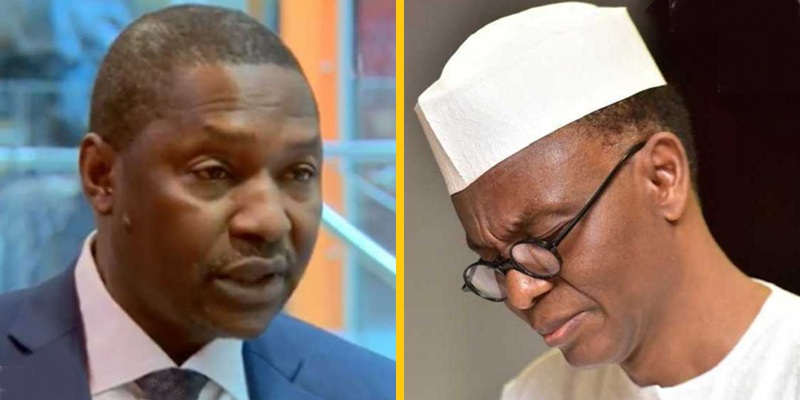

In the turbulent theatre of Nigeria’s politics, few names once commanded as much awe and authority as Abubakar Malami and Nasir El‑Rufai.
Malami, the former Attorney General of the Federation, was the legal strongman of the Buhari era, wielding immense influence over the nation’s justice system.
El‑Rufai, the fiery former Governor of Kaduna State, was celebrated as a reformist, a man of sharp intellect and unflinching boldness.
Together, they embodied the raw power of political office — men whose words could shift policy and whose decisions reverberated across the federation.
Today, however, their names echo not in triumph but in disgrace. Once untouchable, they now stand accused, scrutinized, and diminished. The mighty have indeed fallen.
From Pinnacle to Precipice
Malami’s tenure as Attorney General was marked by sweeping influence over Nigeria’s legal and political framework. He was seen as the custodian of the law, yet critics often accused him of bending it to suit political ends.
His pronouncements carried the weight of finality, and his office became synonymous with the interpretation — and sometimes manipulation — of constitutional authority.
El‑Rufai, meanwhile, carved a reputation as a fearless reformer, unafraid to confront entrenched interests.
His governance in Kaduna was polarizing — hailed by some as visionary for his infrastructural drive and educational reforms, condemned by others as authoritarian for his uncompromising style and controversial policies.
He was a man who thrived on confrontation, often relishing the role of disruptor in Nigeria’s political landscape.
But power, as history teaches, is ephemeral. Allegations of corruption, abuse of office, and questionable dealings now cloud their legacies.
The very institutions they once dominated are now instruments of their reckoning.
Their descent from power illustrates the fragility of influence in a democracy where public opinion and judicial scrutiny eventually catch up with even the most formidable figures.
The Lesson of Accountability
Their fall is not merely personal tragedy; it is a national parable. Nigeria’s democracy, imperfect though it may be, rests on the principle that no one is above the law.
When leaders who once stood at the pinnacle of authority are forced to answer for their actions, it signals that accountability, however delayed, remains possible.
The biblical lamentation, “How art the mighty fallen,” captures the essence of this moment. It is not mockery but sorrow — sorrow for wasted potential, squandered opportunity, and the erosion of trust.
These men could have etched their names in history as reformers and nation‑builders. Instead, scandal and suspicion now define their narrative.
Their plight also reflects a broader truth about Nigerian politics: the culture of impunity is slowly but surely being challenged.
The fall of such towering figures sends a message that the shield of political office cannot forever protect those who misuse it.
A Warning to the Powerful
For those who still wield power, the message is clear: govern with integrity, for the day of reckoning always comes.
Influence is fleeting; accountability is eternal. Nigeria’s citizens are watching, and history is merciless in its judgment.
Malami and El‑Rufai’s plight is a cautionary tale etched into the annals of Nigerian politics.
The mighty have fallen, and in their fall lies a timeless lesson: leadership without integrity is a house built on sand, destined to collapse when the storm of justice arrives.
The Broader Reflection
This editorial is not just about two men; it is about the enduring truth that power must be exercised with humility and responsibility.
For in the end, history remembers not the titles held, but the legacies left behind.
Malami and El‑Rufai once symbolized the heights of political ambition and influence.
Today, they symbolize the consequences of hubris and the inevitability of accountability.
Their story is a reminder to Nigeria’s ruling class: the higher the pedestal, the harder the fall.
And so, as the nation watches their unraveling, one truth resounds across the corridors of power: THE MIGHTY HAVE INDEED FALLEN!
And: NIGERIA MUST LEARN FROM THEIR FALL TO BUILD A FUTURE WHERE INTEGRITY, NOT IMPUNITY, DEFINES LEADERSHIP.