THIS DAWN — The sight of U.S. Navy warships steaming towards the Caribbean, coupled with bold rhetoric from the White House about a “democratic transition” in Venezuela, has returned the Latin American nation to the forefront of American foreign policy.

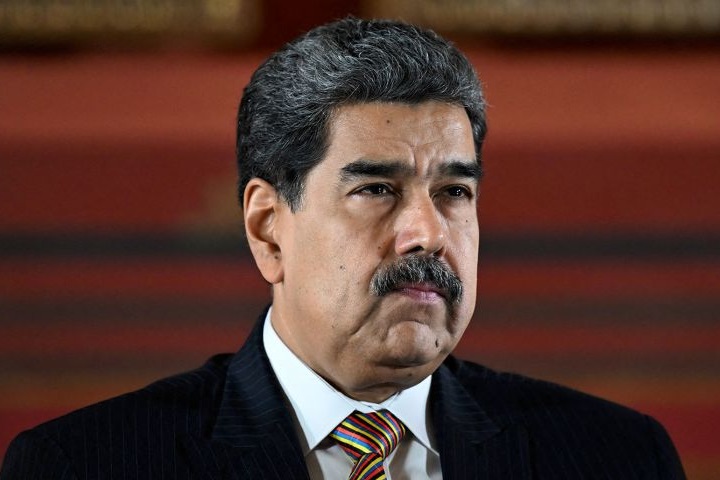
The Trump administration frames this as a moral crusade against the tyranny of Nicolás Maduro. But as the dust settles on the initial pronouncements, a more complex and unsettling picture emerges.
The American public must look beyond the humanitarian talking points to understand the true stakes of this escalating confrontation.
Suffrage of Venezuelans
Let us be clear: the suffering of the Venezuelan people under the corrupt and incompetent Maduro regime is a profound human tragedy.
The nation’s collapse is real, and the desire for freedom is legitimate. However, to view this military posturing solely through the lens of altruism is dangerously naive.
The administration’s motives are a tangled web of geopolitical strategy, domestic politics, and a characteristically theatrical brand of brinkmanship.
The Great Game
First, the Great Game in America’s Backyard.
For years, Caracas has become a client state for two of Washington’s primary adversaries: Russia and China.
Moscow has poured in military advisors and economic support, while Beijing has leveraged its massive loans for deep political influence.
This is not merely about Venezuela; it is about expelling rival powers from a hemisphere the United States has long considered its sphere of influence.
The Monroe Doctrine, it seems, is back with a vengeance, and the target is as much the Kremlin and the CCP as it is the palace in Miraflores.
“Black Gold”
Second, the Allure of Black Gold. Venezuela sits atop the largest proven oil reserves on the planet.
A friendly government in Caracas would pry open these reserves for American companies and fundamentally reshape global energy markets, weakening the leverage of both rivals and adversaries.
While the U.S. is now an energy exporter, control over Venezuelan oil remains a prize of immense strategic and economic value—a fact not lost on an administration led by a former oilman.
The Florida Calculus
Third, and perhaps most cynically, the Florida Calculus.
The large and politically potent Venezuelan (and Cuban) exile community in that critical swing state watches these events with intense interest.
A strong stance against “socialism” in Latin America is a potent political cudgel, used to galvanize a key voting bloc and paint political opponents as weak.
The timing and volume of this confrontation are inextricably linked to the looming electoral battle.
“Madman Theory”
Finally, we witness the “Madman Theory” in action.
President Trump has long believed in the power of unpredictable, overwhelming force as a negotiating tool.
The military buildup is less a prelude to a planned invasion and more a high-stakes bluff—a performance designed to terrify the Maduro inner circle and his military commanders into cracking.
The administration hopes the mere threat of American power will do the work of American soldiers, triggering the internal collapse it desires.
What does Trump want?
So, what does the President want? He wants a win.
A relatively low-cost, high-reward victory that checks multiple boxes: a geopolitical defeat for Russia and China, an economic boon, a domestic political rallying cry, and a dramatic television moment showcasing American strength.
The danger, of course, is that brinksmanship is a dangerous game.
Miscalculations can lead to unintended consequences. An accidental skirmish, a misread signal, or a desperate act by the Maduro regime could spiral into a conflict that no one—least of all the Venezuelan people—can afford.
The path forward requires more than gunboats and rhetoric.
It demands shrewd, consistent diplomacy with regional partners and a clear-eyed focus on the Venezuelan people’s welfare, not just the ouster of a single strongman.
The world is watching to see if American power will be a force for liberation or merely a tool in a larger, more self-interested game.
By Ogbuefi Ndigbo
London