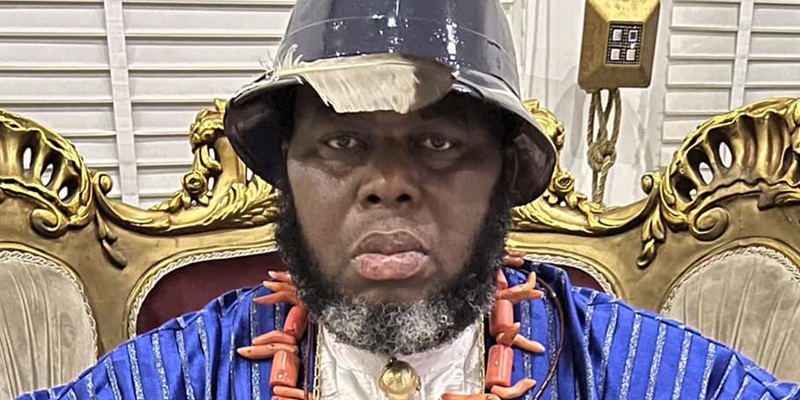
TD Niger Delta figure Asari Dokubo has reignited the long-running debate over the ethnic identity and historical origins of some Rivers State communities.
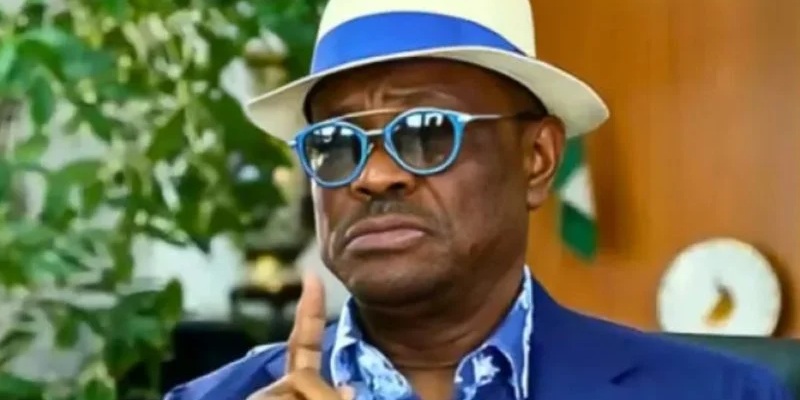
Dokubo questioned FCT Minister Nyesom Wike’s identity claims, while highlighting the linguistic roots of Wike’s name.
Dokubo made the remarks in a video circulating online in which he questioned claims about the historical origins of Wike and some communities in Rivers State.
The video was also shared by human rights lawyer Aloy Ejimakor.
It draws renewed attention to the often-sensitive debate over ethnicity, ancestry and identity in Rivers State.
At the centre of Dokubo’s argument was Wike’s name, Ezebunwo.

‘Why is your name Ezebunwo, not Obabunwo?’ asks Dokubo
Dokubo questioned why Wike bears the name Ezebunwo if, according to the argument he was challenging, his ancestry was connected to the Benin Kingdom.
His argument rests on the linguistic distinction between Eze, a term meaning king or traditional ruler in Igbo, and Oba, the corresponding title widely associated with the Benin/Edo traditional institution.
Dokubo’s point was that if the name were constructed using a Benin royal title, one would expect an Oba-based expression rather than Eze.
However, the linguistic observation by itself does not establish a person’s ethnic ancestry.
Names can be influenced by language contact, migration, intermarriage and historical interaction between neighbouring communities.
Available biographical accounts identify Wike as an Ikwerre from Rumuepirikom in Obio-Akpor, Rivers State.

The bigger Ikwerre-Igbo identity debate
The Dokubo argument touches on a much broader and longstanding question concerning the relationship between the Ikwerre and Igbo peoples.
Linguistically, Ikwerre is classified by several scholarly sources as an Igboid language, within the Volta-Niger branch of the Niger-Congo language family.
A linguistic study by Roseline Alerechi, for example, describes Ikwere as an Igboid language and places it within the West Benue-Congo family.
Historical scholarship, however, shows that the issue cannot simply be reduced to language classification.
A recent review of Ikwerre historiography notes that earlier scholarship often treated the Ikwerre as part of a broader Igbo grouping.
Meanwhile, subsequent historical work has increasingly examined Ikwerre history as a distinct subject.

Academic literature has therefore documented both the historical association of Ikwerre with Igbo and the development of a distinct Ikwerre ethnic identity.
That distinction is important because linguistic classification and ethnic self-identification are not necessarily identical.
Rivers State’s complex ethnic landscape
Rivers State, where Dokubo hails from, is one of Nigeria’s most ethnically and linguistically diverse states.
Its indigenous communities include Ijaw/Ijoid, Ikwerre and other Igboid-speaking groups, Ogoni communities, Ogba, Ekpeye, Etche, Abua/Odual, Andoni and several others.
Academic literature on the state’s linguistic situation describes it as highly heterogeneous, with several language families and numerous speech communities.
Ikwerre communities are concentrated principally around Ikwerre, Emohua, Obio-Akpor and parts of Port Harcourt.
However, neighbouring communities include Ogba-Egbema, Ekpeye, Abua, Etche, Eleme, Igbo and Ijo communities.
This geographical proximity has produced centuries of interaction, migration, intermarriage and cultural exchange.
Consequently, claims about the ancestry of particular Rivers communities can be considerably more complicated than simply assigning them to one modern ethnic category.
Dokubo challenges Benin-origin claims
In the video, Dokubo also rejected claims by some people from Rivers State who trace their ancestry to the ancient Benin Kingdom.
He argued instead that communities that identify as Igbo should acknowledge their Igbo roots rather than adopting a Benin-origin narrative.
His intervention comes amid longstanding debates over the historical origins of several communities in the Niger Delta.
Oral traditions, migration accounts, language, political history and contemporary ethnic self-identification sometimes produce competing narratives in the region.
The issue has particular political significance as far as ethnic identity in Rivers State is concerned.
It has frequently intersected with questions of land ownership, political representation, resource control and claims to indigeneity.
Dokubo asserts his own identity
While challenging the identity claims he was discussing, Dokubo also reaffirmed his own ethnic identity.
He positioned his argument within his broader views about the peoples of the Niger Delta.
Dokubo is widely identified with the Kalabari/Ijaw community.
In a 2007 interview, he discussed his Kalabari identity and traditional title.
He described Buguma as his father’s place and explaining the significance of his Kalabari chieftaincy title.
His latest comments therefore add another dimension to the continuing discussion over how ethnic identity should be understood in Rivers State.
A debate that extends beyond Wike
The controversy is ultimately larger than the identities of Wike or Dokubo.
Rivers State contains communities whose histories have been interpreted differently by historians, linguists and the communities themselves.
Ikwerre provides one prominent example: its language is classified within the Igboid family, while many Ikwerre people maintain a distinct ethnic identity.
That distinction has been documented in historical scholarship and should be considered when discussing claims about the state’s ethnic composition.
The argument over Wike’s name and alleged ancestry therefore reflects a much wider contest over history, language and self-identification in the Niger Delta.
While Dokubo’s Eze-versus-Oba argument is a striking linguistic point, a person’s name alone cannot conclusively establish or disprove ethnic ancestry.
The broader question requires consideration of genealogy, historical records, language, migration traditions and, importantly, the community’s own understanding of its identity.
The debate is likely to continue as ethnic identity remains closely intertwined with the political and historical narratives of Rivers State.