
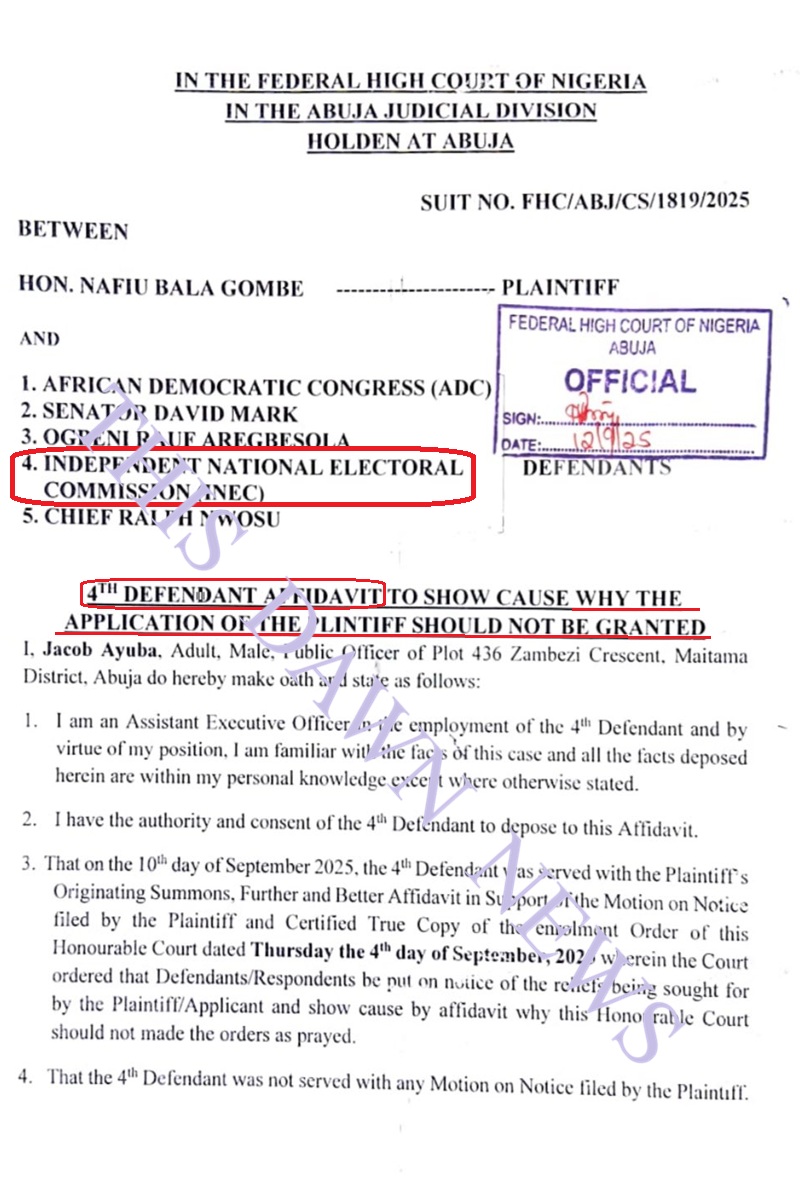
Nigeria’s fragile democratic balance was thrown into fresh controversy this week after the African Democratic Congress (ADC) released an affidavit sworn by the Independent National Electoral Commission (INEC) on September 12, 2025.
INEC explicitly affirmed the recognition of Senator David Mark and Ogbeni Rauf Aregbesola as the party’s National Chairman and National Secretary.
The affidavit, now public, has ignited debate over INEC’s neutrality and the future of multiparty democracy in the country.
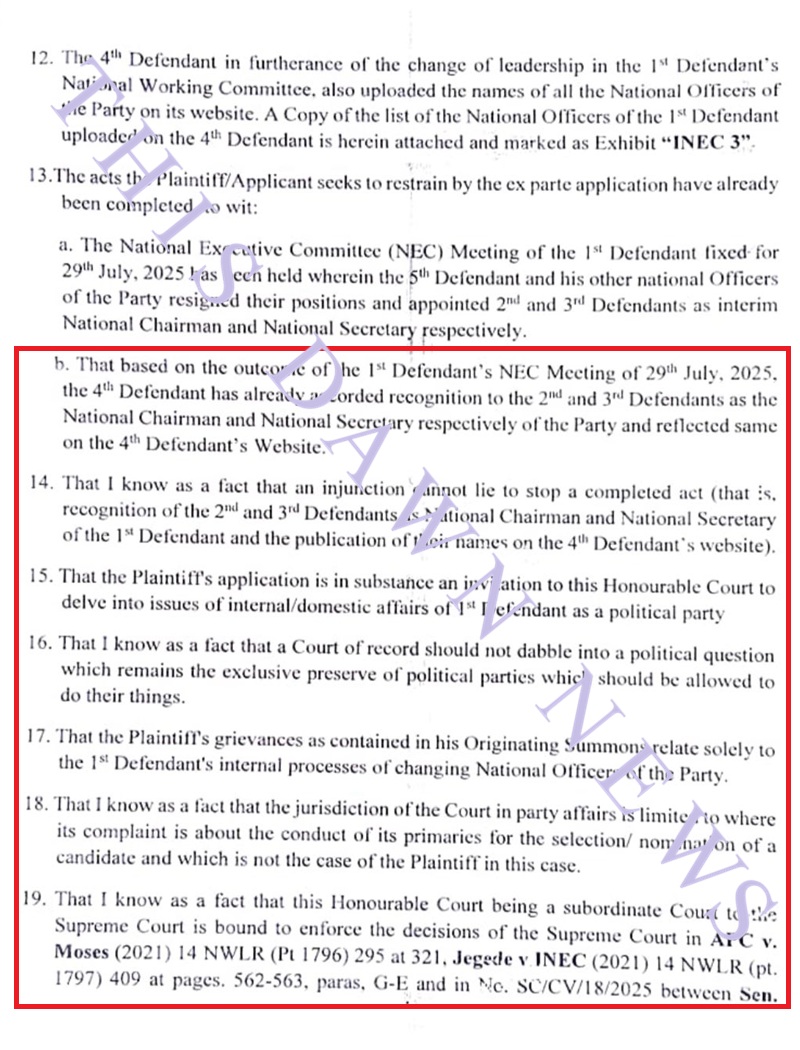
The affidavit, filed at the Federal High Court in Abuja, contains clauses 14 to 19 that are particularly revealing.
In those sections, INEC acknowledged that the ADC’s National Executive Committee (NEC) meeting of July 29, 2025, had already been held, monitored, and reported.
The commission confirmed that the leadership transition was completed, with David Mark and Aregbesola duly recognized and their names uploaded to INEC’s official portal.
INEC Retracts
The affidavit further argued that injunctions cannot restrain completed acts and emphasized that internal party leadership matters fall outside the jurisdiction of the courts.
Cited Supreme Court precedents that limit judicial interference in political party affairs.
Yet, in a dramatic twist, INEC has now suspended recognition of the ADC leadership, removing David Mark and Aregbesola from its portal.
This reversal, coming after the commission had sworn under oath to the contrary, has raised grave concerns about the independence and credibility of Nigeria’s electoral umpire.
Political observers warn that the development signals a dangerous drift toward a one‑party system.
Critics argue that INEC, under its embattled chairman Prof. Amupitan, appears to be acting in concert with the ruling All Progressives Congress (APC) to weaken opposition parties.
“No democracy can survive where state institutions are turned into political weapons against opposition voices.
“What is happening is not just an attack on ADC, but an attempt to silence alternative political platforms altogether,” one analyst noted.
Observers Accuse INEC of Hypocrisy
The ADC leadership has described INEC’s actions as a betrayal of democratic principles.
In a statement, party officials accused the commission of double standards.
They pointed out the absurdity of affirming ADC’s registration and leadership transition in sworn documents, only to later suspend recognition without clear justification.
“This contradiction strikes at the very foundation of democratic fairness and public trust,” the party said.
Civil society groups have also weighed in, warning that the credibility of future elections is at stake.
If INEC is perceived as partial or politically compromised, they argue, public confidence in the electoral process will erode further.
“The impartiality of INEC is the bedrock of Nigeria’s democracy,” said a spokesperson for one advocacy group.
“Once that is lost, the legitimacy of elections themselves is called into question,” he added.
The controversy comes at a time when Nigeria’s political climate is already tense, with opposition parties alleging harassment and systemic efforts to curtail their activities.
The ADC case has become a litmus test for whether INEC can truly act as an impartial umpire or whether it has succumbed to political pressure from the ruling party.
Consequences of INEC’s Maneuvers
Legal experts note that the affidavit’s reliance on Supreme Court precedents underscores the limited role courts should play in internal party matters.
By recognizing the leadership transition as a completed act, INEC effectively insulated ADC’s internal decisions from judicial reversal.
The subsequent suspension of recognition, therefore, not only contradicts its sworn testimony but also undermines the principle of legal certainty.
For many Nigerians, the issue is larger than the fate of one party. It touches on the survival of multiparty democracy itself.
If opposition parties can be delegitimized through administrative maneuvers, the country risks sliding into authoritarianism under the guise of electoral management.
“Every patriotic citizen must understand the seriousness of this moment,” ADC’s statement urged.
“We call on Nigerians to rise to the occasion and save our democracy,” the statement added.
Way Forward
The irony of INEC’s contradictory actions has not been lost on the public.
After affirming the authenticity of ADC’s leadership transition, the commission’s decision to suspend recognition has been described as “ridiculous” and “untenable.”
The latest move was reported in a breaking story titled: “JUST IN: INEC Removes David Mark, Aregbesola from ADC Portal, Suspends Recognition of Party Leadership.”
As the controversy deepens, pressure is mounting on INEC to explain its actions and restore confidence in its neutrality.
For now, the ADC affidavit stands as a stark reminder of the fragile state of Nigeria’s democracy.
It also affirms the urgent need to safeguard institutions from political manipulation.