TDThe Early Political Roots
Hope Uzodimma did not emerge suddenly in Nigerian politics. His political involvement dates back several decades and traverses multiple party platforms.

Before the return of democratic rule in 1999, Uzodimma was already active in Nigeria’s political space.
During the Second Republic, he served as the youth leader of the defunct National Party of Nigeria (NPN) in Imo State.
He was also later associated with the United Nigeria Congress Party (UNCP) during the aborted transition programme of General Sani Abacha.
By the early 2000s, Uzodimma had become a visible political actor within Imo State.
Initially a member of the Peoples Democratic Party (PDP), he made his first serious bid for executive office in 2003, contesting for the governorship of Imo State under the Alliance for Democracy (AD) platform.
The attempt, however, did not succeed.
Undeterred, Uzodimma returned to the PDP and in 2006 again sought the party’s governorship ticket. That ambition was thwarted at the primaries when he lost to Senator Ifẹanyi Ararume.
Yet politics, especially in Nigeria, often rewards persistence.
Rise to the Senate and Abuja Influence
Uzodimma’s major political breakthrough came in 2011, when he was elected Senator representing Imo West Senatorial District under the PDP platform.
His entry into the Senate marked the beginning of his consolidation within national politics.
By 2015, he had secured reelection and established himself as an influential legislator, chairing key committees and building networks within the federal political establishment.
Within the PDP hierarchy, he rose further to become a member of the party’s Board of Trustees (BoT), a position traditionally reserved for senior figures within the party.
Beyond politics, Uzodimma also built significant economic influence through his involvement in the oil and gas sector.
His company, SMIEC Chemical Engineering & Construction Company Limited, reportedly executed several contracts for the Nigerian National Petroleum Corporation (NNPC).
These business interests strengthened his connections within Nigeria’s petroleum industry, an area historically intertwined with political power.
By the late 2010s, Uzodimma had successfully transitioned from a state-level aspirant to a national political figure with significant influence in Abuja.
The 2019 Imo Political Earthquake
The 2019 governorship election in Imo State initially appeared straightforward.
The official results announced by the Independent National Electoral Commission (INEC) were as follows:
- Emeka Ihedioha (PDP)– 273,404 votes
- Uche Nwosu (AA) – 190,364 votes
- Ifẹanyi Ararume (APGA) – 114,676 votes
- Hope Uzodimma (APC) – 96,458 votes
Based on these results, Ihedioha was declared the winner and was sworn in as governor.
Uzodimma, however, rejected the outcome and embarked on a legal battle that would ultimately reshape the political history of the state.
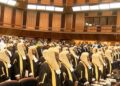
After months of litigation, the Supreme Court overturned the election result in January 2020, nullified Ihedioha’s victory, and declared Uzodimma the winner of the election based on the inclusion of results from previously excluded polling units. The ruling shocked the nation.
It effectively transformed a candidate who had originally placed fourth in the election into the governor of Imo State.
The judgment produced one of the most controversial political identities in Nigeria’s democratic history: “The Supreme Court Governor.”
Supporters described the ruling as a judicial correction of electoral irregularities.
Critics viewed it as a dramatic reinterpretation of electoral mathematics.
Either way, the decision fundamentally altered Imo State’s political landscape and permanently defined Uzodimma’s political identity.
Governance Under Legitimacy Debate
From the moment he assumed office, Uzodimma faced a major political challenge: converting judicial authority into public legitimacy.
Political philosopher Niccolò Machiavelli warned centuries ago that rulers who obtain power through extraordinary circumstances must exercise exceptional political skill to maintain it. “He who acquires a state by fortune must exert greater effort to sustain it.” For Uzodimma, that challenge became immediately evident.
Imo State soon experienced rising security tensions that culminated in the 2021 Owerri correctional facility attack, one of the most dramatic prison breaks in Nigeria’s history. The attack, along with broader insecurity across the Southeast, created a climate of fear that severely disrupted economic and social life within the state.
Critics argue that the administration struggled to articulate a coherent development vision capable of stabilizing the state and restoring confidence among residents.
Supporters, however, insist that the insecurity reflected wider regional dynamics rather than the policies of any single government. But in politics, perception often outweighs explanation.
Strategic Miscalculation in the Presidential Primaries
Uzodimma’s national political calculations encountered another turning point during the 2023 presidential primaries of the All Progressives Congress (APC).
Serving as chairman of the party’s presidential primary committee, Uzodimma reportedly purchased the presidential nomination form for Ahmad Lawan, the then Senate President and a candidate widely believed to enjoy the support of the outgoing Buhari administration.
The move was interpreted in many political circles as an attempt to sustain northern control of the presidency. However, politics often produces unexpected outcomes.
Against formidable odds, Bola Ahmed Tinubu—the Jagaban of Borgu—emerged as the APC presidential candidate, defeating several powerful rivals in what has since become one of the most remarkable political contests in Nigeria’s recent history. For Uzodimma, the result represented a significant political miscalculation.
When Power Recalibrates
Since the emergence of the Tinubu administration, several developments have been interpreted by political observers as signs that Uzodimma’s once formidable influence in Abuja may be undergoing gradual recalibration.
These include:
- The weakening of networks linked to his political protégés.
- Reassignments affecting key allies within the federal cabinet.
- Reduced centrality within the internal power structure of the APC
Individually, these developments appear routine within Nigeria’s fluid political environment. Taken together, however, they suggest a quiet restructuring of influence within the ruling coalition.
The Long Shadow of Power
Politics is rarely static. Alliances evolve, influence shifts, and power centers recalibrate.
Aristotle once observed that the durability of political authority depends on the perception of justice within the state. Where legitimacy remains contested, political stability becomes fragile.
The story of Hope Uzodimma illustrates this enduring truth.
His rise to power was dramatic.
But the shadow cast by the circumstances of that rise continues to follow his political career.
Governance, Economic Claims, and the Debt Debate
Despite persistent criticisms surrounding his administration, the Uzodimma government has consistently pointed to several economic indicators as evidence of fiscal reforms and improved financial management.
One of the most frequently cited achievements by the administration is the reduction of the state’s debt profile.
As of June 2025, Governor Hope Uzodimma announced that Imo State’s total debt had been reduced by approximately 60 percent, dropping from N259 billion in 2020 to about N99 billion.
According to the state government, the debt reduction was achieved without contracting new loans, a claim the administration attributes to fiscal discipline, debt restructuring, and improved revenue management.
Officials within the government have also highlighted what they describe as a significant increase in Internally Generated Revenue (IGR).
They argue that the state has gradually reduced its dependence on federal allocations while strengthening its internal revenue mechanisms.
Supporters of the administration point to these fiscal indicators as evidence that Uzodimma’s government has pursued responsible economic management despite the political controversies surrounding his emergence in office.
Critics, however, argue that while the debt reduction figures are notable, the more pressing question for many residents remains the visible impact of governance on infrastructure, economic activity, and public welfare within the state.
In the end, as political philosophers from Aristotle to Machiavelli have observed, governance is judged not merely by administrative statistics but by the lived experiences of citizens within the polity.
Conclusion
In politics, how power is obtained often determines how it is remembered.
Hope Uzodimma’s journey—from early political activism to Senate prominence, and eventually to the governorship through a controversial Supreme Court ruling—remains one of the most remarkable stories in Nigeria’s democratic evolution.
Yet the same factors that propelled his rise may also be shaping the limits of his influence.
Because in the unforgiving theatre of politics, the cost of a contested mandate is rarely paid immediately.
It is paid gradually — in alliances lost, in influence diminished, and ultimately, in legacy.
Ultimately, the story of Hope Uzodimma transcends the politics of Imo State.
It is a mirror reflecting the deeper contradictions within Nigeria’s democratic experiment.
When electoral outcomes are overturned in courtrooms, when political legitimacy becomes a subject of endless debate, and when power is negotiated more in elite corridors than at the ballot box, democracy begins to lose its moral anchor.
The Uzodimma episode therefore raises a question far greater than the fate of one governor: can a democracy truly endure when the will of the people appears negotiable?
Until that question is answered with clarity and courage, the shadow cast over Imo will continue to stretch across the fragile landscape of Nigeria’s democracy.